Pharmacognosy with the Basics of Plant Biochemistry - Kovalyov V. M. 2004
General Section
Basic Concepts, Terms, and Tasks of Pharmacognosy
Pharmacognosy is a science that studies medicinal plants, herbal and animal-derived medicinal raw Materials, as well as their processed products. Translated from Greek, pharmacognosy means The Study of drugs or knowledge about drugs (pharmakon meaning drug or poison, and gnosis meaning knowledge or study).
Modern pharmacognosy is a highly specialized applied science that examines the biological, biochemical, and medicinal properties of plants, natural raw materials, and products derived from them. The subject of study in pharmacognosy comprises Medicinal Plants and, less frequently, animal-derived objects as sources of medicinal raw materials.
Medicinal plants (Plantae medicinales) are plants containing BIOLOGICALLY ACTIVE SUBSTANCES that are used to harvest medicinal plant materials.
Medicinal plant material (MPM) refers to whole medicinal plants or parts thereof used in a dried (occasionally fresh) state to obtain medicinal substances, herbal medicines (phytopharmaceuticals), and dosage forms, which are approved for medical use.
Every medicinal raw material has a Latin name under which it is described in the national pharmacopoeia, standards, and technical specifications, and prescribed by physicians. These names typically consist of two words. The first indicates the plant organ or product obtained from natural materials (e.g., leaves — Folia, herb — Herba, flowers — Flores, oils — Olea, etc. — see diagram), while the second specifies the genus of the plant supplying this raw material (e.g., valerian rhizomes with roots — Rhizomata cum radicibus Valerianae, sunflower oil — Oleum Helianthi).
In some cases, the plant species is included in the name of the raw material (e.g., Folia Belladonnae — leaves of the plant Atropa belladonna L., Herba Absinthii — herb of the plant Artemisia absinthium L.), and less frequently, both the genus and species names (e.g., Herba Adonidis vernalis — herb of the plant Adonis vernalis L.). The species name is written with a lowercase letter.
Class="center">Types of Medicinal Plant Materials
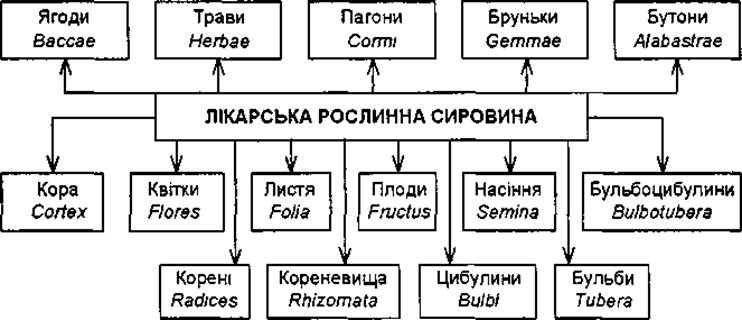
Medicinal raw materials of animal origin include whole animals, their parts, or metabolic products approved for use by authorized institutions.
A medicinal plant is a plant that serves as a source of medicinal plant material and complies with regulatory and technical documentation requirements.
Biologically active substances (BAS) are substances that affect biological processes in Human and Animal organisms.
Active substances are biologically active substances capable of altering the state and Functions of the Organism, exhibiting preventive, diagnostic, or therapeutic effects, and used in the manufacturing of finished medicinal products.
Concomitant substances is a conventional term for metabolic products found in medicinal plants alongside biologically active substances. They can exert positive or negative effects on the organism, influence the absorption of primary biologically active substances by enhancing their efficacy, prolonging their action, etc.
Medicinal products are substances or mixtures thereof of natural, synthetic, or biotechnological origin used for the Prevention, Diagnosis, and Treatment of human diseases, or for altering the state and functions of the organism.
Medicinal products derived from PLANT AND ANIMAL raw materials can be divided into the following groups: 1) medicinal raw materials dispensed to patients from pharmacies in the form of powders, teas, and herbal mixtures; 2) galenical and neo-galenical preparations — alcoholic extracts from plants in the form of tinctures and extracts; neo-galenical preparations are extracts purified from concomitant substances; 3) primary plant Processing products — essential and fatty oils, Gums, resins, etc.; 4) individual active substances — alkaloids, Glycosides, constituents of Essential Oils, etc.
Dosage forms derived from plant and animal raw materials intended for external, internal, and injection use

Standardization of MPM is the determination of identity, quality, and other parameters in comparison with standard requirements.
Diagnostic features (Greek diagnostikos — able to recognize) represent a set of MACROSCOPIC AND MICROSCOPIC characteristics typical of the studied object that allow its authenticity to be established.
Identity is the conformity of the studied object to the name under which it was submitted for analysis.
Purity and quality (numerical indicators) refer to the compliance of MPM, products, and medicinal formulations with standard specifications.
A dosage form is a medicinal product given a state that is convenient for application and ensures the attainment of the required therapeutic effect. A list of dosage forms is provided in the diagram.
Modern pharmacognosy addresses the following tasks.
1. Studying the Chemical composition of Medicinal Plants, pathways of Biosynthesis, and the dynamics of the formation and accumulation of biologically active substances in Organs and Tissues during plant ontogenesis and under the Influence of Environmental factors; finding optimal conditions for harvesting, drying, and storing medicinal plant materials.
2. Standardization of medicinal plant materials; drafting temporary pharmacopoeial monographs (TPM) and revising existing regulatory and technical documentation (RTD); improving Methods for determining plant identity, purity, and quality of raw materials.
3. Medicinal plant resource science, which involves studying the Geographical Distribution of medicinal plants, identifying thickets, assessing stocks, mapping them, and determining potential harvesting volumes, as well as developing and implementing measures to restore the natural resources of the most valuable species.
4. Medicinal plant cultivation, in other words, the identification, acclimatization, and Introduction of medicinal plants, their cultivation, and the breeding of high-yielding varieties.
5. Plant biotechnology — the cultivation of isolated plant Cells and Tissues to obtain biologically active substances.
Successful study of pharmacognosy requires knowledge of botany, biology, ecology, organic, analytical, physical, colloidal, and biological chemistry, physics, human physiology, and Latin. Knowledge of pharmacognosy is essential for studying pharmaceutical and toxicological chemistry, drug technology, pharmacy Organization and economics, pharmacology, pharmacotherapy, clinical pharmacy, and related disciplines.
Last update: 06/08/2026
Editorial and Educational Adaptation: This material has been compiled based on the primary/original source text. The project team performed an editorial review, corrected technical inaccuracies, structured sections, and adapted the content for an educational format.
What was processed:
- elimination of formatting defects (OCR errors, structural breaks, corrupted characters);
- editorial organization of content;
- standardization of terminology in accordance with academic sources;
- verification of factual statements against the original source text.
All mentions of the author, publication year, and origin of the primary text have been preserved in accordance with the source.