Pharmacognosy with Basics of Plant Biochemistry - Kovalyov V. M. 2004
Special Part
Lipids
Fatty Acids
Over 200 Fatty acids have been identified in the plant kingdom. Based on the number of carbon atoms, they are classified into Higher Fatty Acids (containing 16 to 24 carbon atoms) and lower fatty acids (with fewer carbon atoms).
Structure and Classification. In terms of chemical structure, the fatty acids most widely distributed in the PLANT AND ANIMAL kingdoms are saturated or unsaturated monocarboxylic acids with an unbranched carbon chain and an even number of carbon atoms. Unsaturated acids feature double bonds in the cis-configuration. The structure of polyunsaturated acids contains double bonds separated by methylene groups. Alongside systematic and trivial names, abbreviated designations are used for Unsaturated fatty acids, indicating the total number of C atoms, as well as the number and position of double bonds. For example, 9,12,15-octadecatrienoic acid (α-linolenic acid) is designated as 9,12,15-C183, or ∆9, 12, 15-С183, or 18:39,12, 15. Data on the acids that make up most Lipids are presented in Table 2.
Table 2
Class="center">Higher Fatty Acids
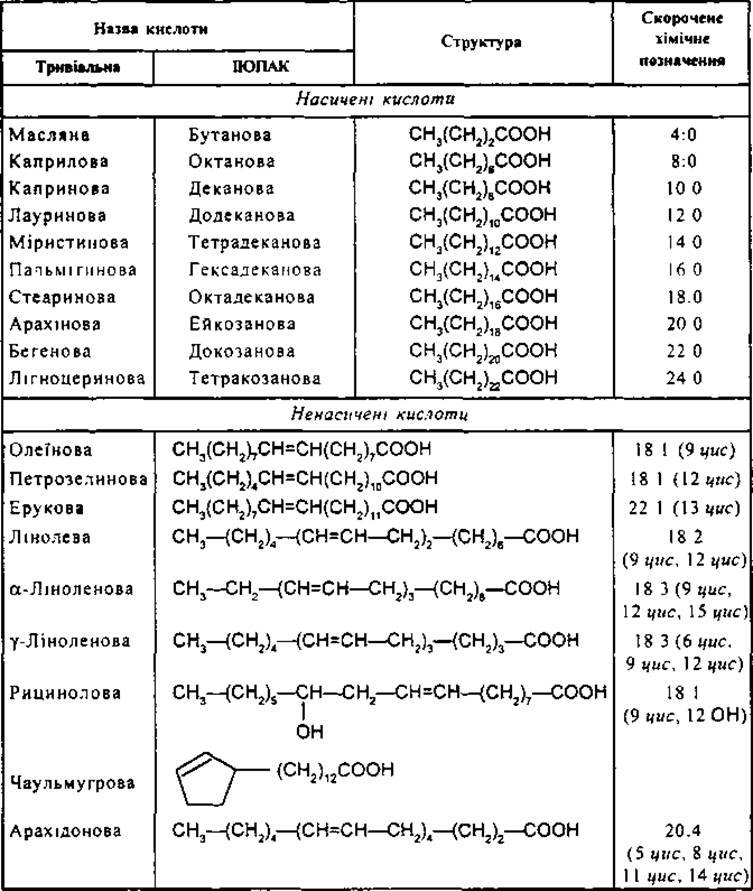
Some plant species contain acids with specific structural features, such as hydroxy acids in castor oil; an epoxy group found in fatty acids of the genus Camellia; and cyclic chaulmoogric acid in chaulmoogra oil. METABOLISM/14.html">Chloroplasts contain acids with a trans-configuration of double bonds.
A special group is formed by eicosapolyenoic acids and unbranched C2O acids with two or more double bonds separated by methylene groups. They constitute a widespread group of BIOLOGICALLY ACTIVE SUBSTANCES known as Eicosanoids. These include Prostaglandins, related compounds (Prostanoids, thromboxanes, etc.), and Leukotrienes.
In recent years, THE CONCEPT OF "Essential Fatty Acids," or vitamin F, has emerged. Initially, only linoleic and α-linolenic acids were classified as essential fatty acids because they are not synthesized in animal organisms and their absence in the diet causes deficiency symptoms. Later, compounds with the general formula CH3(CH2)x (CH=CH—CH2)y (CH2)z COOH, where x = 1,4,5,7; y = 1-6; z = 0-7, having 18 to 24 carbon atoms and a cis-configuration (Table 3), were added to the essential group, since these acids are sometimes synthesized in living organisms and thus are not strictly essential in the exact sense of the word.
Table 3
Biochemical designation of the structure of essential fatty acids with the formula CH3(CH2)x (CH=CH—CH2)y (CH2)z COOH
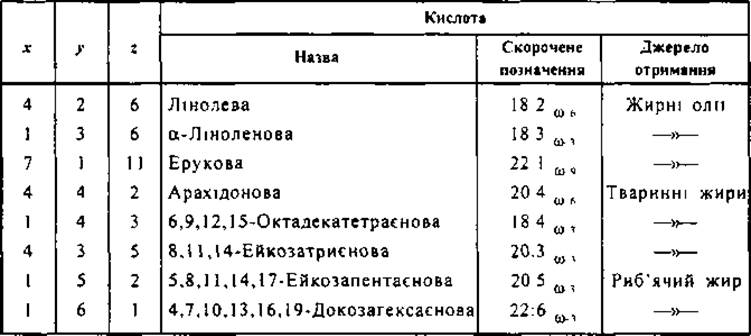
During the metabolism of essential fatty acids, THE POSITION OF the double bond furthest from the COOH group remains unchanged; therefore, biochemists began using new designations that record the total number of carbon atoms, double bonds, and the position of the most distant double bond—for example, 18:3ω3 for α-linolenic acid. This led to the establishment of specific biogenetic families of acids known as ω-3, ω-6, and ω-9 unsaturated acids, which indicate their Biosynthesis and metabolic pathways.
Distribution and BIOLOGICAL Functions OF Fatty Acids. In nature, free Fatty acids are rarely found—only in the seeds and fruits of certain plants, and in the Blood and excreta of animals. They are components of fats, fatty oils, Waxes, and Complex Lipids. Saturated acids predominate in animal-derived lipids, with palmitic acid first and stearic acid second (Table 4). The amounts of short-chain (C6, C14) and long-chain (up to C14) acids are small, and they exist as metabolic products. Among essential fatty acids, linoleic and α-linolenic acids are components of vegetable oils and animal fats, whereas other acids are characteristic exclusively of animal fats. Unsaturated fatty acids are constituents of fatty oils. Among ω-9 fatty acids, 11-eicosenoic acid (20:1), erucic acid, and their higher homologues are present in plant oils. ω-6 acids are common in plankton and less frequently found in higher plants. 11,14-Eicosadienoic acid (20:2) and γ-linolenic acid have been found in plants of the Boraginaceae family. Arachidonic acid occurs in Algae, mosses, and ferns, but not in higher plants. ω-3 fatty acids are characteristic of lower Representatives of the plant kingdom. Their chain length is most often C16–C22; they contain 3 to 6 double bonds separated by methylene groups. However, exceptions occur; for instance, 7,10,13-hexadecatrienoic acid was found in the leaves of rapeseed (Brassica napus). Fatty acids perform energetic and structural functions. Their Cleavage releases a large amount of energy. The breakdown of fatty acids in the Organism yields activated acetic acid (acetyl-CoA), which is utilized in numerous biosynthetic reactions to build CARBOHYDRATES, Amino Acids, Terpenes, etc. As structural building blocks, fatty acids are incorporated into fats and lipid-like substances.
Table 4
Content of Unsaturated Acids in Natural Fats
Fat name |
Acid, % |
||
Linoleic |
α-Linolenic |
Arachidonic |
|
Sunflower oil |
59.8 |
— |
— |
Olive oil |
12.0 |
— |
— |
Soybean oil |
50,9 |
10,3 |
|
Butter |
1.7 |
0.6 |
0.09 |
Lard |
8-9 |
0,7 |
0,5 |
Beef tallow |
2-5 |
0,6 |
0,1 |
Cod Liver oil |
0,3-2 |
0,4 |
1.4 |
The Biological Role of essential fatty acids is not fully understood. Arachidonic, 8,11,14-eicosatrienoic, and 5,8,11,14,17-eicosapentaenoic acids serve as precursors for The biosynthesis of prostaglandins and other lipoperoxides (prostacyclins, thromboxanes, leukotrienes); furthermore, they are an essential component of all Introduction/36.html">Biological Membranes. The absence of essential fatty acids in the diet inhibits growth and reproductive function in young animals, causes dermatitis, reduces blood clotting properties, and affects blood pressure. Essential acids inhibit The Development of atherosclerosis to some extent. Arachidonic acid normalizes these disorders 10 times more effectively than linoleic acid.
Human requirement for essential fatty acids, sometimes referred to as vitamin F, is approximately 10 g per day calculated as linoleic acid.
Prostaglandins
Prostaglandins (PG) are biologically active lipids derived from prostanoic acid, differing from one another in the position of substituents and double bonds in the cyclopentane ring and side chains.
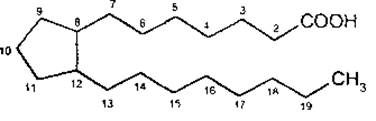
Prostanoic acid
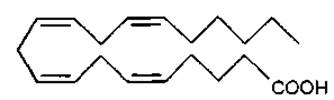
Arachidonic acid
The prostaglandin Skeleton contains 20 carbon atoms, one to three double bonds, one (C15) or two hydroxyl groups, carboxyl residues, and occasionally carbonyl residues.
Prostaglandins and their derivatives are found in the Cells of virtually all mammals. They were first isolated from the vesicular gland. They are widely distributed among many vertebrates and invertebrates (e.g., birds, frogs, carp, sharks, crabs, coral polyps, and certain insects) as well as in A number of plants (e.g., Allium cepa), though in very small quantities (1 μgg/g or less). The only natural source rich in prostaglandins is the gorgonian coral (Plexaura homomalla), in which the content of PGA2 and its derivatives reaches 1.5–2% of the dry weight.
Prostaglandins do not accumulate in Tissues; instead, they are synthesized in response to biological stimuli from endogenous acids: eicosatrienoic, eicosatetraenoic (arachidonic), and eicosapentaenoic (timnodonic). Due to their rapid degradation, and unlike Hormones, prostaglandins act locally near their site of secretion.
Because of their high physiological activity, prostaglandins are sometimes referred to as hormones. They interact with specific receptors on Cytoplasmic membranes, leading to changes (decrease or increase) in the concentration of intracellular NUCLEOTIDES; they are capable of crossing membranes, including the blood-Brain barrier, binding to cellular components, and influencing DNA Synthesis. Certain prostaglandins induce The transport of cations across biological membranes, thereby altering the physiological state of cells.
Prostaglandin-based medications are used in experimental and clinical medicine for inducing abortion, assisting in childbirth, treating gastric ulcers, Bronchial Asthma, and other conditions.
Last update: 06/08/2026
Editorial and Educational Adaptation: This material has been compiled based on the primary/original source text. The project team performed an editorial review, corrected technical inaccuracies, structured sections, and adapted the content for an educational format.
What was processed:
- elimination of formatting defects (OCR errors, structural breaks, corrupted characters);
- editorial organization of content;
- standardization of terminology in accordance with academic sources;
- verification of factual statements against the original source text.
All mentions of the author, publication year, and origin of the primary text have been preserved in accordance with the source.