Biochemistry - The Chemical Reactions of Living Cells Volume 2 - D. Metzler 1980
Types of reactions catalyzed by enzymes
Substitution reactions at carbonyl groups
Type 1.B reactions (Table 7-1) involve the nucleophilic substitution of a group Y attached to the carbonyl carbon atom. The substrate may be an ester (Y = OR), a thioester (Y = SR), or an amide (Y = NHR), while the enzymatic reaction is either a Hydrolysis (when B- is OH- derived from Water) or a transacylation (when B- is the anion of an alcohol, thiol, or amine). Transacylation processes play an exceptionally important role in Biosynthesis, although Enzymes catalyzing hydrolysis reactions have been studied most intensively.
Carbonyl group
Class="center">
is strongly polarized, and its Structure receives a significant contribution from the Resonance form

Due to this, the base readily attacks the electrophilic carbon atom. Although the reactivity of the carbonyl group in amides and esters is considerably decreased by resonance stabilization, the carbonyl carbon atoms of these compounds still retain their electrophilic character and can add basic groups. Thus, in base-catalyzed ester hydrolysis, a hydroxyl ion can add to the carbonyl group to form a saturated "tetrahedral" intermediate;

Similar intermediates can be formed by the action of many enzymes catalyzing type 1.B reactions (Table 7-1). However, for convenience of Classification, these reactions can be viewed as simple substitution reactions at the carbon atom, keeping in mind that saturated intermediates may form in some cases.
Hydrolysis reactions include acetylcholinesterase of Nerve Cells (Supplement 7-B) and A large number of digestive enzymes. Among the latter, proteinases and peptidases are the most thoroughly studied. Pepsin, Trypsin, Chymotrypsin, and carboxypeptidase are highly efficient catalysts for Protein Cleavage. All of them are secreted as inactive proenzymes (Chap. 6, Sect. F.2), otherwise known as zymogens [26]. Following synthesis on the Ribosomes of The Endoplasmic reticulum in specialized secretory cells, the proenzymes are "packaged" into zymogen granules, which then migrate to The Cell surface and are secreted into the extracellular environment. Pepsinogen is a component of gastric juice, whereas chymotrypsinogen, trypsinogen, and other pancreatic proenzymes enter the Small Intestine via the pancreatic duct. Upon reaching their Site of Action, zymogens are converted into active enzymes by the action of another enzyme molecule that cleaves off a fragment (sometimes quite large) of the polypeptide chain from the precursor [25].
Supplement 7-B
Insecticides
Currently, more than 200 organic insecticides are used to destroy insects without causing significant harm to humans and animalsa-d. The action of many of these compounds involves the inhibition of cellular Respiration; others "uncouple" ATP synthesis and electron transport. Chlorinated Hydrocarbons, such as DDT, affect The Nervous system, although The Mechanism of this action has not yet been fully established. One of the largest classes of organic insecticides acts on a specific nervous system enzyme—acetylcholinesterase. The neurotransmitter Acetylcholine is released from nerve endings in the region of many synapses (Chap. 16). Acetylcholine (which is highly toxic when present in excess) must be rapidly degraded; otherwise, the synapse will not be ready to transmit the next impulse:

As in the case of chymotrypsin, the Active Site of acetylcholinesterase contains a Serine residue that reacts with organophosphorus compounds (e.g., diisopropyl fluorophosphate; Sect. D.1.a).
In the 1930s, the exceptionally high toxicity of pyrophosphate esters and dialkyl fluorophosphates was established; these findings formed the basis for The Development of insecticides and so-called nerve gases in Germany and England. One of the best-known compounds of this type is diisopropyl fluorophosphate (DFP) itself, whose LD50 (the dose lethal to 50% of experimental animals) upon intravenous administration is only 0.5 µg per kg of animal body weight. This extremely hazardous compound can cause rapid death even when absorbed through the Skin. A multitude of organophosphorus compounds and other acetylcholinesterase inhibitors exhibiting selective toxicity toward insects have been discovered. Examples include

The high group-transfer potential characteristic of the phosphate group in a pyrophosphate bond—thanks to which ATP plays such a vital role in cells—also accounts for the ability of tetraethyl pyrophosphate (TEPP) to phosphorylate the active sites of acetylcholinesesterases. Although TEPP is a highly toxic compound, it is rapidly hydrolyzed, and within a few hours after application, all toxic groups are destroyed.
Two of the most widely used insecticides today are parathion and malathion. These compounds are much less toxic than DFP or TEPP. Their effectiveness as insecticides is acquired following bioactivation, during which the P=S bond is converted into a P=O bond:

The desulfuration reaction proceeds with the participation of Liver microsomal oxidases, with the sulfur ultimately being oxidized to sulfatee.
The reactivity of parathion toward cholinesesterases is ensured by the high group-transfer potential conferred by the presence of an excellent leaving group—the p-nitrophenolate anion (see also Sect. D.1.b). If the P—O bond of this group is hydrolyzed before the desulfuration reaction takes place, the phosphorus-containing compound becomes harmless. Thus, The problem of creating effective insecticides involves finding compounds that are rapidly activated in the insect Organism but easily degraded in higher animals. Such factors as the ability of the compound to penetrate the insect cuticle and its rate of elimination from the organism are also of great importance.
Phosphorylated esterases formed by the action of organophosphorus inhibitors are quite stable, but antidotes capable of reversing the inhibition have been found. The oxime of the 2-formyl-1-methylpyridinium ion (pralidoxime) is highly effective in this regarde. It is believed that the positive charge of this compound facilitates its binding at the site normally occupied by the quaternary nitrogen atom of acetylcholine, thereby displacing the dialkylphosphate group:
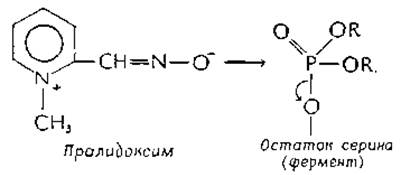
Carbaryl, a widely used methyl carbamate, serves as a pseudosubstrate for acetylcholinesterase, reacting 105–106 times slower than normal substrates. The resulting carbamoylated enzyme is not as stable as phosphorylated enzymes, and therefore inhibition by carbaryl is reversible.
a Casida J. E., (1973). Annu. Rev. Biochem., 42, 259—278.
б Heath D. F., (1961). Organophosphorus poisons. Pergamon, Oxford.
в Schrader G., (1963). Die Entwicklung neuer insektizider Phosphorsäure- Ester. Verlag Chemie, Weinheim.
г Bull W. H. O., 44, 1—470 (1971).
д Nakatsugawa T., Tolman N. M., Dahm P. A. (1961). Biochem Pharmacol., 18, 1103—1114.
e Wilson I. B., Ginsburg S. (1955). Biochim. biophys. acta, 18, 168—170.
Last update: 06/08/2026
Editorial and Educational Adaptation: This material has been compiled based on the primary/original source text. The project team performed an editorial review, corrected technical inaccuracies, structured sections, and adapted the content for an educational format.
What was processed:
- elimination of formatting defects (OCR errors, structural breaks, corrupted characters);
- editorial organization of content;
- standardization of terminology in accordance with academic sources;
- verification of factual statements against the original source text.
All mentions of the author, publication year, and origin of the primary text have been preserved in accordance with the source.