Biochemistry - The Chemical Reactions of Living Cells, Volume 2 - D. Metzler 1980
How electrons meet oxygen, how ATP is generated in the process, and other related phenomena
Utilization of energy from inorganic reactions
Reduced inorganic compounds as respiratory substrates
a. Hydrogen-oxidizing Bacteria
Certain species of bacteria belonging to the genera Hydrogenomonas, Pseudomonas, and Alcaligenes can oxidize H2 with oxygen:
Class="center">
Some bacteria are capable of oxidizing carbon monoxide:

Hydrogen bacteria can also oxidize Organic compounds. Their METABOLISM is relatively straightforward. Electrons flow through a chain of carriers, generating three ATP molecules. The key enzyme is a membrane-bound Hydrogenase that supplies electrons to the carrier chain. A separate soluble hydrogenase (sometimes referred to as hydrogen dehydrogenase) transfers electrons to NADP+ to yield NADPH, which is subsequently utilized in the reductive pentose phosphate cycle and other biosynthetic processes [110].
It is probably appropriate here to comment on the widespread occurrence of various hydrogenases [111]. These Enzymes are found in numerous organisms, including certain plants and animals (Ch. 9, Sec. E,2); they frequently serve to release "excess" hydrogen from Cells (Ch. 9, Sec. E,2). In this case, the function of hydrogenases is the reverse of that in hydrogen-oxidizing bacteria. Some hydrogenases are membrane-bound and linked to formate dehydrogenase via a group of unidentified carriers (Ch. 9, Sec. B,3). In strictly anaerobic organisms, such as clostridia, hydrogenases are associated with ferredoxins. Purified hydrogenases have been shown to be iron-sulfur Proteins [50, 111, 112]. The enzyme from Clostridium pasteurianum has a Molecular Weight of 60,000 and contains four iron atoms and four labile sulfur atoms. It has been suggested that hydrogenase contains an Fe4S4 cluster capable of accepting or donating one or two electrons, and that this cluster serves as the binding or formation site for H2 [111].
b. Nitrifying bacteria
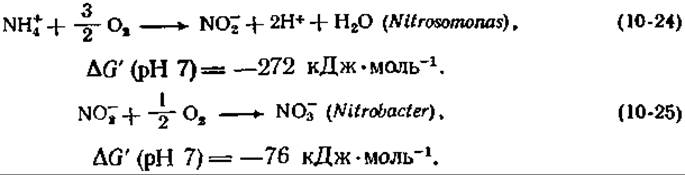
Two genera of soil bacteria convert ammonium ions into nitrite and nitrate [Equations (10-24) and (10-25)]1) [113]:
These free-energy changes can be estimated from the data in Table 3-3. Using the first Column (∆G0f), it is calculated that ∆G'0 for Equation (10-24) is –34.5–237.2+79.5. To obtain ∆G′ (pH 7), one must subtract the term 2×7×5.708 kJ, which corresponds to the dilution of hydrogen ions from an activity of unity to a concentration of 10-7 M. Alternatively, one can use the value of ∆G'ox (pH 7) for oxidation by NAD+. In this case, ∆G' (pH 7) for Equation (10-24) is estimated as 12.3+372.7–219.0×3 kJ. The third term represents the Free energy of oxidation of three moles of NADH by 
Structure/19.html">The Importance of these reactions for bacterial Energy Metabolism was established in 1895 by Winogradsky, who first introduced THE CONCEPT OF chemoautotrophy. Because nitrifying bacteria grow slowly (with a generation time of ~10–12 h), it has been difficult to obtain a sufficient biomass for biochemical studies, and progress in investigating them has been relatively limited. The most complex reaction sequence appears to be that catalyzed by Nitrosomonas bacteria [Equation (10-26)], which is presumed to proceed in three stages:
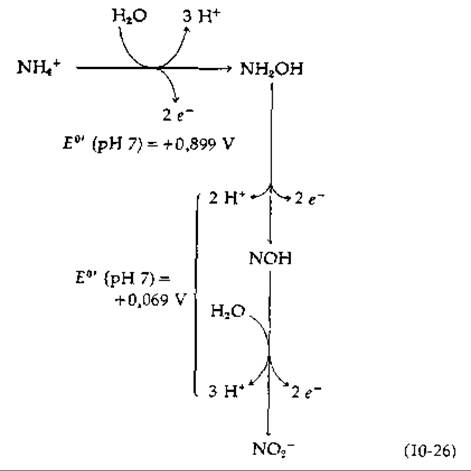
The presence of hydrazine blocks The oxidation of hydroxylamine (NH2OH) and leads to the accumulation of this intermediate [Equation (10-26)]. The oxidation of the ammonium ion by molecular O2 to hydroxylamine is an endergonic process with ∆G' (pH 7) = 16 kJ∙mol-1 and cannot supply energy to The Cell. On the other hand, the oxidation of hydroxylamine to nitrate driven by O2 is a highly exergonic reaction with ∆G' (pH 7) = -228 kJ∙mol-1. The corresponding electrode potentials for the two- and four-electron oxidation steps are given in Equation (10-26). As can be seen, the second step delivers four electrons to the Electron Transport Chain at a potential roughly equivalent to that of a flavoprotein. For every pair of electrons, two ATP molecules must be synthesized, so the overall reaction yields four ATP molecules.
Attempts to prepare a soluble NH+4-oxidizing system have been unsuccessful, but hydroxylamine-oxidizing particles containing Cytochromes of types b and c, and possibly flavins, have been isolated [114, 115]. Apparently, these particles are cleaved from the terminal oxidase system (cytochrome a).
Another genus of nitrifying bacteria, Nitrobacter, obtains energy through a simpler reaction [Equation (10-25)] accompanied by a relatively small decrease in free energy. The two-electron oxidation transfers electrons to the transport chain at E0' = 0.42 V. It is logical to assume that one ATP molecule should be formed per pair of electrons. However, the membranes of Nitrobacter contain an elusive system of various cytochromes [116, 117]. It is only clear that a portion of the ATP generated during Electron transfer from nitrite to oxygen is utilized to drive reverse electron flow, which generates the reduced pyridine NUCLEOTIDES required for biosynthetic reactions [Equation (10-27)].
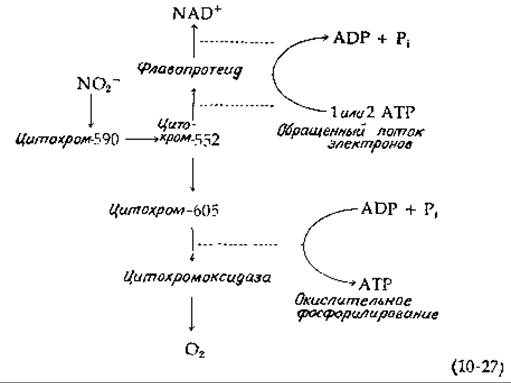
An interesting structural feature of Nitrobacter is the presence of multiple bilayer membranes completely surrounding the cell interior. Nitrite entering the cell is oxidized on these membranes without being able to penetrate into the Cytoplasm, where it could exert a toxic effect.
c. Sulfur-oxidizing bacteria
Bacteria of the genus Thiobacillus are capable of oxidizing sulfide, elemental sulfur, thiosulfate, and sulfite to sulfate [12, 118–120]. Many of these small Gram-negative organisms, found in Water and soil, can grow on a simple salt medium containing oxidizable sulfur compounds and CO2. The tendency of sulfur atoms to form chain molecules somewhat complicates the understanding of the energy-yielding reactions. For instance, during sulfide oxidation, it remains unclear whether it must necessarily be converted to elemental sulfur as shown in Equation (10-28) (step a, bottom left).
It could potentially be oxidized to sulfide via an intermediate organic derivative. However, the precipitation of elemental sulfur (S08)1) is frequently observed. Thiosulfate is readily oxidized by all species; its main metabolic pathway begins with Cleavage into S0 and SO2-3 [Equation (10-28), step b]. At high thiosulfate concentrations, a fraction of it may be oxidized to tetrathionate [Equation (10-28), step c].
1) Sulfur is often deposited as small globules inside the Cells of the sulfur-oxidizing bacterium Beggiatoa.
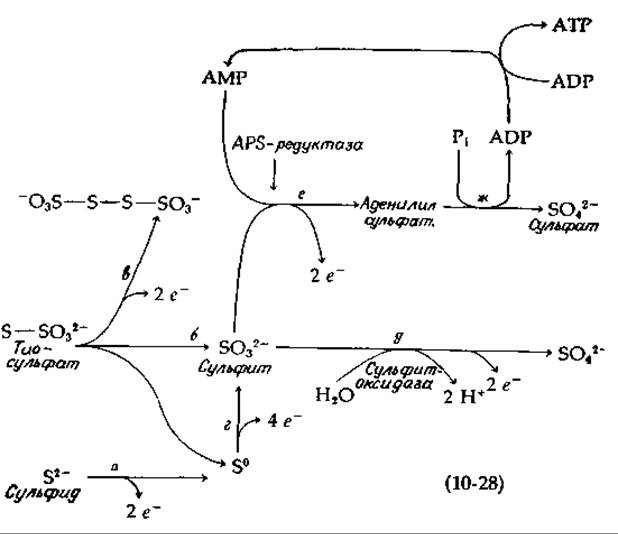
Although the details of the process remain unknown, Glutathione may be involved in the initial stage of elemental sulfur oxidation [Equation (10-28), step d]:

The oxidation of this linear polysulfide can proceed either by the successive cleavage of single sulfur atoms to yield sulfide, or by the simultaneous removal of two sulfur atoms to form thiosulfate [118, 119].
The oxidation of sulfite to sulfate is catalyzed by sulfite-cytochrome c reductase [sulfite oxidase; equation (10-28), step d] or proceeds via The formation of adenylylsulfate (also known as adenosine-5'-phosphosulfate, abbreviated as APS).
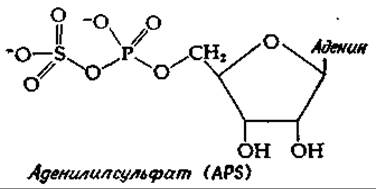
The oxidation of sulfide via adenylylsulfate [equation (10-28), steps e and f] is particularly notable because it provides a mechanism for substrate-level phosphorylation—the only such example known in chemolithotrophic bacteria. However, regardless of which of the two sulfite oxidation pathways is utilized, sulfur bacteria derive their energy through electron transport. Given the standard Redox Potential of the sulfate-sulfite couple, E0' (pH 7) = —0,454 V [E0' (pH 2) = —0,158 V], a substantial amount of energy can be generated via this electron transfer. Notably, the oxidation of sulfite to sulfate is accompanied by the release of hydrogen ions. In fact, the optimal pH for the growth of Thiobacillus thiooxidans is 2, and these bacteria can tolerate 5% sulfuric acid [119].
The "iron bacterium" Thiobacillus ferrooxidans obtains energy by oxidizing ferrous ions to ferric ions, followed by the precipitation of ferric hydroxide [equation (10-30)].

Since the redox potential of the Fe(II)/Fe(III) couple at pH 7 is +0.77 V, the energy yield from this reaction is relatively low. Significantly, these bacteria are also capable of oxidizing reduced sulfur compounds. Of particular interest is their oxidation of the mineral pyrite, an iron monosulfide [equation (10-31)]:

Because sulfuric acid is generated in this reaction, bacteria inhabiting abandoned mines have historically posed a severe water pollution problem: drainage water emerging from these sites often exhibited a pH of 2.3 or even lower [121].
Bacteria are not the only organisms capable of oxidizing reduced sulfur compounds. For instance, animal Liver contains a molybdenum-containing sulfite oxidase (Ch. 14, Sec. G), whose primary function is likely the detoxification of sulfur dioxide through the oxidation of sulfite to sulfate [122].
Last update: 06/08/2026
Editorial and Educational Adaptation: This material has been compiled based on the primary/original source text. The project team performed an editorial review, corrected technical inaccuracies, structured sections, and adapted the content for an educational format.
What was processed:
- elimination of formatting defects (OCR errors, structural breaks, corrupted characters);
- editorial organization of content;
- standardization of terminology in accordance with academic sources;
- verification of factual statements against the original source text.
All mentions of the author, publication year, and origin of the primary text have been preserved in accordance with the source.