Biochemistry: The Chemical Reactions of Living Cells, Volume 2 - D. Metzler 1980
Organization of Metabolism: Catabolic Pathways
Catabolism of Sugars
Glycolysis
Because most sugars have an oxygen atom attached to each carbon atom, oxidative chemical attack can occur at any point along the molecule. Each sugar contains a potentially free aldehyde or ketone group, and the carbonyl group can be readily shifted to an adjacent position by isomerases. Aldolytic Cleavage is also possible at numerous points. For these reasons, Carbohydrate METABOLISM is complex and diverse. Nevertheless, in the Energy Metabolism of most organisms, including humans, the glycolytic1) pathway—by which hexoses are converted to Pyruvate (Ch. 7, Sec. A,5, and Fig. 9-7)—vastly outweighs all others in importance.
1) The word "Glycolysis" means The breakdown of sugars or Glycogen. Originally, it referred solely to anaerobic Fermentation culminating in The formation of lactate or ethanol and CO2, but it now has a broader meaning and is used to describe the breakdown of sugars proceeding via the formation of glucose-6-phosphate, fructose diphosphate, and pyruvate, both in the presence and absence of oxygen.
The discovery of glycolysis followed directly from the experiments of Büchner, as well as Harden and Young, on the fermentation of sugar by Yeast juice (Ch. 8, Sec. 3). Soon, investigations into Alcoholic Fermentation merged with another line of research concerning Muscle tissue. Physiologists became intrigued by the process that enabled an isolated muscle to derive energy for contraction in the absence of oxygen. Hill demonstrated that this energy is provided by The conversion of glycogen to lactate, and somewhat later Meyerhof showed that the accompanying Chemical Reactions are similar to those observed in alcoholic fermentation. The elucidation of the Structure and function of pyridine NUCLEOTIDES in 1934 (Ch. 8, Sec. 3) coincided with important studies on glycolysis conducted by Embden in Frankfurt and Parnas in Poland. Thus, The sequence of glycolytic reactions (the Embden–Meyerhof–Parnas pathway) was soon elucidated. All the Enzymes catalyzing the individual steps of this process have now been isolated, crystallized, and studied in detail.
a. Formation of Pyruvate
The conversion of glucose to pyruvate requires the participation of ten enzymes (Fig. 9-7). The entire reaction sequence can be divided into four stages: preparation for chain cleavage (reactions 1–3), chain cleavage and equilibration of triose phosphates (reactions 4 and 5), oxidative ATP formation (reactions 6 and 7), and the conversion of 3-phosphoglycerate to pyruvate (reactions 8–10).
In preparation for chain cleavage, free glucose is phosphorylated by an ATP molecule through the action of hexokinase (reaction 1). There are several hexokinases in Tissues; some of these are relatively nonspecific and also catalyze the phosphorylation of other sugars, such as mannose and galactose (Ch. 6, Sec. E,2; Ch. 7, Sec. D,6). The phosphorylation product, glucose-6-phosphate, can also be formed without the expenditure of ATP by the cleavage of glucosyl residues from glycogen via Glycogen phosphorylase (reaction 1a), followed by the action of phosphoglucomutase [reaction 1b; see also equation (7-26)]. The latter enzyme transfers the phosphoryl group from the oxygen at C-1 to the oxygen at C-6.
Why do Cells initiate sugar metabolism by attaching a phosphoryl group to the sugar? First, because the charged phosphoryl group facilitates the binding of sugar phosphates to enzymes. Second, from a kinetic standpoint, it is advantageous to launch a long reaction sequence with a virtually irreversible reaction, such as the phosphorylation of glucose. In addition, a catalytic role for the phosphate group has been suggested (Ch. 7, Sec. K, 2, a).
Reaction 2 in Fig. 9-7 is a simple isomerization that shifts the carbonyl group to the C-2 position, thereby enabling $\beta$-cleavage into two three-carbon fragments. Prior to this cleavage, a second phosphorylation occurs (reaction 3), leading to the Formation of fructose-1,6-diphosphate. Consequently, after the cleavage of fructose diphosphate by aldolase, each of the resulting halves bears a phosphate group. This second "priming reaction" (reaction 3) is the first step of a sequence unique to glycolysis. It is hardly surprising, therefore, that The enzyme catalyzing it—Phosphofructokinase—is one of the most tightly regulated catalysts in The Glycolytic Pathway [equation (6-91); Ch. 11, Sec. E,4].
Class="center">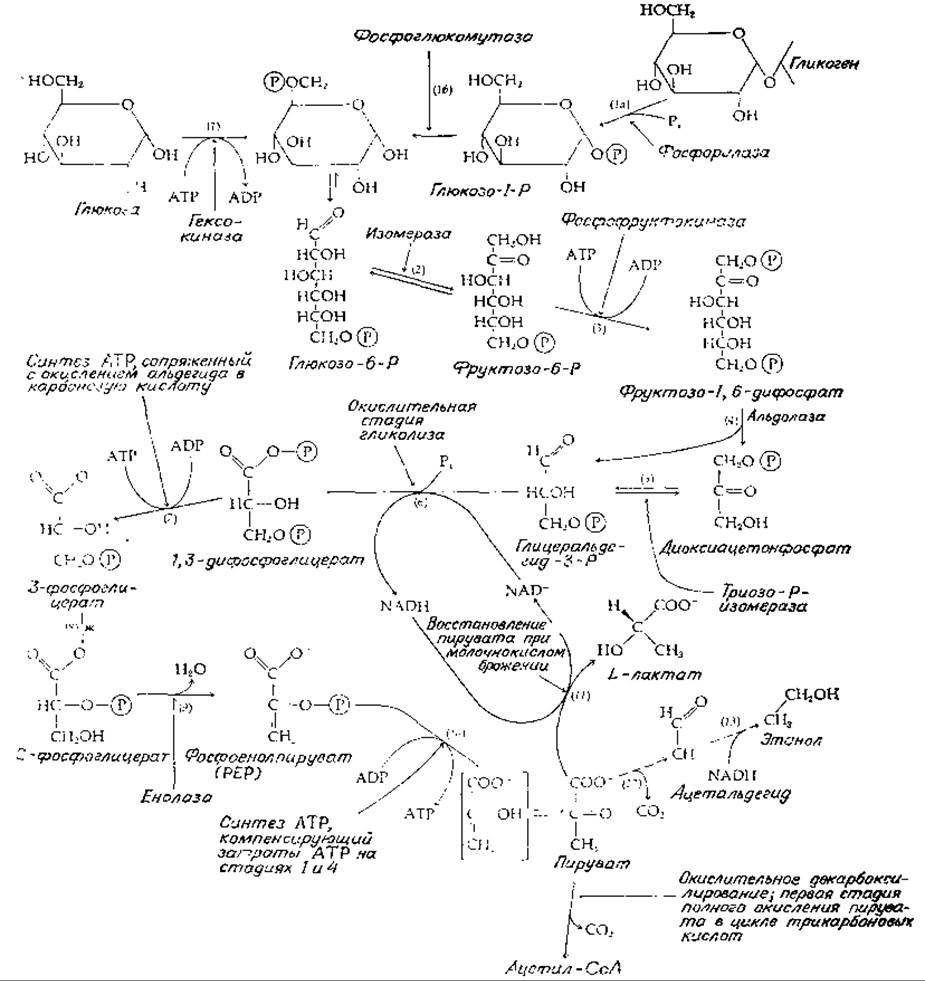
FIG. 9-7. Glycolysis, cleavage of hexose residues (via the pyruvate formation pathway).
The cleavage of fructose diphosphate (reaction 4) is catalyzed by aldolase [equation (7-64)]; the products are glyceraldehyde-3-phosphate and dihydroxyacetone phosphate. An equilibrium is established between these two triose phosphates through the action of an isomerase (reaction 5; see also Ch. 7, Sec. I, 4). Thus, the metabolism of both halves of the hexose can proceed toward pyruvate via glyceraldehyde-3-phosphate. At the same time, an alternative pathway exists for dihydroxyacetone phosphate involving its reduction to glycerol phosphate, a lipid precursor and intermediate in certain Types of fermentation.
The oxidation of glyceraldehyde-3-phosphate to the corresponding carboxylic acid, 3-phosphoglyceric acid (Fig. 9-7, reactions 6 and 7), is coupled with the synthesis of an ATP molecule from ADP and $P_i$ (Fig. 8-13). Note that during glycolysis, two molecules of ATP are formed per molecule of hexose cleaved, while simultaneously two molecules of $NAD^+$ are reduced to NADH.
The conversion of 3-phosphoglycerate to pyruvate begins with The transfer of the phosphoryl group from the oxygen at C-3 to the oxygen at C-2 (reaction 8), followed by dehydration via a standard $\alpha,\beta$-elimination catalyzed by enolase (reaction 9). The resulting product, phosphoenolpyruvate (PEP; Ch. 7, Sec. K, 3, g), is a "high-energy" compound whose phosphoryl group can be readily transferred to ADP (by the action of pyruvate kinase); the residual enol of pyruvic acid (enclosed in brackets in Fig. 9-7) spontaneously converts into the much more stable pyruvate ion (compare with equation 7-59). Because two molecules of PEP are formed per glucose molecule, this process offsets the consumption of two ATP molecules that occurs in the Initial Stages of converting glucose to fructose-1,6-diphosphate.
b. Further Metabolism of Pyruvate
In aerobic metabolism, which occurs in most of our body tissues, pyruvate is converted via oxidative decarboxylation into acetyl-CoA, which is subsequently fully oxidized in The Tricarboxylic Acid Cycle (Fig. 9-2). The NADH generated in reaction 6, as well as during The oxidative decarboxylation of pyruvate and in the subsequent Reactions of the tricarboxylic acid cycle, is reoxidized in the Mitochondrial Electron Transport chain. Another major pathway of pyruvate metabolism involves fermentation. For example, the enzyme Lactate dehydrogenase catalyzes the reduction of pyruvate coupled to NADH oxidation (reaction 11) to yield L-lactate (D-lactate is formed in many Bacteria). As shown in Fig. 9-7, this reaction can be coupled with reaction 6, which generates NADH. As a result, a balanced process of glucose fermentation to lactate can take place in the absence of oxygen (Ch. 7, Sec. A, 6). In a similar process, yeast cells first decarboxylate pyruvate ($\alpha$-cleavage) to acetaldehyde, which is then reduced to ethanol using the NADH produced in reaction 6 (Fig. 9-7, reactions 12 and 13). These fermentation reactions are discussed further in Sec. E.
Last update: 06/08/2026
Editorial and Educational Adaptation: This material has been compiled based on the primary/original source text. The project team performed an editorial review, corrected technical inaccuracies, structured sections, and adapted the content for an educational format.
What was processed:
- elimination of formatting defects (OCR errors, structural breaks, corrupted characters);
- editorial organization of content;
- standardization of terminology in accordance with academic sources;
- verification of factual statements against the original source text.
All mentions of the author, publication year, and origin of the primary text have been preserved in accordance with the source.