Biochemistry: The Chemical Reactions of Living Cells, Volume 2 - D. Metzler 1980
Coenzymes: specialized natural reagents
Coenzyme forms of vitamin B12
Methane synthesis
The second type of Methyl group transfer from methylcobalamin occurs during methane formation by anaerobic Bacteria, which is a quantitatively important reaction in the biosphere. Methanogenic bacteria can convert the methyl groups of methanol, acetate, or N5-CH3-H4Fol into methane, as well as reduce CO2, formaldehyde, or formate to methane.
It is noteworthy that the cofactor involved is not vitamin B12 as such, but factor A — a corrinoid containing 5-hydroxybenzimidazole (p. 286). The reactions leading to the synthesis of methylcorrinoid are not known, but if vitamin B12s (Co+) is added, the methyl groups can be bound as methylcobalamin, indicating the presence of Co+ in the natural corrinoid carrier. For some time, it was believed that methylcorrinoid is directly reduced by hydrogen to methane, but it has recently been shown that this requires a low-molecular-weight coenzyme designated as coenzyme M [187]. This coenzyme is a simple sulfonic acid whose Structure is shown below [equation (8-87)].
Class="center">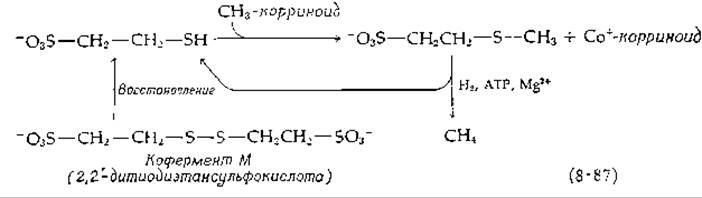
The thiol groups of the reduced coenzyme react with methylcorrinoid to yield methylated coenzyme M, the reduction of which by hydrogen—requiring ATP and Mg2+—releases methane [188]. The natural reductant can be either H2 coupled with Hydrogenase (Ch. 10, Sect. E,1) or Pyruvate via reduced ferredoxin generated by pyruvate : ferredoxin oxidoreductase (Sect. K,3).
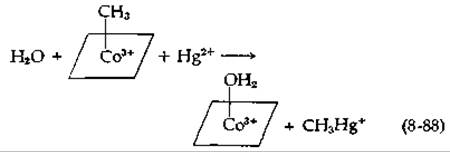
A third important methyl transfer reaction is the transfer from methylcorrinoids to mercury, arsenic, selenium, or tellurium. These reactions are of particular interest because they lead to The formation of methyl- and dimethylmercury and dimethylarsine, which are toxic compounds [189]. Earlier, we examined transfer reactions in which a methyl group is transferred from a methylcorrinoid to nucleophilic groups, such as the —SH group of homocysteine. In these reactions, the methyl group is actually transferred as a positive CH3 ion, i.e., via nucleophilic substitution at a carbon atom (as in The transfer of a methyl group from S-adenosylmethionine or methyl-H4Fol). By contrast, transfer to Hg2+ proceeds as a carbanion CH-3 without A change in the valence of cobalt. Unlike other transmethylating agents (such as S-adenosylmethionine), methylcorrinoids are capable of entering into reactions of this type without the participation of Enzymes. Note that after reaction (8-88) takes place, cobalt is in the 3+ state. Remethylation of the corrinoid apparently becomes possible only after the reduction of cobalt to Co(II). [A second methyl group can be transferred via a reaction of the same type to yield (CH3)2Hg.]
The methylation of arsenic is of major importance in connection with The problem of environmental pollution, owing to the widespread use of arsenic compounds as insecticides and the presence of arsenate in phosphates used in household detergents [189, 190]. Following reduction to arsenite, methylation proceeds in two stages [equation (8-89)].
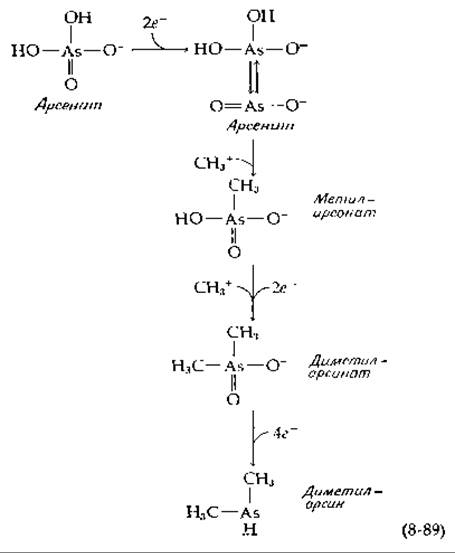
Additional reduction steps lead to the formation of dimethylarsine, one of the principal products of the action of methanogenic bacteria on arsenate. Although it has been suggested that methyl transfer proceeds via the formation of CH3 with simultaneous proton abstraction from the substrate, the details of this reaction are still under investigation. The CH3 radical can be transferred with the formation of a cobalt(II)-corrinoid [191].
The anaerobic bacterium Clostridium aceticum can obtain energy for growth through the reduction of CO2 by hydrogen [163, 191]:

Presumably, one molecule of CO2 is reduced to formate and then to methylcorrinoid. Through a process not yet elucidated, the latter combines with another CO2 molecule to yield acetate. A carboxymethylcobalt intermediate has been postulated
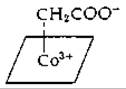
Evidence indicates that CO2 is not incorporated directly, but is transferred from pyruvate [192].
As we have seen, vitamin B12 and its analogues are catalysts with diverse Functions. How many reactions dependent on them remain to be discovered? How is the catalysis of corresponding reactions achieved in green plants and other organisms that lack cobalt-containing catalysts? The Answers to these questions may bring many surprises.
1. The following disorders are caused by deficiencies of specific Vitamins. Which vitamin do you associate with each of the listed conditions: a) scurvy, b) Rickets, c) beriberi, d) pellagra?
2. Complete the following table:
|
Type of reaction or enzyme |
Coenzyme or prosthetic group |
|
α-Keto acid decarboxylation Oxidative Decarboxylation of α-keto acids Transketolase Pyruvate carboxylase ß-Ketothiolase Formyl group transfer Methane formation |
3. Which Coenzymes contain ADP?
4. Consider carbon–carbon bond Cleavage in metabolic cycles and specify the individual enzymatic reactions. Summarize what you consider to be the GENERAL PATTERNS OF reactions of this type.
5. Name the substrate typical of Pyridoxal phosphate-dependent enzymes. Depict the formula of the coenzyme-substrate intermediate. Explain the mechanisms of transamination, decarboxylation, and deamination (of ß-hydroxy Amino Acids) as Reactions Catalyzed by enzymes of this group.
6. What is Thiamine diphosphate (thiamine pyrophosphate)? How does it react with α-keto acid substrates? Outline in detail the mechanisms of α-keto acid decarboxylation a) to aldehydes and b) to acyl-coenzyme A derivatives. c) Briefly outline the MECHANISM OF ACTION of the enzyme transketolase.
7. Write the formula for Lipoic Acid and explain the binding of this compound to Proteins. Show precisely how this compound participates in The oxidative decarboxylation of α-keto acids.
8. What is the formula of biotin, and how is it bound to enzymes? Write the equations for the two steps of the Catalytic Mechanism of biotin-dependent enzymes.
9. Illustrate The conversion of Folic acid into tetrahydrofolic acid. Write the reaction equations for the latter with: a) formaldehyde, b) formic acid, and c) Serine. Indicate how the one-carbon unit is transferred to: d) Purines, e) Methionine, and f) the methyl group of thymine.
10. Provide Examples of typical oxidative transformations of NAD+ and NADP+. Indicate the main source of NADH in Cells. Compare the [NADH]/[NAD+] and [NADPH]/[NADP+] ratios in Tissues. What is the usual metabolic fate of NADH?
11. List some typical substrates for Flavoproteins. Illustrate the reversible reduction of the prosthetic group. Write the Chemical Reactions Involving flavoproteins in: a) Fatty acid oxidation, b) The Tricarboxylic Acid Cycle, and c) the Electron Transport Chain.
12. Write the equation for the reaction in propionic acid METABOLISM that depends on the coenzyme form of vitamin B12.
13. Thymidine 5'-phosphate (thymidylic acid, dTMP) is formed via the conversion of deoxyuridine 5'-phosphate (dUMP), which involves the transfer of a one-carbon unit from tetrahydrofolic acid.
a. Draw the structural formula of deoxyuridine 5'-phosphate and methylenetetrahydrofolic acid. Propose a step-by-step mechanism for the reaction between these two compounds leading to the formation of dTMP.
b. T-even Bacteriophages contain 5-hydroxymethylcytidylic acid. Propose a mechanism for the synthesis of this nucleotide.
Note. These reactions are discussed in Chapter 14.
Last update: 06/08/2026
Editorial and Educational Adaptation: This material has been compiled based on the primary/original source text. The project team performed an editorial review, corrected technical inaccuracies, structured sections, and adapted the content for an educational format.
What was processed:
- elimination of formatting defects (OCR errors, structural breaks, corrupted characters);
- editorial organization of content;
- standardization of terminology in accordance with academic sources;
- verification of factual statements against the original source text.
All mentions of the author, publication year, and origin of the primary text have been preserved in accordance with the source.