Human Biochemistry, Volume 1 - Murray R. 1993
Protein and Amino Acid Metabolism
Catabolism of Amino Acid Nitrogen
Transamination
Transamination, catalyzed by transaminases (aminotransferases), is the reversible conversion between a pair of Amino Acids and a pair of keto acids. Typically, these are a-amino acids and a-keto acids (Fig. 30.3).
Pyridoxal phosphate is an essential component of the Active Site of transaminases and many Other Enzymes that utilize Amino acids as substrates. In all pyridoxal phosphate-dependent amino acid reactions, the initial step involves The formation of an enzyme-bound intermediate, a Schiff base. This intermediate is stabilized through interaction with the cationic region of the active site; it then rearranges to release the keto acid and form enzyme-bound pyridoxamine phosphate. The bound amino form of the coenzyme can subsequently react with a keto acid to form a corresponding Schiff base. Thus, during transamination, the coenzyme acts as an amino group carrier. Since the Equilibrium Constant for most transamination reactions is close to unity, transamination is readily reversible. This allows transaminases to function in both the Catabolism and Biosynthesis OF AMINO Acids.
Class="center">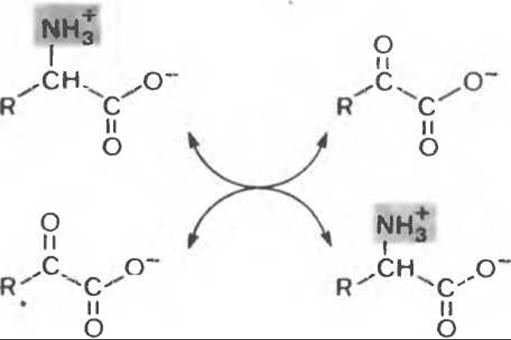
Fig. 30.3. Transamination. The reaction involves two a-amino acids and two a-keto acids. Although transamination can occasionally involve non-a-amino or non-a-carbonyl groups, such instances are relatively rare. The reaction is readily reversible, with an equilibrium constant close to unity.
Most mammalian Tissues contain two transaminases: Alanine-Pyruvate transaminase (alanine transaminase) and glutamate-α-ketoglutarate transaminase (glutamate transaminase). They catalyze The transfer of amino groups from Most amino acids to yield alanine (from pyruvate) or glutamate (from α-ketoglutarate) (Fig. 30.4).
Each transaminase is specific for particular pairs of amino and keto acids. Because alanine can also serve as a substrate for glutamate transaminase, the amino nitrogen of all amino acids involved in transamination can be funneled into glutamate. This is of vital importance since L-glutamate is the only amino acid in mammalian tissues that undergoes Oxidative Deamination at a significant rate. Consequently, when free ammonia is generated from the α-amino groups of amino acids, it is incorporated primarily into the α-amino group of L-glutamate.

Fig. 30.4. Action of alanine transaminase (top) and glutamate transaminase (bottom).
Most amino acids (though not all) serve as substrates for transaminases. The exceptions are Lysine, Threonine, and the cyclic imino acids Proline and hydroxyproline. Transamination is not restricted solely to α-amino groups. The δ-amino group of Ornithine (but not the ε-amino group of lysine) also readily participates in the reaction, yielding glutamate-γ-semialdehyde (see Fig. 31.3). In certain pathological conditions, elevated serum transaminase concentrations are observed (see Appendix).
Last update: 06/08/2026
Editorial and Educational Adaptation: This material has been compiled based on the primary/original source text. The project team performed an editorial review, corrected technical inaccuracies, structured sections, and adapted the content for an educational format.
What was processed:
- elimination of formatting defects (OCR errors, structural breaks, corrupted characters);
- editorial organization of content;
- standardization of terminology in accordance with academic sources;
- verification of factual statements against the original source text.
All mentions of the author, publication year, and origin of the primary text have been preserved in accordance with the source.