Principles of Biochemistry, Volume 2 - A. Lehninger 1985
Bioenergetics and Metabolism
The ATP Cycle and Cellular Bioenergetics
ATP can also be cleaved into AMP and pyrophosphate.
Although in cellular reactions the ATP utilized is typically cleaved to ADP and phosphate (Pi), and ADP serves as the immediate phosphate acceptor in energy-releasing reactions, There are also CELLULAR REACTIONS IN which both terminal phosphate groups of ATP, ß and γ, are cleaved off as a single fragment (Fig. 14-2); the resulting Cleavage products in this case are inorganic pyrophosphate (PPi) and adenosine monophosphate (AMP). An example of such a reaction is the enzymatic activation of Fatty acids with The formation of their CoA derivatives (Fig. 18-2); the fatty acid thereby acquires energy and is converted into the corresponding CoA derivative (Fig. 14-16), which is subsequently used as an activated precursor in Lipid Biosynthesis;
Class="center">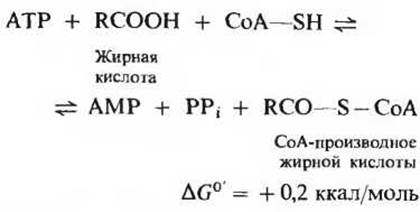
Table 14-6. Membrane ATPases transporting various cations
|
Enzyme name |
Cell type |
Localization |
Function |
|
Na+, K+-ATPase |
Most animal Cells |
Maintains a high intracellular K+ concentration |
|
|
H+-ATPase |
Parietal Cells of the gastric mucosa |
Same |
Secretes H+ into gastric juice |
|
H+-ATPase |
Animal and plant cells |
Inner mitochondrial membrane |
Participates in oxidative and photosynthetic phosphorylation of ADP to ATP |
|
Plant cells |
Inner membrane of METABOLISM/14.html">Chloroplasts |
||
|
Plasma membrane |
|||
|
Ca2+-ATPase |
Animal cells |
Same |
Pumps Ca2+ ions out of cells, contributing to the accumulation of these ions in the Cytosol |
|
Sarcoplasmic reticulum |
Pumps Ca2+ ions into the cisternae of the sarcoplasmic reticulum, causing Muscle relaxation |
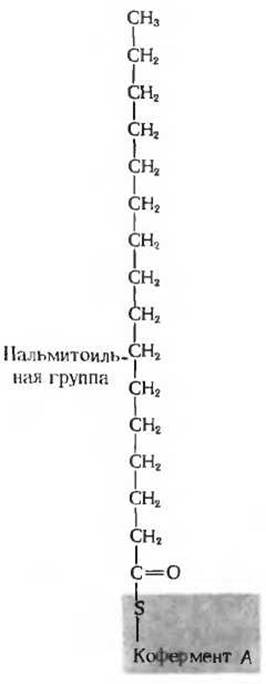
Fig. 14-16. Palmitoyl-coenzyme A serves as a typical example of a fatty acid CoA derivative. The Hydrolysis involving the Cleavage of the thioester bond (C—S bond) between the Fatty acid and coenzyme A is characterized by a high ∆G0' value of approximately —7.5 kcal/mol. Fatty acid CoA derivatives play The Role of activated precursors in The process of lipid biosynthesis.
This activation reaction is accompanied by the pyrophosphate cleavage of ATP, yielding pyrophosphate and AMP as products; whereas in standard orthophosphate cleavage, only a single orthophosphate group is split off from ATP, as, for example, in the hexokinase reaction
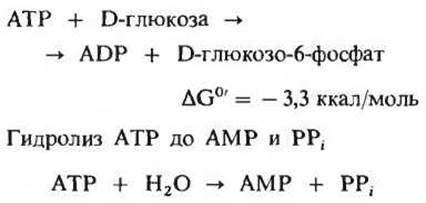
is characterized by a value of ∆G0' = -7.7 kcal/mol, which slightly exceeds the ∆G0' of hydrolysis of the terminal, or γ-phosphate, bond. Inorganic pyrophosphate is subsequently hydrolyzed in the presence of pyrophosphatase to yield two molecules of inorganic orthophosphate.

The overall reaction is described by the equation

The ∆G0' value of this overall reaction equals the algebraic sum of the ∆G0' values of its two consecutive stages. It is easy to see that the ∆G0' of the overall reaction is exactly twice as large as the ∆G0' of hydrolysis of the terminal phosphate groups of ATP and ADP.
Consuming two phosphate groups of ATP to activate a single precursor molecule might seem wasteful—that is, one might get the impression that phosphate group energy is expended uneconomically in this case. Later, however, we will see that this underlies an important mechanism ensuring the completion of certain biosynthetic reactions. ATP pyrophosphate cleavage is utilized in an unusual way by fireflies, for instance: it serves as their energy source for light emission (Box 14-3).
AMP is returned to the ATP cycle through the action of a specific enzyme present in all animal cells. This enzyme, adenylate kinase, catalyzes the reversible phosphorylation of AMP to ADP:

The ADP formed in this process can then be rephosphorylated to ATP.
Adenylate kinase has another vital function: this enzyme helps maintain the cellular ATP level when the reaction it catalyzes proceeds in the reverse direction

that is, when it catalyzes The transfer of a terminal phosphate group from one ADP molecule to another, which is thereby converted into ATP. Thus, in contracting Muscles, adenylate kinase allows two phosphate groups of ATP, γ and ß, to be utilized as an energy source (Fig. 14-17). Consequently, by acting on ADP, adenylate kinase can replenish the pool of creatine phosphate, which serves as a source of ATP During Muscle contraction.
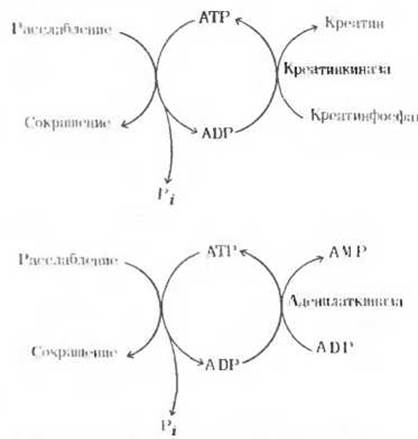
Fig. 14-17. Two processes ensuring the maintenance of an adequate ATP level in rapidly contracting skeletal muscles operating under anaerobic conditions.
Box 14-3. ATP supplies energy for firefly Bioluminescence
Bioluminescence, which requires substantial amounts of energy, is characteristic of many species of Fungi, marine microorganisms, jellyfish, crustaceans, and fireflies (Fig. 1). In fireflies, the reaction sequence responsible for converting chemical energy into light energy involves a combination of ATP energy and oxidative energy. William McElroy and his colleagues at Johns Hopkins University isolated two main biochemical components involved in the luminescence process from many thousands of fireflies collected for this purpose by children in the vicinity of Baltimore: luciferin (Fig. 2), a carboxylic acid of rather complex Structure, and the enzyme luciferase. To generate light flashes, luciferin must first be activated in an enzymatic reaction with ATP. At this stage, pyrophosphate cleavage of ATP leads to the formation of luciferyl adenylate (Fig. 2). Subsequently, under the action of molecular oxygen, luciferase-catalyzed Oxidative Decarboxylation of luciferin takes place, resulting in the formation of oxyluciferin. It is this reaction, proceeding through a series of intermediates, that is accompanied by flashes of light (Fig. 3). The spectral COMPOSITION OF THE emitted light varies among different firefly species; it likely depends on The structure of the luciferase. The cycle is completed by a sequence of reactions that regenerate luciferin from oxyluciferin. In other bioluminescent organisms, light emission is driven by ENZYMATIC REACTIONS OF a different type.
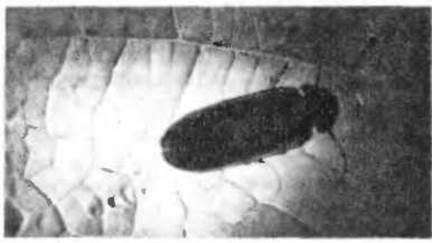
Fig. 1. Firefly.
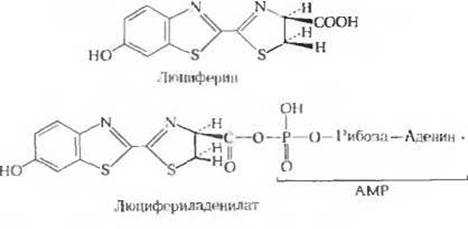
Fig. 2. Main components responsible for firefly bioluminescence.
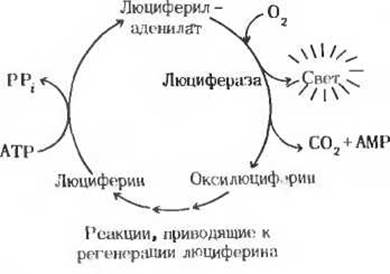
Fig. 3. Cyclic Conversion of the components involved in firefly luminescence.
Purified firefly luciferin and luciferase are used to measure extremely small amounts of ATP. The intensity of the light flash serves as a measure of the ATP quantity. This method makes it possible to detect amounts of ATP on the order of several picomoles (10-12 mol).
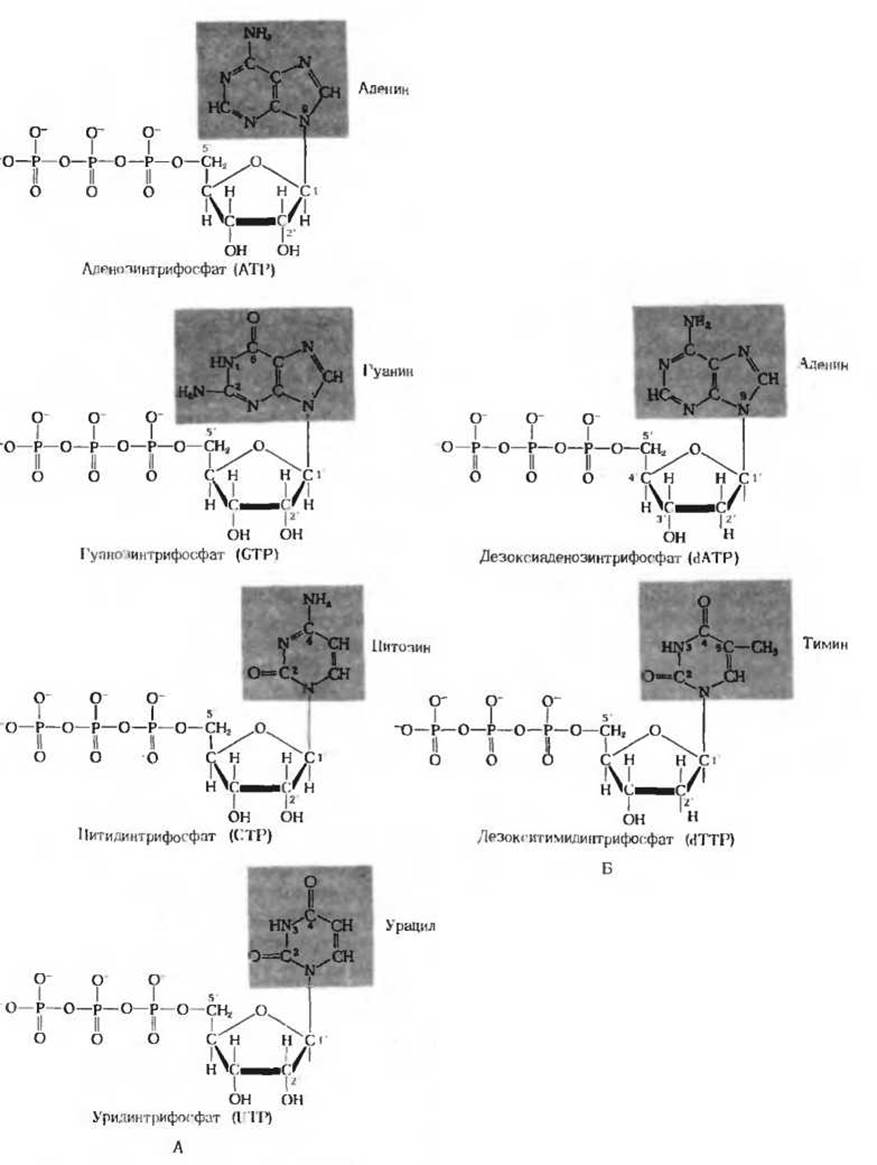
Fig. 14-18. A. Four nucleoside 5'-triphosphates. Each contains a specific base (shown on a red Background). B. In the molecule of deoxynucleoside 5'-triphosphates, a hydrogen atom is present at the 2' position instead of a hydroxyl group. Deoxythymidine triphosphate serves as the precursor for thymidylate residues incorporated into DNA. RNA lacks thymidylate residues; instead, they contain uridylate residues (with uridine triphosphate serving as their precursor).
Last update: 06/08/2026
Editorial and Educational Adaptation: This material has been compiled based on the primary/original source text. The project team performed an editorial review, corrected technical inaccuracies, structured sections, and adapted the content for an educational format.
What was processed:
- elimination of formatting defects (OCR errors, structural breaks, corrupted characters);
- editorial organization of content;
- standardization of terminology in accordance with academic sources;
- verification of factual statements against the original source text.
All mentions of the author, publication year, and origin of the primary text have been preserved in accordance with the source.