Principles of Biochemistry Volume 2 - A. Lehninger 1985
Bioenergetics and Metabolism
ATP Cycle and Cellular Bioenergetics
ATP also supplies energy for active transport across membranes
The chemical energy of ATP is also used to perform osmotic work—that is, the work required to transport specific ions or molecules across a membrane from one compartment into another where their concentration is higher. We can calculate The amount of Free energy required to transport 1 mol of an uncharged solute across a membrane, such as from the extracellular environment into a Cell, if we know the concentrations of the uncharged solute in the extracellular environment and inside The Cell (Fig. 14-14). For this calculation, we use the general equation
Class="center">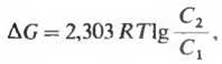
where C1 is the molar concentration of the given solute in the external environment, C2 is its molar concentration inside the cell, R is the gas constant, and T is the absolute Temperature. Using this equation, we can determine the amount of free energy required to move 1 mol of glucose against a 100-fold concentration gradient—for example, from a medium with an initial glucose concentration of 1.0 mM into a compartment where its final concentration is 100 mM. Substituting the appropriate values into the equation, we obtain
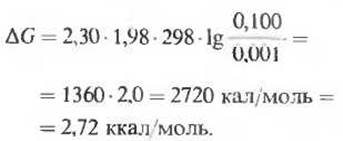
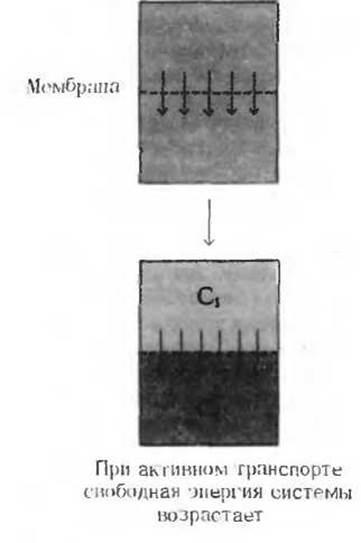
Fig. 14-14. Active Transport of a solute against a concentration gradient. Starting from the point of equilibrium—that is, the moment when the concentrations of the given solute in both compartments are equal—active transport of the substance from one compartment to the other drives its movement against the concentration gradient. The creation and maintenance of a concentration gradient of any solute between compartments located on opposite sides of a membrane requires an input of free energy. If energy supply ceases for any reason, the solute from the compartment with the higher concentration begins to diffuse back, and diffusion continues until equilibrium is re-established—that is, until the concentrations of the substance on both sides of the membrane are equalized.
The change in free energy in this case is expressed by a positive value, meaning that the 2.72 kcal of free energy required to transport 1 mole of glucose (or any neutral substance) against a 100-fold concentration gradient must be supplied to the system via a coupled reaction capable of serving as an energy source.
Concentration gradients across cell membranes (transmembrane gradients) vary widely. Perhaps the maximum concentration gradient in the body is maintained by The Plasma Membrane of parietal Cells in the gastric mucosa, which secrete Hydrochloric acid into gastric juice. The concentration of HCl in gastric juice can reach 0.1 M (pH 1.0), whereas the concentration of H+ ions within the cells is approximately 10-7 M (pH 7.0). This means that parietal cells are capable of secreting hydrogen ions even against a gradient on the order of 106:1. Evidently, these cells possess highly active membrane "pumps" for hydrogen ion secretion, as maintaining such a steep concentration gradient requires a substantial amount of energy. The Transport of substances across membranes against a concentration gradient is called active transport. The formation of gastric HCl is stimulated by a specific membrane-bound enzyme—the so-called H+-translocating ATPase. During gastric juice formation, for each molecule of cytosolic ATP hydrolyzed to ADP and phosphate, two H+ ions are pumped out of the Cytosol and across the plasma membrane.
Another important example of active transport is the Transmembrane Movement of Na+ and K+ ions in all animal cells. This process has been studied most thoroughly in erythrocytes (red Blood Cells). It has been established that the K+ concentration in the erythrocyte cytosol reaches approximately 110 mM, whereas in Blood Plasma it is only 3 mM. At the same time, the concentration of Na+ in blood plasma reaches 140 mM, while in erythrocytes it is approximately 4 mM. Maintaining such steep transmembrane gradients requires the energy of ATP. The erythrocyte membrane contains a specialized enzyme called the Na+, K+-transporting ATPase, which Functions both as an enzyme and as a molecular pump. This ATPase catalyzes the hydrolytic Cleavage of ATP to ADP and phosphate, utilizing the released free energy to pump K+ ions from the extracellular environment into the cell and Na+ ions from the cell into the extracellular environment (Fig. 14-15). The energy-transducing step in this process is The transfer of the terminal phosphate group of ATP to the Na+, K+-ATPase molecule. In the subsequent step, the enzyme-bound phosphate group is cleaved and released into the cytosol as inorganic phosphate, providing the energy for The transport of Na+ and K+ across the membrane in opposite directions, both against their concentration gradients. The products of this process, ADP and phosphate, are "recharged"—that is, converted back into ATP—using energy derived from The breakdown of glucose. The Na+, K+-ATPase hydrolyzes ATP only in the presence of intracellular Na+ ions and extracellular K+ ions. The Na+, K+-ATPase molecule, consisting of two α- and two β-subunits, spans the plasma membrane entirely. During ion translocation, it undergoes a conformational change. In the Kidneys, where Na+ ions pass into the urine and K+ ions must be retained in the blood, The active transport of these ions consumes nearly two-thirds of all ATP generated through cellular Respiration. ATPases that transport other ions play a crucial role in various cell membranes (Table 14-6).
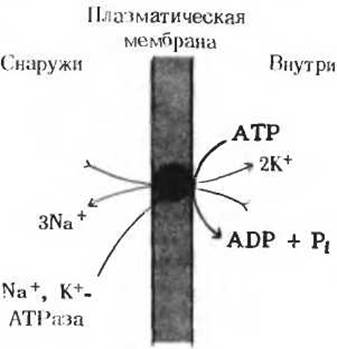
Fig. 14-15. Scheme illustrating the action of Na+, K+-ATPase. Free Energy is required to transport K+ into the cell (where its concentration is higher than in the extracellular environment) and to transport Na+ out of the cell into the environment (where the concentration of these ions is higher than inside the cell). The source of this energy is the Hydrolysis of ATP. For each molecule of ATP hydrolyzed to ADP and Pi, three Na+ ions exit the cell and two K+ ions enter it from the extracellular environment. This ion transport involves two stages. In The First stage, the ATPase molecule is phosphorylated by ATP, which enables it to bind a Na+ ion. In the second stage, a K+ ion binds, resulting in the Transmembrane Translocation of Na+ and K+ accompanied by the release of free phosphate into the cytosol. ATP and its hydrolysis products (ADP and Pi) remain inside the cell.
Last update: 06/08/2026
Editorial and Educational Adaptation: This material has been compiled based on the primary/original source text. The project team performed an editorial review, corrected technical inaccuracies, structured sections, and adapted the content for an educational format.
What was processed:
- elimination of formatting defects (OCR errors, structural breaks, corrupted characters);
- editorial organization of content;
- standardization of terminology in accordance with academic sources;
- verification of factual statements against the original source text.
All mentions of the author, publication year, and origin of the primary text have been preserved in accordance with the source.