Chemistry and Biology of Proteins - F. Haurowitz 1953
Conjugated Proteins
Glycoproteins (Mucoproteins)
The terms Glycoproteins and mucoproteins are used to designate a group of Conjugated Proteins that incorporate glucose or other sugars and sugar derivatives. The glycoprotein group encompasses compounds of diverse COMPOSITION AND PROPERTIES. Based on The properties of their carbohydrate component, this group is divided into two subgroups: 1) neutral glycoproteins and 2) acidic glycoproteins [39]. The first subgroup includes glycoproteins containing neutral CARBOHYDRATES built from Monosaccharides or amino sugars. The second subgroup comprises glycoproteins whose carbohydrate moiety contains hexuronic acids or sulfuric acid esters of sugars. It should always be kept in mind, however, that the carbohydrate component of most glycoproteins represents a mixture of acidic and neutral carbohydrates, and therefore this Classification cannot be considered entirely satisfactory. Another classification is based on the quantitative carbohydrate content of glycoproteins. Compounds containing more than 4% carbohydrates are termed mucoids or mucoproteins, whereas those containing less than 4% are designated as glycoproteins [38].
To date, none of the glycoproteins has been isolated in a pure crystalline state. Some "glycoproteins" are likely mixtures of various compounds, while others are formed from proteins and carbohydrates during the isolation process and should be considered artifacts. The resistance of glycoproteins to Denaturing Agents is frequently exploited to separate them from proteins. In this Procedure, proteins are precipitated by heating their solutions, after which glycoproteins are recovered from the filtrate via salting out or acidification.
Until recently, some uncertainty persisted as to whether glycoproteins contain a small number of large polysaccharide molecules linked to protein chains, or A large number of small sugar molecules bound to various Functional groups of the protein. It is now generally accepted that the prosthetic groups of typical glycoproteins consist of Polysaccharides. Proteins can associate with polysaccharides in vitro to form more or less stable complexes [40]. Tyrosine and Arginine exhibit the strongest propensity for forming compounds with polysaccharides [40]. Based on this observation, it has been suggested that polysaccharides are attached specifically to these Amino Acids within the glycoprotein molecule. In acidic glycoproteins, the linkage between polysaccharide acids and the protein likely occurs via salt-like bonds formed between the acidic groups of the polysaccharides and the basic groups of the proteins [41]. In addition to these salt-like bonds, dipole interactions between the protein and the prosthetic group may also be operative.
Cartilage tissue consists primarily of Collagen and chondroitinsulfuric acid. Chondroitin sulfuric acid is a polysaccharide containing equivalent amounts of glucuronic acid and acetylchondrosamine sulfuric acid ester [42]. The chondroitin sulfuric acid ester prepared from cartilage is a polysaccharide whose dissolution imparts high viscosity to solutions and which exhibits Streaming Birefringence [43]. Its molecular weight is approximately 260,000, and its molecular chain length reaches 4,700 Å [43]. It remains unresolved whether the chains of this polysaccharide are straight [44] or branched [45]. Chondroitin sulfuric acid binds to protein at pH 4.85, i.e., below the isoelectric point of the protein [46].
The bulk of cartilage protein is collagen, an insoluble fibrous scleroprotein (see Chapter IX) composed of long peptide chains. The polyvalent anions of chondroitin sulfuric acid apparently combine with the basic groups of the protein strands, forming a network of fibrous polysaccharide anions and protein cations [46]. Upon boiling cartilage in Water, collagen is converted into water-soluble gelatin, which combines with chondroitin sulfuric acid to form the so-called chondromucoid. This compound is evidently a degradation product of native collagen [46]. Since collagen contains an excess of negative groups at physiological tissue pH values, it is highly probable that not only salt linkages but also Structure/103.html">Van der Waals forces contribute to the complex formation between collagen and chondroitin sulfuric acid [46]. Like cartilage, Skin and bone also contain collagen, which is likely associated with the same glycoprotein found in cartilage. The question of whether amyloid belongs to the category of chondroitin sulfate-containing glycoproteins remains open. Amyloid is deposited in The Liver and other Organs during chronic inflammatory processes. It yields a purple coloration upon reaction with iodine, a property that inspired the name "amyloid" due to its resemblance to starch. Amyloid contains sulfuric acid esters [47].
Mucins are glycoproteins found in saliva, gastric and intestinal juices, and various other secretions. They appear to consist of long, thread-like molecules that yield highly viscous solutions upon dissolution. Mucins belong to the group of acidic glycoproteins and contain hexuronic acid, most likely glucuronic acid (COOH ∙ CHOH ∙ CHOH ∙ CHOH ∙ CHOH ∙ CHO) [39]. Gluconic acid (CH2OH ∙ CHOH ∙ CHOH ∙ CHOH ∙ CHOH ∙ COOH) has been detected in mucin from the submaxillary salivary gland [38]. In addition to hexuronic acids, mucins contain 5–8% mannose and 5–8% acetylated glucosamine [48] or chondrosamine [49]. Because mucins contain only traces of sulfuric acid, they cannot incorporate any significant amount of mucoitinsulfuric acid, contrary to earlier assumptions [48].
Owing to the presence of hexuronic or hexonic acids in their structure, mucins are acidic substances with an isoelectric point ranging between pH 3 and 5 [50]. Mucins can be precipitated from saliva and other secretions by acetic acid and redissolved upon The addition of alkalis.
Glycoproteins extracted from various organs with water or salt solutions are designated as mucoids. Large quantities of mucoids have been found in cysts, particularly Ovarian Cysts. Mucoids are also constituents of the vitreous humor of the eye. Different mucoids contain varying carbohydrates. The mucoid of the eye's vitreous humor contains acetylglucosamine and glucuronic acid, whereas the corneal mucoid contains mucoitinsulfuric acid, which is an ester of hyaluronic acid and sulfuric acid [51]. Chondroitin sulfuric acid has been identified in mucoids isolated from tendons [52]; however, it is possible that this mucoid is a secondary artifact arising from collagen degradation, and that tendons themselves contain only collagen and chondroitin sulfuric acid. Mucoids extracted from urine contain glucosamine and galactose [53].
Hyaluronic acid, a component of the vitreous humor mucoid, is a polysaccharide containing equivalent proportions of N-acetylglucosamine and glucuronic acid [54]. This polysaccharide has also been isolated from the umbilical cord and synovial membranes [43]. Its molecular weight is approximately 200,000, and its molecular chain length varies between 4,800 and 10,000 Å [43]. The Physiological Role of highly viscous hyaluronic acid is to anchor Cells in position by acting as a cementing substance that fills the intercellular spaces [55]. It is likely bound to the proteins of corresponding Tissues in a manner analogous to how chondroitin sulfuric acid binds to cartilage and bone proteins. Hyaluronic acid is responsible for the gelatinous consistency of the vitreous humor and the umbilical cord.
Ovomucoid, a glycoprotein isolated from egg white, has been investigated in great detail. When egg proteins are thermally coagulated, ovomucoid remains in the filtrate, from which it can be precipitated by the addition of ethanol. The carbohydrate component of this protein accounts for 20% of the total compound [56, 57] and comprises 3 molecules of mannose, 7 molecules of acetylglucosamine, and 1 molecule of galactose. Thus, this carbohydrate consists of 11 monosaccharide residues, and its structure likely corresponds to the following formula [56]:
Class="center">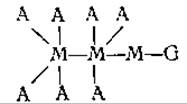
where A represents N-acetylglucosamine, M is mannopyranose, and G denotes galactopyranose [56].
The carbohydrate is apparently linked to the protein via an ester bond formed between the hydroxyl group of acetylglucosamine and a carboxyl group of the protein. In the egg, ovomucoid forms complexes with other proteins [58].
Glycoproteins have likewise been identified in Blood serum. They are typically isolated using the following procedure: globulins are first removed by salting out with an equal volume of saturated ammonium sulfate solution, after which a mixture of albumins and glycoproteins is precipitated from the filtrate by adjusting the pH to 4.7, the isoelectric point of albumins. The precipitate is dissolved in water, and globoglycoid is salted out with an equal volume of a saturated ammonium sulfate solution at pH 7.6 [59]. The precipitated protein is carbohydrate-free and closely resembles serum albumin in its properties [60]. The remaining serum albumin in solution is thermally coagulated. Two glycoproteins can subsequently be isolated from the filtrate: seroglycoid and seromucoid. Seroglycoid, which contains galactose, mannose, and glucosamine, is not a homogeneous protein, as it can be fractionated into several components using concentrated Buffer solutions [61]. The second glycoprotein, seromucoid, contains 10.7% carbohydrate composed of N-acetylglucosamine, d-galactose, and d-mannose in a 1:1:1 molar ratio [60]. Horse serum contains 0.5% globoglycoid and approximately comparable amounts of seroglycoid and seromucoid [59]. When blood serum is fractionated with ethanol, glycoproteins partition into fraction IV (see Chapter VIII). This fraction also harbors the a2-globulin, which contains a substantial carbohydrate fraction alongside two other conjugated proteins: glycoprotein and mucoprotein [62].
The gonadotropic hormone found in the urine of pregnant women also belongs to the class of glycoproteins. It contains 18% carbohydrate (see Chapter XIII).
The proteins that constitute the substances determining the specific blood group properties of erythrocytes likewise contain carbohydrates. It has long been established that erythrocytes can be classified into four primary groups, designated as A, B, AB, and O. The substances determining these blood group characteristics are correspondingly denoted as A, B, and O. Red Blood Cells bearing these substances are agglutinated by sera from other groups because such sera contain specific agglutinins. The blood group substances of red blood cells are glycoproteins or glycopolypeptides that incorporate a high proportion of carbohydrates alongside amino acids [70]. Red blood cells contain only minor quantities of these substances; however, highly similar compounds have been found in much greater concentrations in saliva, commercial peptone preparations, various Pepsin preparations, and porcine stomachs [63–66]. Substance A isolated from various tissues is very similar, though not identical, to the substance A of erythrocytes. Both preparations contain 40–70% carbohydrates composed of d-galactose, d-mannose, d-glucosamine, and d-fucose [65]. This carbohydrate is a polymeric structure with fucose occupying the terminal groups [67]. In substance A isolated from the pig Stomach, glucosamine nitrogen accounts for 39% and Amino Acid Nitrogen for 27.1% of the total nitrogen. Hydrolysis of this substance yielded 1.6% Glycine, 0.7% valine, 0.3% isoleucine, 3.3% Proline, 1.9% Histidine, 0.3% tyrosine, 0.1% phenylalanine, 0.2% Tryptophan, and trace amounts of Other Amino Acids [68].
Substances B and O closely resemble substance A. All three substances, when isolated from saliva and ovarian cyst fluids [69], contain 5.3–5.7% total nitrogen, 2.3–2.9% amino acid nitrogen, and 1.7–1.8% hexosamine nitrogen. They yield positive Sakaguchi reactions for arginine, diazo reactions, and biuret tests. None of these substances contain sulfur [63]. The precise nature of other nitrogenous constituents within blood group substances remains to be elucidated, nor is it known how the carbohydrate is bound to the protein or polypeptide moiety. In their Native State, all these substances are highly viscous and form gels at pH 8.5. Exposure to sodium hydroxide or sodium carbonate destroys their viscosity [70], likely As a result of Protein Denaturation or Cleavage. All these substances are inactivated by heating [67].
It remains unsettled whether the insect cuticle contains a true glycoprotein or consists of two interpenetrating layers of protein and carbohydrate (Chitin) [71].
Last update: 06/08/2026
Editorial and Educational Adaptation: This material has been compiled based on the primary/original source text. The project team performed an editorial review, corrected technical inaccuracies, structured sections, and adapted the content for an educational format.
What was processed:
- elimination of formatting defects (OCR errors, structural breaks, corrupted characters);
- editorial organization of content;
- standardization of terminology in accordance with academic sources;
- verification of factual statements against the original source text.
All mentions of the author, publication year, and origin of the primary text have been preserved in accordance with the source.