ECOLOGICAL BIOCHEMISTRY - Textbook - V. M. Isaienko 2005
Chapter 8. RESISTANCE AND ADAPTATION OF PLANTS AND ANIMALS
8.3. Resistance and Adaptation of Animals to Environmental Conditions
8.3.4. Adaptation to Pressure Changes
Changes in pressure directly affect biochemical processes within Cells. Mechanisms of adaptation to varying pressure encompass anatomical, physiological, and biochemical aspects, and are closely linked to other environmental factors, particularly the availability of oxygen for Respiration.
It is worth noting that the majority of organisms inhabit terrestrial environments and the upper layers of aquatic ecosystems, where they experience moderate and relatively stable pressure. Even at the highest point on Earth (Mount Everest), atmospheric pressure is only four times lower than at sea level (Table 8.10).
Class="center">Table 8.10
ATMOSPHERIC PRESSURE AT VARIOUS ALTITUDES AND Water PRESSURE AT VARIOUS DEPTHS
Absolute Pressure |
|||
Pa |
atm |
mmHg |
|
Mount Everest summit |
2,34 • 104 |
0,25 |
190 |
Sea level |
1,013 • 105 |
1,0 |
760 |
5 km water depth |
5,065 • 107 |
500 |
3,8 • 105 |
10 km water depth |
1,013 • 108 |
1000 |
7,6 • 105 |
In the sea and deep lakes, water pressure acts as a multifaceted environmental factor influencing living organisms. Not only do marine organisms thrive under immense pressures, but some are also capable of adapting to drastic pressure fluctuations within remarkably short periods, sometimes in a matter of hours. For instance, lanternfishes of the family Myctophidae undertake daily vertical Migrations of 300 to 500 meters. Certain fish species (such as Stomias and Ectreposebastes) and squids are capable of even greater vertical migrations ranging from 1000 to 2500 meters. Certain benthos forms feature larval stages for which the pressure differential across different life cycle phases can be even more pronounced. Organisms capable of vertical migration in the water Column are simultaneously subjected to Temperature variations—typically within a range of 10–15 °C—as well as fluctuations in dissolved oxygen levels.
Pressure-related effects on organisms can be divided into two main categories: 1) those determined by The impact of pressure on metabolic processes; and 2) structural effects associated with alterations in structures maintained by "weak" bonds (see subsection 3.3.3). These two categories partially overlap.
The Effect of pressure on Proteins and enzymatic reactions. One of the primary factors determining how pressure influences reaction rates is the volume change that occurs during The formation of the activated enzyme-substrate complex. The equation describing this pressure-dependent relationship is as follows:
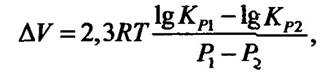
where ΔV is the volume change resulting from the reaction; R is the gas constant; T is the absolute temperature; and KP1 and KP2 are the reaction equilibrium constants at pressures P1 and P2, respectively.
When the volume of the activated complex equals the average volume of its components, the reaction rate remains unaffected by pressure. If the volume of this complex exceeds the average volume of its components prior to activation, pressure inhibits the reaction rate; conversely, pressure accelerates the reaction rate when the volume of the activated complex is smaller than that of the interacting reactants. For enzymatic reactions, there exists a specific optimum pressure determined by: 1) the diffusion rate of reactants resulting from changes in medium viscosity induced by pressure; and 2) the potential Denaturation of Enzymes under high pressure. Both of these factors are also temperature-dependent.
When two or more enzymes compete for a single shared substrate, pressure effects can determine the metabolic pathway. An example of such a process is METABOLISM/18.html">The Influence of pressure on the potential conversion PATHWAYS OF GLUCOSE-6-phosphate (Fig. 8.4):
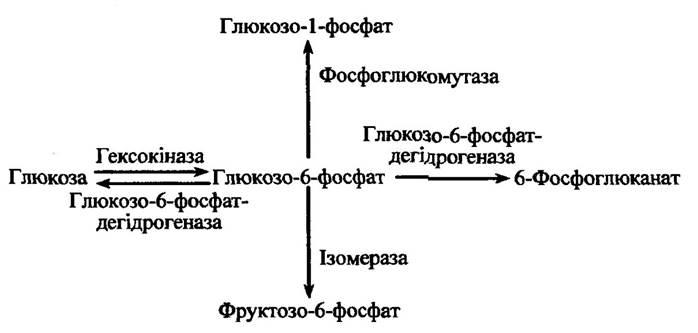
Fig. 8.4. Pathways of glucose-6-phosphate metabolism in the Liver of vertebrates
When hexokinase exhibits high relative activity, the pathway favoring The conversion of glucose into glucose-6-phosphate predominates (Fig. 8.4). These conversion reactions differ in: 1) the direction of the initial reactions; 2) their underlying mechanisms; and 3) the intermediates of their activated complexes, among other factors.
Pressure-induced structural changes in molecules can be classified into two categories: 1) transitions between solid, liquid, and gaseous states that affect the Functions of macromolecules, particularly enzymes; and 2) structural alterations in macromolecules directly linked to their functional properties.
Each enzymatic system exhibits specific responses to pressure, which depend on: 1) the number of "weak" bonds capable of forming or breaking under pressure; 2) the types of bonds undergoing alteration; and 3) the specific role these bonds play in maintaining the overall macromolecular Structure.
As noted previously, hydrogen, ionic, and hydrophobic interactions—collectively referred to as "weak" bonds—play a crucial role in determining molecular conformation and state of aggregation. The disruption of hydrogen and Hydrophobic bonds within protein molecules, leading to their denaturation (alteration of Tertiary and Quaternary structures), results in a net decrease in the volume of the protein-water system. This is caused by the effect of hydrophobic and ionic groups on water structure, as amino acid residues possessing these types of bonds pack water molecules more densely than they are arranged in bulk water. As already mentioned, the volume of the system is pressure-dependent.
Pressure affects not only the volume of the surrounding water containing the proteins, but also the packing density of polypeptide chains—in other words, The quaternary structure—with protein volume decreasing as pressure rises. In deep-sea organisms adapted to varying pressures, proteins do not undergo volume changes upon exposure to high pressure.
A classic example of the effect of pressure on protein polymerization, which is driven primarily by hydrophobic interactions, is the Formation of the filamentous protein F-Actin (a Muscle contractile element) from monomeric G-actin units (Fig. 8.5).
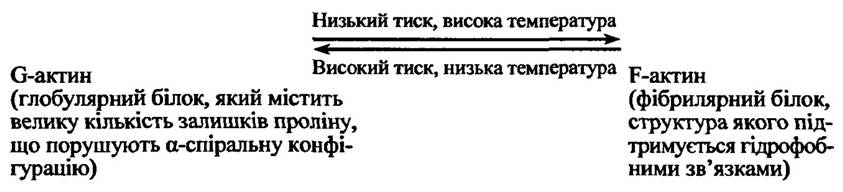
Fig. 8.5. Diagram of low-pressure polymerization and high-pressure depolymerization of F-actin
Pressure also affects the polymerization of Myosin (Fig. 8.6):

Fig. 8.6. Diagram of low-pressure polymerization and high-pressure depolymerization of the myosin polymer
An example of a pressure-dependent phase transition of proteins from a sol state (true solutions) to a gel state (aggregate formation) is the formation of abnormal Hemoglobin S (HbS) in the Blood of patients with Sickle-Cell Anemia. In the HbS molecule, the glutamic acid residue at position 6 of the P-chain of normal hemoglobin (HbS) is substituted by valine. This leads to hydrophobic interactions between this valine residue and the valine residues at positions 1 and 5 of the P-chain. Such valine-valine interactions are pressure-dependent: at a temperature of 37 °C and pressures up to 50 atm (5.065 • 106 Pa), hemoglobin exists in a sol state, and the probability of valine-valine interactions is low.
In addition to affecting Protein Structure and the formation of Protein Assemblies, pressure can also alter the interaction of proteins with Lipids, Nucleic Acids, and other molecules.
The effect of pressure on Transcription and Translation Processes. The interaction between nucleic acids is largely insensitive to pressure. For instance, double-stranded DNA, whose structure is maintained mainly by Hydrogen Bonds, denatures only at extremely high pressures of 2000 — 3000 atm (1.52 • 109 — 2.28 • 109 Pa). Transcription and translation processes can be altered at somewhat lower pressures. In experiments on Escherichia coli studying the synthesis of P-galactosidase, it was established that the synthesis of this enzyme ceases under a pressure of 680 atm (6.89 • 107 Pa). Upon release of pressure, the synthesis of this enzyme resumes. Apparently, cells contain Messenger RNA ready to participate in translation once high pressure is removed. The immediate recovery of P-galactosidase synthesis after the removal of pressure indicates that enzyme synthesis is blocked by pressure at the translational level.
High pressure also disrupts The structure of Ribosomes and Polysomes. In the Ciliate Tetrahymena piriformis, newly formed polysomes are relatively easily disrupted by high pressure, whereas already functioning polysomes remain almost unaffected. Thus, only the initiation stage of translation, which is encoded in the messenger RNA, is sensitive to pressure.
The effect of pressure on Membrane Structure. Introduction/36.html">Biological Membranes, as is well known, are also stabilized by "weak" bonds. The basis of their structure is a lipid bilayer with a hydrophobic interior region and polar outer phospholipid "heads". Membranes exist in a liquid-crystalline state. At low temperatures (0–20 °C), membranes of many organisms transition into a "solid" state As a result of the crystallization of the aliphatic chains of Phospholipids (see subsection 3.3.3). The transition temperature from the "liquid" to the "solid" state is altered by pressure.
For saturated Hydrocarbons, the temperature of such a phase transition increases by approximately 20 °C per 1000 atm (1.013 • 108 Pa) increase in pressure. For example, in dodecane (Cn-hydrocarbon), the liquid-to-solid transition point at 1 atm (1.013 • 105 Pa) corresponds to -10 °C, whereas at 1000 atm (1.013 • 108 Pa) it is 15 °C; for octadecane (C18-hydrocarbon), it is 27 °C and 50 °C, respectively.
It is worth noting that in marine organisms, even at relatively low pressures, the majority of Membrane Lipids might be expected to exist in a "solid" state. However, this does not occur because The properties of membranes that determine their phase transitions are "tuned" to the effects of high pressure.
Membrane phase transitions are largely determined by the length of the hydrocarbon chain, the number (even or odd) of carbon atoms, the degree of saturation, and so forth. For example, aliphatic hydrocarbons with an odd number of carbon atoms have a lower phase transition point than those with an even number. This is due to the weaker packing ability of hydrocarbons with an odd number of carbon atoms in crystals.
Pressure also affects the functional activity of biological membranes, which is determined by Membrane Proteins. The manifestation of these proteins' activity is linked to protein-lipid interactions that depend on "weak" forces sensitive to pressure, as noted earlier. Changes in pressure also affect membrane viscosity; an increase in viscosity due to elevated pressure reduces diffusion. If the reaction rate is limited by the diffusion of reactants to the enzyme, a slowdown of the reaction under elevated pressure is possible. The reduction in diffusion also causes the inhibition of substance transport across membranes.
It should be noted that, unlike organic liquids, the viscosity of water decreases as pressure increases from 1 atm (1.013 • 105 Pa) to 1000 atm (1.013 • 108 Pa). At even higher pressures, as well as in the presence of dissolved substances in water, its viscosity increases, but to a much lesser extent than the effect of pressure on organic liquids.
Enzyme adaptation to pressure in marine animals. The adaptation of marine animals to pressure depends on whether they permanently inhabit deep-sea environments with high pressure, or are capable of vertical migration through the water column daily or during certain life cycles.
When comparing The activity of the enzyme fructose-1,6-bisphosphatase, which plays a major role in regulating Gluconeogenesis (catalyzing the reaction fructose-1,6-bisphosphate → fructose-6-phosphate + Pi), in trout and the deep-sea grenadier fish of the family Coryphaenoides, it was found that at physiological substrate concentrations and under high pressure, the enzyme activity decreases in trout, whereas it increases slightly in the grenadier. Such a slight increase in fructose-1,6-bisphosphatase activity in the grenadier indicates that the activity of this enzyme is practically independent of pressure. This occurs because the enhancement of the catalyzed reaction rate observed at increased pressure is offset by a decrease in enzyme activity caused by a reduction in the enzyme's affinity for the substrate.
Pressure affects not only the affinity of enzymes for substrates, but also for Cofactors, inhibitors, or activators, etc. For example, in the case of the same fructose-1,6-bisphosphatase, the affinity for Mg2+, which participates in the catalyzed reaction, changes. At high pressure and low concentrations of Mg2+, the Mg2+-dependent activity of this enzyme is inhibited in trout, whereas at high pressure and high concentrations of Mg2+, it is activated. In the grenadier, the enzyme's affinity for Mg2+ remains virtually unchanged with pressure variations. Similar effects are also observed during the interaction of fructose-1,6-bisphosphatase with its activity regulator—intracellular AMP.
Another important enzyme in glucose metabolism is Pyruvate kinase, which catalyzes the following reaction:

The rate of this reaction decreases under the influence of high pressure.
Deep-sea Fishes (such as the grenadier Coryphaenoides) and midwater species capable of vertical migration (for example, the splitfin Ectreposebastes imus) are significantly less sensitive to elevated pressure than surface-dwelling species (such as rainbow trout). In the former, the high-pressure-induced inhibition of the pyruvate kinase reaction rate is compensated by opposing effects. The main ones include: an increase in the enzyme's affinity for the substrate, the removal of the inhibitory effect of high pressure, and a decrease in ATP content due to the activating action of fructose bisphosphate.
A similar effect, manifested as the net result of opposing Changes in the overall catalytic capacity of the enzyme, is characteristic not only of fructose bisphosphatases and pyruvate Kinases, but also of many enzymes in deep-sea organisms.
Last update: 06/08/2026
Editorial and Educational Adaptation: This material has been compiled based on the primary/original source text. The project team performed an editorial review, corrected technical inaccuracies, structured sections, and adapted the content for an educational format.
What was processed:
- elimination of formatting defects (OCR errors, structural breaks, corrupted characters);
- editorial organization of content;
- standardization of terminology in accordance with academic sources;
- verification of factual statements against the original source text.
All mentions of the author, publication year, and origin of the primary text have been preserved in accordance with the source.