BIOCHEMISTRY - Main Regulators and Biological Fluids of the Human Body - 2016
4. CHEMICAL COMPOSITION OF URINE
4.6. Practical Part. Investigation of the Mineral Composition and Active Reaction of Urine
Objective - to study the inorganic composition and determine the acidity of the test urine.
All processes in The Human Body take place in an aqueous medium, so the Role of Water in vital activity cannot be overestimated. Mineral Substances are involved in The formation of all Organs and Tissues, help maintain osmotic pressure, activate many Enzymes, etc. The normal content of water and mineral salts in Blood and urine is constant, making their determination essential for assessing the body's functional state.
Experiment 1. Determination of urine reaction
The normal urine reaction ranges within pH 5 - 7 and depends on the diet. Urine in humans and carnivorous animals is weakly acidic or acidic. Urine becomes distinctly acidic in diabetes due to the appearance of large amounts of Ketone Bodies.
An alkaline urine reaction may occur during vomiting, certain genitourinary tract disorders, or after the intake of sodium bicarbonate and mineral waters.
The urine reaction is determined either by observing the color change of litmus or universal indicator paper, or by using bromothymol blue as an indicator.
Place red or blue litmus paper, or universal indicator paper, on a Glass slide set on a sheet of white paper. Using a glass rod, apply a drop of urine onto the paper and observe the indicator's color change.
To determine the urine reaction using bromothymol blue, add two drops of the indicator solution to 4 - 5 ml of urine and observe the color change of the solution. An acidic urine reaction turns yellow, a weakly acidic one turns brown, a weakly alkaline one turns green, and an alkaline one turns blue.
Bromothymol blue is prepared from a 1% alcohol solution: dilute it with distilled water in a 1:3 ratio to obtain a 0.25% solution.
The report should indicate:
1) how the color of the indicator paper changed (specifying the exact type used) and what this indicates;
2) how the color of the urine changed after adding the bromothymol blue indicator solution and what follows from this;
3) a general Conclusion regarding the active reaction of the urine.
Experiment 2. Detection of chlorides in urine
About 15 g of chlorides (calculated as sodium chloride - NaCI) are excreted in the urine daily. In certain conditions (lobar Pneumonia, Cancer, Kidney lesions), chloride retention is observed in the body. Determining chloride levels in urine is important when prescribing a salt-free diet. The chloride content in the urine of a healthy person roughly corresponds to the sodium chloride content in their diet.
The detection of chlorides is based on the formation of silver chloride, which is insoluble in nitric acid but soluble in an aqueous ammonia solution.
Add 2 - 4 drops of a 1% silver nitrate (АgNO3) solution to 20 drops of urine. A white, curdy precipitate of silver chloride (АgCI) appears, which darkens upon exposure to light and is insoluble in nitric acid but soluble in ammonia. Mix the Contents of the test tube, transfer a portion to another test tube, and add 1 - 2 drops of a 10% ammonia solution (NH4ОН). The precipitate dissolves. To the other portion, add 10% nitric acid (HNO3) drop by drop; the precipitate does not dissolve.
Class="center">
The report should note the Formation of the precipitate and state whether it dissolves in the ammoniacal solution. Draw a conclusion about the presence of chlorides in the urine and explain its clinical significance.
Experiment 3. Detection of phosphates in urine
Phosphorus is of great importance to the body. It is a component of bone and dental tissue, maintains osmotic pressure, and phosphorus-containing salts (adenosine triphosphates) serve as the primary source of energy in the body for both vital Functions and physical exertion. Phosphorus ensures the activation of glucose, Fatty acids, and Amino Acids, and regulates the selective permeability of Cell membranes. Phosphates are formed in the body through The breakdown of phosphorus-containing organic substances: Nucleoproteins, Phosphoproteins, phosphatides, ATP, etc. Phosphorus is excreted in the urine as mono- and disubstituted salts of potassium, sodium, calcium, magnesium, and ammonium.
The amount of phosphoric acid salts excreted in the urine reflects the intensity of phosphorus-containing organic compound METABOLISM and normally ranges from 1.5 to 6.0 g per day for an adult, calculated as phosphorus pentoxide (V). Elevated phosphorus levels in urine occur in leukemia and infectious diseases, while decreased levels are observed in Rickets. The detection of phosphates is based on their ability to form a yellow precipitate with a molybdate reagent.
Add 2 - 3 drops of a 10% ammonia solution (NН4ОН) to 20 drops of urine. The resulting precipitate of calcium and magnesium phosphates, Са3(РO4)2 and Мg3(РO4)2, is filtered off and dissolved directly on the filter paper using 2 - 3 drops of a 10% nitric acid solution (НNO3). Add 10 - 15 drops of molybdate reagent to the filtrate and boil. Upon heating, the liquid turns yellow, and upon cooling, a crystalline yellow precipitate of ammonium phosphomolybdate, (NН4)2РO4 • 12МоO3, separates out:

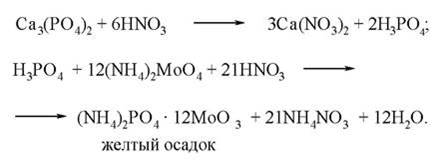
To prepare the molybdate reagent, dissolve 7.5 g of ammonium molybdate, (NH4)2MoO4, in 100 ml of a 32% nitric acid solution (НNO3).
In your report, note any color change of the solution and the formation of a precipitate. Conclude whether phosphates are present in the urine and explain the Clinical significance of this finding.
Experiment 4. Detection of Sulfates in Urine
Sulfur is involved in numerous Metabolic Pathways in the body, including the synthesis of Hormones (Insulin, oxytocin) and the detoxification of harmful compounds (phenol, cresol). Urinary sulfur-containing substances are produced as a byproduct of Protein metabolism in tissues. Sulfur is excreted in the urine as inorganic sulfates, ethereal sulfates, and the so-called neutral sulfur fraction (e.g., Cysteine, thiocyanates, etc.). The amount of excreted sulfates depends directly on Dietary Protein Intake. On average, about 2.5 g of sulfur is excreted in the urine as sulfates per day. Sulfates in urine are detected by the appearance of a white barium sulfate precipitate, which is insoluble in both acids and alkalis.
Add 5 drops of a 10% Hydrochloric acid solution (НСI) to 20 drops of urine, followed by dropwise addition of a 5% barium chloride solution (ВаСI2) until a white crystalline precipitate of barium sulfate forms completely:

In your report, note the formation of the precipitate. Conclude whether sulfates are present in the urine and explain The Significance of this finding.
Experiment 5. Detection of Ammonium Salts in Urine
Ammonium salts account for 4 - 5% of total urinary nitrogen, which corresponds to an excretion of 0.6 - 1.2 g of ammonia per day.
Pour 2 - 3 ml of urine and 1 - 2 ml of milk of lime (a saturated solution of calcium hydroxide, Са(ОН2) into a test tube, mix the two liquids thoroughly, and hold a piece of phenolphthalein indicator paper, pre-moistened with water, near the Mouth of the test tube without touching the walls. After a short time, the paper turns red due to the release of ammonia (NН3):

Alternatively, red litmus paper or another indicator strip, also pre-moistened with water, can be used to detect ammonia. In this case, they will turn blue.
In your report, specify which indicator paper was used, what color change occurred, and explain the clinical or physiological significance of this result.
Last update: 06/08/2026
Editorial and Educational Adaptation: This material has been compiled based on the primary/original source text. The project team performed an editorial review, corrected technical inaccuracies, structured sections, and adapted the content for an educational format.
What was processed:
- elimination of formatting defects (OCR errors, structural breaks, corrupted characters);
- editorial organization of content;
- standardization of terminology in accordance with academic sources;
- verification of factual statements against the original source text.
All mentions of the author, publication year, and origin of the primary text have been preserved in accordance with the source.