Biological Chemistry - Berezov T. T., Korovkin B. F. 1998
Lipid Metabolism
Eicosanoids
Eicosanoids are a large group of physiologically and pharmacologically active compounds. They include Prostanoids (Prostaglandins, prostacyclins, thromboxanes) and Leukotrienes.
The most active precursor of eicosanoids is arachidonic acid, which is a component of Cell/33.html">Plasma Membrane Phospholipids. The latter is released from the membrane phospholipid bilayer through the action of phospholipase A2. Other Essential Fatty acids (linoleic and α-linolenic acids) also participate in The formation of eicosanoids, but only after elongation by two carbon atoms and desaturation, i.e., conversion into 20-carbon tetraenoic acids. Therefore, eicosanoids can be divided into 3 groups (each comprising prostaglandins, thromboxanes, and leukotrienes) depending on their precursors: linoleate, arachidonate, and linolenate.
The Metabolic pathways of arachidonate (the substrate) vary, with prostanoid synthesis competing with leukotriene synthesis for the substrate. These two pathways are referred to as the cyclooxygenase and lipoxygenase pathways, respectively (Fig. 11.5).
Class="center">
Fig. 11.5. Involvement of arachidonic acid in the formation of eicosanoids (after A.N. Klimov and N.G. Nikulcheva).
Prostaglandins (PG, Pg). Structurally, PGs are 20-carbon fatty acids containing a 5-carbon ring and hydroxyl and/or keto groups:
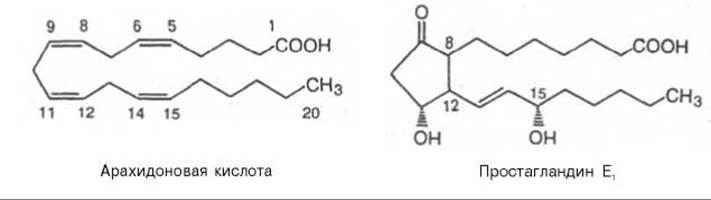
Six primary natural PGs have been discovered: three of the E series (ether-soluble) and three of the F series (phosphate-soluble). E-series PGs contain a keto group at position 9, whereas F-series PGs contain a hydroxyl group. There are also several secondary PGs, which are products of the enzymatic conversion of primary ones.
PGs exert their effects at extremely low concentrations (1–10 ng/mL). When administered into the body, they cause smooth Muscle contraction, regulate Blood flow to specific Organs, have a variable effect on blood pressure, control Ion transport across membranes, etc.
Overall, while not Hormones, PGs modulate hormonal action. They predominantly affect the physiological Functions of the Cells in which they are synthesized. The Nature of PG action depends on The Cell type, which distinguishes PGs from hormones with their unambiguous effects.
PGs can be used therapeutically to prevent Fertilization, stimulate normal labor, terminate Pregnancy, prevent or relieve gastric ulcers, treat inflammatory processes, regulate blood pressure, and relieve asthma attacks, among other Applications.
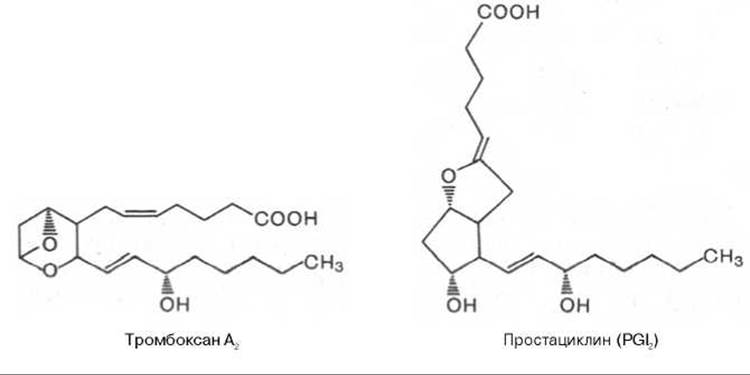
Among the products of secondary PG endoperoxidation, thromboxanes and prostacyclins are particularly noteworthy. Thromboxanes are produced in platelets and, upon release into the bloodstream, cause blood vessel constriction and platelet aggregation.
Prostacyclins are produced in the walls of Blood Vessels and are potent inhibitors of platelet aggregation. Thus, thromboxanes and prostacyclins act as antagonists. Consequently, The ratio of thromboxane to prostacyclin largely determines the conditions for thrombus formation on the vascular endothelial surface. The formulas of the two most important representatives of these compounds are given below:
Leukotrienes. These are derivatives of 20-carbon polyunsaturated (eicosanoic) acids. The name "leukotrienes" comes from two words: "leukocytes" (these compounds were first discovered in leukocytes) and "trienes" (in all representatives of this class of compounds, three out of four unsaturated bonds are conjugated). Leukotrienes are synthesized from eicosanoic acids in leukocytes, mastocytoma cells, platelets, and macrophages via the lipoxygenase pathway in response to immunological and non-immunological stimuli. The Structure of one of the leukotrienes is shown below:

Leukotrienes are primarily considered mediators of inflammatory responses; they induce bronchial muscle contraction at concentrations 100 to 1000 times lower than histamine and promote coronary vessel constriction. Overall, the physiological and pathological functions of leukotrienes remain largely unclear.
Last update: 06/08/2026
Editorial and Educational Adaptation: This material has been compiled based on the primary/original source text. The project team performed an editorial review, corrected technical inaccuracies, structured sections, and adapted the content for an educational format.
What was processed:
- elimination of formatting defects (OCR errors, structural breaks, corrupted characters);
- editorial organization of content;
- standardization of terminology in accordance with academic sources;
- verification of factual statements against the original source text.
All mentions of the author, publication year, and origin of the primary text have been preserved in accordance with the source.