Biochemistry and Molecular Biology - Belyasova, N.A. 2002
Fundamentals of Genetic Engineering
Construction and Analysis of Genomic Libraries
Gene Insertion into a Vector
A Gene obtained by one method or another can determine the Synthesis of the corresponding product only within a Cell, provided that it is expressed. In addition, the gene must be capable of Replication so that all Cells in a population contain it and produce the required amount of the product. All of these conditions (introducing genes into cells, their replication, METABOLISM/31.html">Transcription, and Translation) are mediated by DNA vectors (vectors).
Vectors are small, autonomously replicating DNA molecules—such as Plasmids, phage DNAs, or other Viruses, or their modifications—that ensure penetration into The Cell and stable inheritance of foreign DNA (genes). Vector replicons must meet several requirements: contain a replication ori and replicate autonomously; be stably inherited by the host cell; be maintained in a high copy number within the cell; have sufficient capacity to clone large genes within them; contain convenient restriction sites; contain markers that allow direct Selection of cells that have taken up the cloned DNA segment and the vector itself; and possess a broad host range, among other properties.
Because plasmids, like the viruses used to construct cloning vectors, are inherently specific to the species of organisms in which they can replicate, vector design must take into account the host cells in which cloning will be performed. Among the numerous vector-host systems developed to date, the most widely used are those in which E. coli Bacteria serve as the host, and plasmids or Bacteriophages of the bacterium serve as the vector. It should be noted that researchers' concerns regarding the unpredictable outcomes of eukaryotic Gene cloning stimulated the search for and creation of attenuated host bacterial strains. In particular, "safe" E. coli K-12 strains were developed, featuring A number of characteristics that prevent "escape" from the laboratory: a requirement for specific growth factors absent in natural ecological niches, and a fragile Cell wall sensitive to hypotonic media, among others.
Plasmid Vectors. A large number of vectors based on plasmid replicons have been created for E. coli, among which derivatives of the ColE1 plasmid, particularly pBR322 (Fig. 20.4), have become especially widespread. This vector was constructed by combining in vivo Genetic Methods and Recombinant DNA technology.
Plasmid pBR322 is 4,362 bp long, and its nucleotide sequence has been completely determined. The vector contains genes conferring resistance to two Antibiotics—ampicillin and tetracycline—as well as 12 unique recognition sites for restriction Enzymes (each of the 12 restriction enzymes can cleave the molecule at only a single site).
The advantages of this vector are as follows. First, it can be present in cells in a high copy number per chromosome. Second, it contains two selectable markers (ampicillin and tetracycline resistance), with restriction sites for several enzymes located within the genes determining Antibiotic Resistance. This advantage manifests itself in the fact that if a foreign DNA fragment is inserted into a site located inside a resistance gene, that gene is inactivated, and cells inheriting the plasmid with the cloned DNA fragment can be detected by the loss of resistance to a particular antibiotic. For example, if the Pst I restriction enzyme is used to insert a DNA fragment, the integrity of the gene responsible for ampicillin resistance will be disrupted. However, tetracycline resistance will be retained, allowing cells that have received such vectors to be selected on a medium containing tetracycline, and subsequently screened for sensitivity to the second antibiotic to identify those containing the cloned fragment.
Class="center">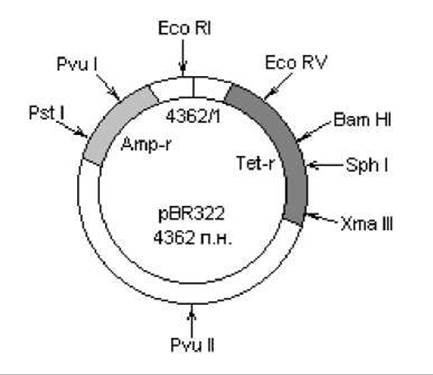
Fig. 20.4. Restriction map of plasmid pBR322. Shown are: THE ORIGIN OF replication (4362/1); genes for ampicillin (Amp-r) and tetracycline (Tet-r) resistance; and restriction sites for several restriction enzymes.
This technique in Introduction/32.html">Genetic Engineering is known as "insertional marker inactivation."
Other approaches exist for selecting cells that have taken up vectors with inserted DNA. One such approach, for example, relies on the ability of the N-terminal portion of $\beta$-galactosidase to Complement a specific mutant $\beta$-galactosidase in a bacterial cell. The Procedure is as follows. A portion of the E. coli *lac* Operon, including the promoter, operator, and 5'-coding region of the *lacZ* gene (which encodes the N-terminal part of $\beta$-galactosidase, Fig. 3–5), is introduced into the vector. A polylinker is inserted into this region without disrupting either the reading frame or The activity of the N-terminal portion of $\beta$-galactosidase. The polylinker is an artificially synthesized sequence containing multiple restriction sites for various Nucleases. If the polylinker lacks an insert, such a vector genome directs the synthesis of the N-terminal part of $\beta$-galactosidase, which, together with the C-terminal part produced by a special E. coli strain, forms active $\beta$-galactosidase. This enzyme produces a blue coloration of cells on a medium containing the chromogenic substrate Xgal and an inducer. If foreign DNA is inserted into the polylinker, complementation is disrupted, and cells that have taken up the recombinant DNA form uncolored colonies.
Vectors constructed on The basis of plasmid replicons have certain drawbacks, the primary one being a decrease in copy number per cell as the size of the hybrid plasmid increases. As a result, cloning DNA fragments exceeding 10 kbp becomes inefficient. Phage vectors, cosmids, and phasmids are used to clone such large DNA fragments.
Phage vectors. When using phage vectors, the viable product containing the recombinant DNA is not a population of cells, as in the case of plasmid vectors, but a population of phage particles. Phage vectors are more efficient than plasmid Vectors for Cloning large inserts. The most common vectors for E. coli are those constructed based on phages $\lambda$ and M13.
The Genome of temperate phage $\lambda$ is represented by a double-stranded DNA molecule of 48.5 kbp, which is packaged into the HEAD as a linear molecule with single-stranded complementary ends (sticky ends). Upon entry into the cell, the sticky ends pair with each other, the molecule circularizes, and it is sealed by DNA ligase. The pairing sites of the sticky ends are designated as cos-sites; they participate in The formation of phage genomes during rolling-circle replication (Chapter 1). The $\lambda$ prophage in lysogenic cells exists in a state integrated with the nucleoid (the mechanism and features of this phenomenon are described in Chapter 2).
Certain Features of the $\lambda$ phage genome are important for vector construction. First, the entire central region (more than 1/3 of the genome) is non-essential for the lytic cycle and is required solely for establishing the lysogenic state. Thus, it can be replaced by foreign DNA while the phage retains its ability to lyse cells. Second, successful packaging of DNA into phage heads requires its length to be between 38 kbp and 52 kbp.
Currently, a large number of diverse vectors based on phage $\lambda$ have been constructed. Typical ones contain restriction sites for EcoRI that flank a region of the genome unnecessary for the lytic cycle (Fig. 20.5). Treatment of such vector DNA with the EcoRI restriction enzyme yields three fragments, among which the terminal fragments (containing genes essential for the lytic cycle) can be selected due to their relatively large size. These fragments are mixed with foreign DNA treated with EcoRI to obtain hybrid molecules in which the central region is represented by the insert fragment (Fig. 20.5). The resulting hybrid molecules are then packaged into phage $\lambda$ heads in vitro. This is accomplished using E. coli cell cultures infected with mutant strains of phage $\lambda$, one of which has a defect in a gene responsible for DNA packaging into the head, and the other in the Synthesis of specific head Proteins. Such phages are unable to undergo the lytic cycle but ensure the accumulation within cells of a large number of intermediates required for the assembly of phage particles: empty heads, tails, and assembly enzymes. If extracts of such cells are mixed with vector DNA containing inserts of a specific size, packaging into phage heads occurs, forming mature phage particles. In the next step, sensitive cells are infected with these particles to yield a progeny of phages carrying the cloned DNAs. Fragments up to 15 kbp in length can be cloned using vectors based on phage $\lambda$.
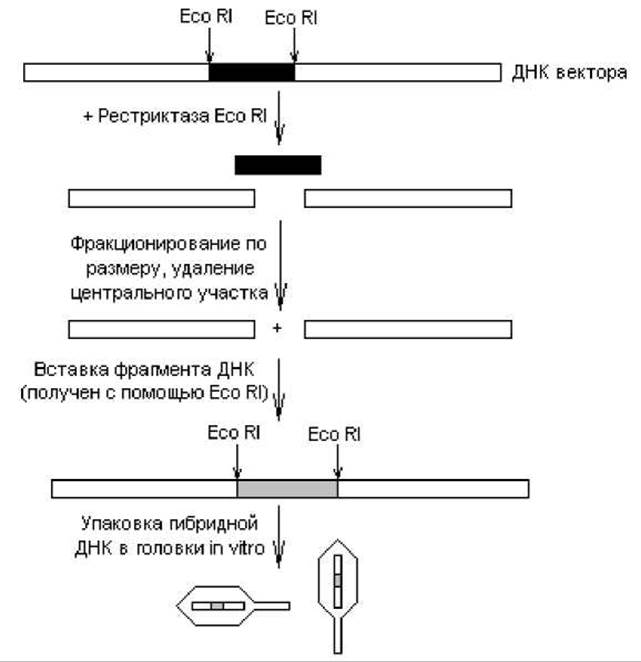
Fig. 20.5. Insertion of genes into phage $\lambda$-based vectors
Another category of phage vectors for E. coli is based on the M13 phage genome. This filamentous "male" phage (which adsorbs to F-pili) contains single-stranded DNA. When the phage DNA penetrates E. coli cells, it replicates to form double-stranded ("+"/"-") intermediates, whose "+" strands are subsequently repackaged to form numerous phage particles. The double-stranded intermediate (the replicative form, RF) accumulates in cells to a level of 100–200 copies. It is isolated and used as a cloning vector. A distinctive feature of phage M13 is that it does not kill the cells but merely slows their division. Phage particles are continuously secreted into the culture medium, and their titer can reach 1012 per ml. On a lawn of sensitive bacteria, the phage appears as turbid plaques.
Polylinkers are incorporated into the phage DNA to facilitate the introduction of foreign DNA. When a heterologous sequence is inserted into the M13 DNA RF, only one of the strands of this insert is packaged into the phage particles (Fig. 20.6). Single-stranded DNA molecules are not used for vector construction because they cannot be cleaved with commonly used restriction enzymes. By cloning a fragment in M13 in both orientations, large quantities of each strand can be obtained.
To facilitate the selection of recombinant forms (phages whose genomes have incorporated a foreign DNA insert), insertions are made into the non-coding region of the vector containing a portion of the E. coli *lac* operon—which mediates the complementation of mutant $\beta$-galactosidase—along with a polylinker. When the polylinker lacks an insert, phage particles grown on a special mutant E. coli strain in the presence of an inducer and a chromogenic substrate form blue negative plaques. The insertion of a DNA fragment into the vector within the polylinker region disrupts complementation, and the plaques remain uncolored.
The advantage of M13-based phage vectors is their ability to accommodate very large inserts, since in this case the DNA packaging process does not depend on the size of the phage genome. The most important application of M13 phage-derived vectors is the generation of single-stranded DNA templates for Sanger sequencing. Furthermore, single-stranded DNAs are ideal targets for Site-Directed Mutagenesis.
Analysis of the foregoing reveals that plasmid and phage vectors each have distinct advantages, which prompted the design of vectors combining The properties of both. This group comprises the so-called plasmid-phage vectors, which include cosmids and phasmids.

Fig. 20.6. Insertion of DNA fragments into phage M13-based vectors
Cosmids. These represent a type of hybrid vector that replicates using a plasmid-type mechanism but retains The ability to be packaged in vitro into phage $\lambda$ capsids. In other words, cosmids are plasmids containing the cos-region (sticky ends) of phage $\lambda$ DNA. Thanks to the cos-sites, these vectors can be introduced into the cell not by transformation, but via conventional infection, thereby increasing the efficiency of obtaining recombinant cells 100-fold or more. DNA fragments ranging from 33 to 49 kbp in size can be cloned in cosmid vectors; thus, these vectors are designed for inserting large eukaryotic genes, which is of particular importance for constructing eukaryotic Genomic Libraries.
An example of a cosmid vector is the plasmid pBR322, which has phage λ cos-sites cloned within its ampicillin resistance gene. If such a vector is cleaved with a restriction endonuclease and mixed with foreign DNA fragments generated by digesting the genome with the same restriction enzyme, a mixture of concatemers may form.
Concatemers are long molecules in which the phage λ genomes (or the DNA replacing them) repeat multiple times and are separated from each other by cos-sites (Fig. 20.7). When these concatemers are mixed with the proteins responsible for packaging phage λ DNA, they are cleaved at the cos-sites, and the DNA is incorporated into the capsid. For this to occur, the distance between two adjacent cos-sites must be 38–52 kbp.
As with λ-vectors, the mixture of concatemers may include vector molecules without inserts, as well as those with multiple repeating inserts. Following cell infection, the recombinant DNA is maintained as a plasmid, in this case conferring resistance to tetracycline.

Fig. 20.7. The Use of cosmid vectors for cloning
Phasmids. These are also hybrid vectors capable of developing both as a phage and as a plasmid, since they contain all the genes necessary for the lytic cycle, as well as the genes required for plasmid replication. The cloning capacity of phasmids is smaller than that of cosmids and is comparable to that of phage vectors. An advantage of phasmids is that their DNA size is too small for a monomer to be packaged into the phage λ capsid, yet too large for a vector dimer to be packaged. Therefore, negative colonies can only be formed by recombinant phasmids, as their sizes match the capacity of the phage λ head.
The insertion of a foreign DNA fragment into a phasmid is carried out similarly to the previously described Examples for other vectors, most frequently via restriction sites. Afterward, the hybrid phasmids are packaged into capsids in vitro, as described above. Upon infection of sensitive cells, phasmids drive the lytic cycle and form plaques on a test culture lawn. However, if the vector contains the $cI$ gene encoding the repressor Protein Structure, the phasmid replicates as a plasmid rather than a phage. Often, mutant $cI$ genes are utilized within phasmids, determining The structure of a Temperature-sensitive repressor protein that is inactivated at elevated temperatures. In this case, the phasmid behaves like a plasmid at low temperatures, but upon a temperature increase of a few degrees, it is induced into the lytic cycle. This property of phasmids proves very useful in many cases.
Certain bacteriophages exhibit phasmid properties—for instance, phage P1, which in the prophage state does not integrate into the chromosome but is maintained as a plasmid. The phage P1 $clr100$ mutant is capable of induction into the lytic cycle at temperatures above 32°C, meaning it behaves like a typical phasmid.
The types of vectors used for gene cloning in *E. coli* cells have been characterized above. For other species of prokaryotes, numerous different vector molecules have also been constructed, among which so-called "shuttle vectors" stand out. Their defining feature is the ability to replicate in different host cells, which is achieved by introducing additional origins of replication (ori) into the vector, along with genes required for replication that are not supplied by the host cells. Some shuttle vectors can be maintained in the cells of various prokaryotes, while others function in the cells of certain PROKARYOTES AND EUKARYOTES (Yeasts, plants, animals). The use of shuttle vectors offers a distinct convenience for gene cloning and the analysis of their products, since the same genes gain the ability to replicate and be expressed in different organisms.
One example of the design of shuttle vectors is the combination of a portion of the 2 µm (two-micron) Yeast plasmid from *Saccharomyces cerevisiae* with the plasmid pBR322, which contains the yeast HIS3 gene (encoding one of the enzymes for Histidine Biosynthesis). It turned out that the HIS3 gene is also expressed in bacterial cells because it contains a region homologous to the corresponding *E. coli* promoter. Such a vector replicates in the Cells of the yeast *S. cerevisiae* and in *E. coli* bacteria, allowing for the direct selection of cells that have taken it up by using histidine-dependent strains on a synthetic medium lacking this amino acid.
The basis for vectors used in cloning animal genes is most frequently the genome of the simian virus SV40. The General Principles of vector construction in this case are the same as those for phage λ-based vectors.
For plant cells, which lack their own native plasmids, the basis for vectors is frequently provided by plant virus genomes, as well as the bacterial pTi plasmid, which mediates The transfer of plasmid DNA segments into the genomes of various dicotyledonous plants and induces the formation of tumors (crown galls). The family of pTi plasmids has been identified in the Gram-negative bacterium *Agrobacterium tumefaciens*.
Last update: 06/08/2026
Editorial and Educational Adaptation: This material has been compiled based on the primary/original source text. The project team performed an editorial review, corrected technical inaccuracies, structured sections, and adapted the content for an educational format.
What was processed:
- elimination of formatting defects (OCR errors, structural breaks, corrupted characters);
- editorial organization of content;
- standardization of terminology in accordance with academic sources;
- verification of factual statements against the original source text.
All mentions of the author, publication year, and origin of the primary text have been preserved in accordance with the source.