MICROBIOLOGY Study Guide - 2012
CHAPTER 13. PATHOGENIC MICROORGANISMS
13.3. IMMUNITY, ITS TYPES AND FACTORS
Depending on The properties of the pathogen and The Nature of its impact on the macroorganism, the infectious process can manifest in various ways, ranging from asymptomatic carriage to severe, potentially fatal disease forms. Over the course of the disease, the macroorganism strives to diminish or completely eradicate the pathogen's activity and restore disrupted Homeostasis. In most cases, an infectious disease culminates in recovery and the acquisition of a new quality by the Organism — Immunity.
Immunity (from Latin immunitas — exemption or release from something) refers to the specific non-susceptibility or resistance of an organism to infectious diseases. Immunity is understood as the aggregate of hereditary and acquired physiological adaptations of the organism that prevent the penetration and spread of pathogenic agents, neutralize the products they secrete, and facilitate the elimination of foreign protein substances (Antigens) and the microorganisms themselves.
Class="center">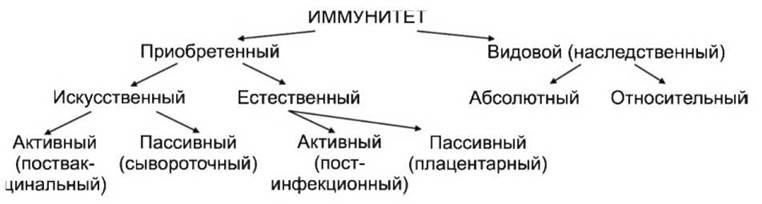
Species immunity, or genetic resistance, is the non-susceptibility of certain animal species to diseases that affect other species. Species immunity is inherited. For instance, humans are not susceptible to cattle plague or fowl cholera; conversely, animals do not contract many human diseases, such as typhoid fever, cholera, scarlet fever, and measles. Species immunity can be absolute or relative. With absolute immunity, it is impossible to induce a disease in a given animal species that is typical for another species. For example, horses possess absolute immunity to rinderpest. Relative species immunity can be compromised by changes in environmental conditions (for example, when body Temperature rises, frogs, normally insusceptible to tetanus toxin, develop a sensitivity to it).
Acquired immunity is specific and not heritable. It develops naturally As a result of an infectious disease or is artificially induced by exposing The Immune System to an antigen (e.g., through vaccination).
Natural active (post-infection) immunity emerges after an organism has suffered through an infectious disease. Following certain illnesses, it can persist throughout life.
Natural passive immunity (placental immunity) is possessed by newborns, who acquire it from the mother's immune system during prenatal development. The mother's Antibodies cross the Placenta into the fetus, which is why immunity acquired in this manner is termed placental.
Artificial active immunity (post-vaccination immunity) arises following vaccination with microbes or their metabolic products (toxins). This immunity is less durable than its natural counterpart. For example, the salmonellosis vaccine confers immunity for approximately 6 months, whereas the anthrax vaccine lasts for 1 year.
Artificial passive immunity (serum immunity) results from the Introduction of preformed protective factors — IMMUNOGLOBULINS (antibodies) harvested from another immune organism — into the body. These accumulate in the immune serum of a naturally convalescent or vaccinated animal.
13.3.1. Factors of Immunity
The means by which a macroorganism defends itself against foreign impacts are highly diverse. Both non-specific and specific mechanisms of anti-infective defense are distinguished.
Innate factors of non-specific defense include the Skin, mucosal membranes, Lysozyme, normal microflora, and phagocytosis.
Skin and mucous membranes act as mechanical barriers preventing The entry of microorganisms and other antigens into the body. Organic acids (acetic, formic, lactic, etc.) secreted by the sweat and Sebaceous Glands of the skin possess bactericidal properties. Consequently, various microorganisms rapidly disappear from the skin surface.
Lysozyme is found in large quantities in all bodily secretions, fluids, and Tissues (saliva, tears, intestinal mucus, breast milk, Blood serum, leukocytes, etc.). Lysozyme is produced by blood monocytes and tissue macrophages. It induces the lysis of many saprophytic and pathogenic Bacteria. The Mechanism of lysozyme action involves the Hydrolysis of glycosidic bonds between N-acetylglucosamine and N-acetylmuramic acid within the peptidoglycan layer of murein.
HUMAN NORMAL MICROFLORA contributes to The Development of the immune system and maintains it in a state of high activity. Many members of the normal microflora exhibit antagonistic activity against pathogenic microorganisms, preventing their colonization and proliferation within the body.
Over the course of evolution, a complex of humoral and cellular factors providing non-specific resistance to foreign substances and microbes entering the body has been formed. Humoral factors include The Complement System, interferon, transferrin, β-lysins, Fibronectin, and others. These substances are present in the blood and bodily fluids.
Phagocytosis (from Greek phago — to devour, cytos — Cell) is a vital protective reaction of the organism. This natural phenomenon was first observed in 1882 by Ilya Mechnikov.
Phagocytosis is The process of engulfing and digesting antigenic substances, including microorganisms, by specialized Cells known as phagocytes. Phagocytes capture bacteria, Fungi, and Viruses, inactivating them through a battery of Enzymes and the capacity to secrete H2O2 and other peroxide compounds that generate active oxygen.
The primary cells involved in shaping the specific Immune Response are lymphocytes. There are two types of lymphocytes: T AND B lymphocytes, which derive their names from the Organs where they mature (T lymphocytes in the Thymus, B lymphocytes in the bursa of Fabricius or the Bone Marrow). Macrophages constitute a third type of cell participating in the specific immune response. T lymphocytes are subdivided into T-helper cells, which assist in mounting the immune response; T-suppressor cells, which downregulate the Development of the immune response; and T-effector cells, which ensure the accumulation of killer cells. The principal function of B lymphocytes is to transform, upon receiving an appropriate signal, into plasma cells (plasmocytes) that secrete specific antibodies.
Antibodies provide specific protection within the body against various genetically foreign substances (Biopolymers) known as antigens. Antibodies interact with antigens to form antigen-antibody complexes. Antibodies belong to immunoglobulins (Ig). Based on structural and antigenic characteristics, immunoglobulins are divided into 5 classes: G, M, A, E, D.
The outcome of antibody-microorganism interaction includes agglutination reactions (clumping of microbes), bacterial lysis, and the neutralization of their toxins.
Specific antibodies appear in the blood, colostrum, milk, and tissue fluid after the macroorganism has undergone an infectious disease or following immunization.
Last update: 13/08/2026
Editorial and Educational Adaptation: This material has been compiled based on the primary/original source text. The project team performed an editorial review, corrected technical inaccuracies, structured sections, and adapted the content for an educational format.
What was processed:
- elimination of formatting defects (OCR errors, structural breaks, corrupted characters);
- editorial organization of content;
- standardization of terminology in accordance with academic sources;
- verification of factual statements against the original source text.
All mentions of the author, publication year, and origin of the primary text have been preserved in accordance with the source.