Molecular Biotechnology: Principles and Applications - Glick B., Pasternak J. 2002
Molecular Biotechnology of Microbial Systems
Biodegradation of Toxic Compounds and Biomass Utilization
Genetically engineered metabolic pathways for xenobiotic biodegradation
Some microorganisms possess a natural ability to degrade various xenobiotics; however, it should be kept in mind that:
1) no single microorganism can degrade all Organic compounds; 2) high concentrations of some organic compounds inhibit the function or growth of the microorganisms that degrade them; 3) most contaminated sites contain a mixture of chemicals, and a microorganism capable of degrading one or more components may be inactivated by other components; 4) many nonpolar compounds adsorb to soil particles, becoming less bioavailable; 5) biodegradation of organic compounds is often quite slow. Some of these problems can be solved by conjugative transfer of Plasmids encoding Enzymes of different Catabolic pathways into a single recipient strain (Fig. 13.5). If two plasmids contain homologous regions, recombination can occur between them to form a larger hybrid plasmid that retains The properties of both parental plasmids. If the two plasmids do not contain homologous regions and belong to different incompatibility groups, they can coexist within a single bacterium.
Plasmid transfer
In the 1970s, Chakrabarty and his colleagues created the first bacterial strain with broader catabolic capabilities. It degraded most petroleum Hydrocarbons and was dubbed the "superbug." To construct it, they used plasmids, each encoding enzymes that degrade a specific Class of hydrocarbons: plasmid CAM determined the degradation of camphor, OCT of octane, NAH of naphthalene, and XYL of xylene (Fig. 13.5). First, the CAM plasmid was transferred by conjugation into a strain carrying the OCT plasmid. These two plasmids are incompatible (they cannot coexist in a single Cell as separate plasmids), but recombination between them yields a single plasmid combining their Functions. Next, the NAH plasmid was similarly transferred into a strain carrying the XYL plasmid. These plasmids are compatible and can coexist in a single host cell. Finally, the hybrid plasmid was transferred into the strain carrying the NAH and XYL plasmids. As a result of these manipulations, a strain was obtained that grows on crude oil better than any of the original strains, either individually or combined.

Fig. 13.1. Pathways of enzymatic conversion of Aromatic Compounds to catechol by xenobiotic-degrading Bacteria.

Fig. 13.2. Pathways of enzymatic conversion of aromatic compounds to protocatechuate by xenobiotic-degrading bacteria.

Fig. 13.3. The ortho-Cleavage pathway during the enzymatic conversion of catechol and protocatechuate to acetyl-CoA and succinate.
Although this strain itself was not used for oil spill cleanup, it played a crucial role in the ESTABLISHMENT OF THE biotechnology industry. The inventor of the "superbug" was granted a US patent describing The Structure of this strain and its potential Applications. This was the first patent issued for a genetically modified microorganism and upheld by the US Supreme Court, demonstrating that biotechnology companies could protect their inventions in the same way as chemical and pharmaceutical companies.

Fig. 13.4. The meta-cleavage pathway during the enzymatic conversion of catechol and protocatechuate to Pyruvate and acetaldehyde.
Most xenobiotic-degrading bacteria modified by plasmid transfer are mesophilic microorganisms (growing well at 20–40 °C), whereas Water temperatures in polluted rivers, lakes, and oceans typically range from 0 to 20 °C.
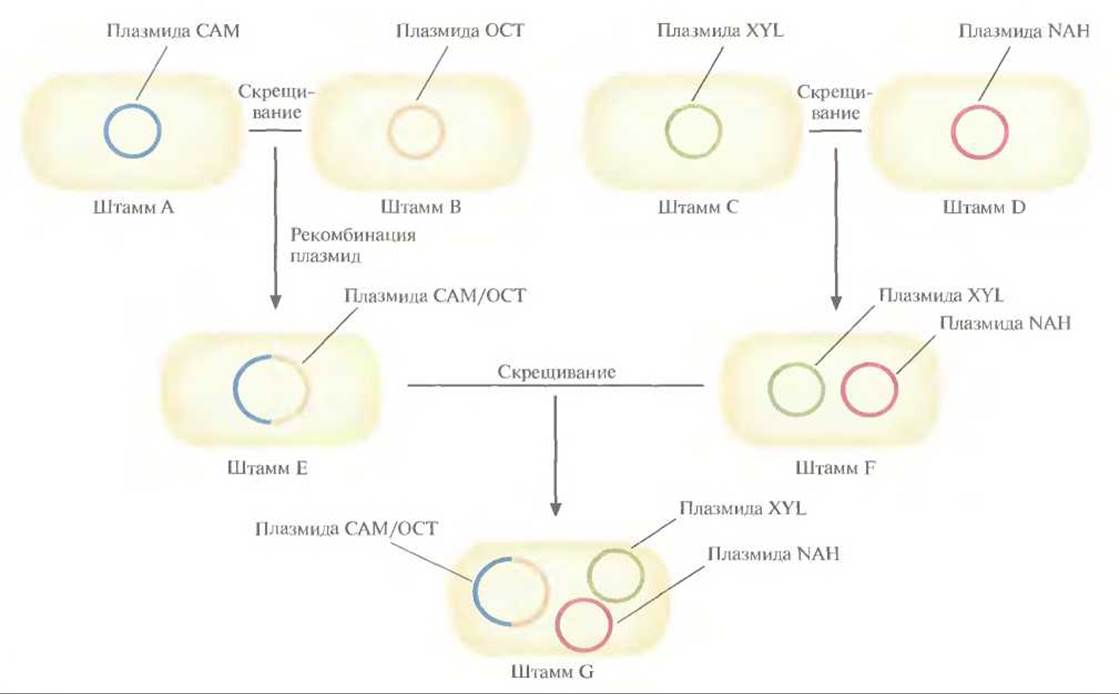
Fig. 13.5. Construction of a bacterial strain capable of degrading camphor, octane, xylene, and naphthalene. Strain A, carrying the CAM plasmid (which determines camphor degradation), is crossed with strain B, carrying the OCT plasmid (octane degradation). This produces strain E, which contains a hybrid plasmid formed by Homologous Recombination between the parental plasmids and possessing the functions of both. Strain C, containing the XYL plasmid (xylene degradation), is crossed with strain D, containing the NAH plasmid (naphthalene degradation), to yield strain F, which carries both of these plasmids. Finally, strains E and F are crossed, resulting in strain G, which contains the CAM/OCT, XYL, and NAH plasmids.
To test whether a bacterium could be engineered to possess broader catabolic capabilities while remaining capable of GROWTH AND DEVELOPMENT at low temperatures, the TOL plasmid (determining toluene degradation) from a mesophilic Pseudomonas putida strain was transferred via conjugation into a psychrophilic (low Temperature optimum) strain that utilizes salicylate at temperatures near 0 °C. The transformed strain contained the introduced TOL plasmid and its own SAL plasmid, which determines salicylate degradation, and was capable of utilizing both salicylate and toluene as sole carbon sources at 0 °C (Table 13.2). The wild-type (untransformed) psychrophilic strain could not grow at any temperature when toluene (toluate) was the sole carbon source. This work demonstrated the feasibility of creating psychrophilic bacterial strains that effectively degrade xenobiotics under natural conditions, though additional research is required for their practical development.
Gene modification
Combining different Metabolic Pathways in a single microorganism via conjugation is only one way to engineer bacteria with novel properties. Their catabolic capabilities can also be expanded by modifying the genes encoding the enzymes of a particular metabolic pathway. The feasibility of this approach was tested using plasmid pWWO, which contains 12 genes encoding the meta-cleavage of toluene and xylene. Pseudomonas strains carrying this plasmid can use alkylbenzoates as a carbon source (Fig. 13.6). These genes are part of a single xyl Operon controlled by the Pm promoter. The transcriptional activity of this promoter is positively regulated by the product of the xylS gene, which is activated by almost all substrates of this metabolic pathway (e.g., benzoate and 3-methylbenzoate) (Fig. 13.6). Detailed biochemical and genetic analysis revealed that bacteria carrying the pWWO plasmid can degrade 4-ethylbenzoate only to 4-ethylcatechol, which inactivates catechol 2,3-dioxygenase (the product of the xylE gene, one of the Key Enzymes of this pathway); thus, it is not degraded and accumulates in the medium. Furthermore, unlike other alkylbenzoates, 4-ethylbenzoate does not activate the XylS protein; therefore, if it is the sole substrate, the xyl operon is not transcribed. To improve The Natural System for the meta-cleavage of alkylbenzoates, two main challenges must be addressed: 1) prevent the inactivation of catechol 2,3-dioxygenase by 4-ethylbenzoate; and 2) induce METABOLISM/31.html">Transcription of the xyl operon genes when 4-ethylbenzoate is the sole substrate.
Table 13.2. Generation times of wild-type and transformed psychrophilic P. putida strains utilizing salicylate or toluate as the sole carbon source at different temperatures1)
|
Temperature, °C |
Generation time, h |
||
|
wild-type strain, salicylate2) |
transformed strain, salicylate |
transformed strain, toluate |
|
|
37 |
No growth |
No growth |
No growth |
|
30 |
2,2 |
2,5 |
2,0 |
|
25 |
2,1 |
3,2 |
1,3 |
|
20 |
2,6 |
3,8 |
1,9 |
|
15 |
3,2 |
4,2 |
2,9 |
|
10 |
6,3 |
5,6 |
3,3 |
|
5 |
13,9 |
12,9 |
12,2 |
|
0 |
18,6 |
18,1 |
24,4 |
1) Modified from Koletic et al., Appl. Environ. Microbiol. 54: 638-641, 1988.
2) The wild-type strain cannot utilize toluate at any temperature because it lacks the necessary enzymes.
To address the second challenge, a search for a mutant plasmid was conducted. For this purpose, a tetracycline resistance gene under the control of the Pm promoter was inserted into a plasmid carrying an ampicillin resistance gene. The xylS gene was cloned into another plasmid carrying a kanamycin resistance gene. E. coli Cells were transformed with these constructs, and cells containing both plasmids were selected based on ampicillin and kanamycin resistance (Fig. 13.7, A). These cells were then treated with the mutagen ethyl methanesulfonate and grown on a medium containing tetracycline and 4-ethylbenzoate. Cells growing on this medium contain a mutant xylS gene and produce an altered XylS protein (S*) capable of interacting with 4-ethylbenzoate and activating transcription of the tetracycline resistance gene. To resolve the inactivation of catechol 2,3-dioxygenase, the mutant xylS gene was cloned into a broad-host-range plasmid carrying a kanamycin resistance gene and introduced into P. putida cells containing the pWWO plasmid (Fig. 13.7, B). The transformed cells were plated at high density on minimal medium plates containing 4-ethylbenzoate as the sole carbon source, kanamycin to select for plasmid-bearing cells, and ethyl methanesulfonate. Cells growing on this medium produce an altered catechol 2,3-dioxygenase that is not inhibited by 4-ethylcatechol. Additional analysis confirmed that a mutation had indeed occurred in the pWWO catechol 2,3-dioxygenase gene, and that the two mutant genes (xylS and the catechol 2,3-dioxygenase gene) enable the degradation of 4-ethylbenzoate.

Fig. 13.6. The meta-cleavage pathway of toluene and xylene and the xyl operon of plasmid pWWO. The xyl operon is controlled by the Pm promoter, which is regulated by the xylS gene product, which in turn is activated by one of the starting substrates. The xylX–xylH genes are under the control of the Pm promoter. The xylS gene is not part of the operon and is expressed constitutively. The starting substrate can be benzoate (R and R' are H), 3-methylbenzoate (R is H, R' is СН3), 3-ethylbenzoate (R is H, R' is СН2СН3), and 4-methylbenzoate (R is СН3, R' is H). The xylXYZ genes encode toluene dioxygenase, xylL encodes dihydroxycyclohexadiene carboxylate dehydrogenase, xylE encodes catechol 2,3-dioxygenase, xylF encodes hydroxymuconic semialdehyde hydrolase, xylG encodes hydroxymuconic semialdehyde dehydrogenase, xylH encodes 4-oxalocrotonate tautomerase, xyll encodes 4-oxalocrotonate decarboxylase, xylJ encodes 2-oxopent-4-enoate hydratase, and xylK encodes 2-oxo-4-hydroxypentanoate aldolase.
Both modified genes are involved in the degradation of all substrates in this metabolic pathway. Therefore, the strategy used to increase the efficiency of 4-ethylbenzoate cleavage is also applicable to Other Compounds: a mutation leading to overproduction of the XylS protein can enhance the activation of the Pm promoter and increase The rate of substrate degradation; in addition, the Pm promoter can be selectively modified to make it stronger while retaining its ability to interact with the XylS protein. Thus, this work demonstrates that it is entirely feasible to improve a given catabolic pathway using Recombinant DNA technology, traditional mutagenesis, and appropriate Selection Methods.
One of the most common soil and water pollutants is trichloroethylene, which is widely used as a solvent and degreasing agent. It persists in the environment for a long time and is considered a carcinogen. In addition, anaerobic soil bacteria can dehalogenate it, converting it into the even more toxic compound vinyl chloride. It has been shown that some strains of P. putida that degrade aromatic compounds, such as toluene, also degrade trichloroethylene. Genetic studies have established that the complete detoxification of trichloroethylene does not require all the Enzymes of the toluene and xylene meta-cleavage pathway; toluene dioxygenase, which normally catalyzes The oxidation of toluene to cis-toluene dihydrodiol, is sufficient.

Fig. 13.7. A. Construction of a system for the Synthesis of the XylS protein activated by 4-ethylbenzoate. First, the promoter of the tetracycline resistance gene in plasmid pBR322 is replaced with the Pm promoter to obtain plasmid pJLR200. Then, the xylS gene with its own promoter is inserted into a broad-host-range plasmid carrying a kanamycin resistance gene. E. coli is transformed with the resulting plasmids. Transformed cells are selected for ampicillin and kanamycin resistance and subjected to mutagenesis with ethyl methanesulfonate. In cells carrying the mutant xylS gene (S*), the XylS protein is activated by 4-ethylbenzoate (EB), which in turn activates the Pm promoter, allowing them to grow on a medium containing 4-ethylbenzoate and tetracycline.

Fig. 13.7. (Continued) B. Construction of a system for the synthesis of a modified catechol 2,3-dioxygenase that is not inhibited by 4-ethylcatechol. A P. putida strain carrying plasmid pWWO is transformed with a broad-host-range plasmid containing the mutant xylS* gene, whose product activates the Pm promoter. Chemical mutagenesis of the transformed cells is performed, and they are grown on a minimal medium containing 4-ethylbenzoate and kanamycin. Cells growing on this medium contain a mutant catechol 2,3-dioxygenase gene (mutation X in the middle of the xyl operon).
The formation of functional toluene dioxygenase is encoded by four genes (Fig. 13.8, A). These were isolated and expressed in E. coli under the control of a strong inducible tac promoter activated by isopropyl-β-D-thiogalactopyranoside (IPTG), resulting in the degradation of trichloroethylene to harmless compounds. The initial rate of trichloroethylene degradation in E. coli is lower than in P. putida, but it persists longer in E. coli. This difference may be related to the lower sensitivity of E. coli compared to P. putida to the damaging effects of trichloroethylene. In one variation of this experiment, a recombinant Pseudomonas strain was constructed that combined elements of two different catabolic pathways. Bacterial strains capable of degrading biphenyl contain biphenyl dioxygenase. This enzyme complex consists of a two-subunit terminal dioxygenase, ferredoxin, and ferredoxin reductase. In Structure and function, biphenyl dioxygenase is similar to toluene dioxygenase; however, biphenyl-utilizing pseudomonads cannot grow on toluene, and toluene-utilizing strains do not grow on biphenyl. After replacing the bphA1 gene encoding the large subunit of biphenyl dioxygenase in P. putida strain KF715 with the todC1 gene encoding the large subunit of toluene dioxygenase from P. putida strain F1 via homologous recombination, a strain capable of efficiently degrading trichloroethylene was obtained (Table 13.3). Furthermore, this strain grows on many aromatic compounds, suggesting the possibility of creating microorganisms capable of degrading several different compounds simultaneously.

Fig. 13.8. A. Cloned toluene dioxygenase operon under the control of the E. coli tac promoter. The formation of toluene dioxygenase is mediated by four genes (todA, todB, todC1, and todC2). The todA gene encodes a flavoprotein that accepts electrons from reduced nicotinamide adenine dinucleotide (NADH) and transfers them to ferredoxin. The latter is encoded by the todB gene and reduces the terminal dioxygenase encoded by the todC1 and todC2 genes. These genes are equivalent to the xylXYZ genes in Fig. 13.6, B. Conversion of toluene to cis-toluene dihydrodiol by the joint action of Tod Proteins.
Last update: 12/08/2026
Editorial and Educational Adaptation: This material has been compiled based on the primary/original source text. The project team performed an editorial review, corrected technical inaccuracies, structured sections, and adapted the content for an educational format.
What was processed:
- elimination of formatting defects (OCR errors, structural breaks, corrupted characters);
- editorial organization of content;
- standardization of terminology in accordance with academic sources;
- verification of factual statements against the original source text.
All mentions of the author, publication year, and origin of the primary text have been preserved in accordance with the source.