BIOTECHNOLOGY - V. H. Herasymenko - 2006
Part II. Special Biotechnologies
Chapter 13. BIOTECHNOLOGY OF INTERFERON PRODUCTION
13.3. GENETIC ENGINEERING METHOD FOR PRODUCING INTERFERONS
Developing a biotechnology for interferon production is a complex, multi-stage process. Experiments on transferring human interferon genes into bacterial Cells began in late 1977 and early 1978, almost simultaneously by research groups in Switzerland, Japan, the USA, and the Soviet Union. However, at the onset of these studies, The Structure of the interferon protein was unknown, precluding the Chemical synthesis of the Gene. Furthermore, within the pool of mRNA molecules encoding various Proteins, the proportion of interferon mRNA was extremely low—approximately 0.1%—which significantly hindered its isolation. To clone the interferon gene, all researchers utilized the reverse METABOLISM/31.html">Transcription method applied to interferon mRNA. Within a short period (1979–1982), the genes for leukocyte, fibroblast, and immune interferons were successfully cloned in E. coli. Sufficient data regarding the structure of interferons and their genes were thus obtained. It was established that interferons are initially synthesized as precursors containing a signal peptide at the N-terminus of the polypeptide chain. This signal peptide is subsequently cleaved off, yielding the mature interferon, which exhibits full biological activity.
The first gene to be cloned was that of fibroblast interferon as part of a hybrid plasmid in E. coli cells (Japan, 1979). Nucleotide sequence analysis revealed that β-interferon is synthesized within The Cell as a precursor polypeptide consisting of 187 Amino Acids, known as pre-interferon. During the secretion of pre-interferon from the cell, a 21-amino-acid signal peptide is cleaved off, leaving mature β-interferon with 166 amino acids.
In 1980 and 1982, the genes for α- and γ-interferons were cloned, respectively. The polypeptide chains of the pro-interferons consist of 189 and 166 amino acid residues, while the mature interferons contain 166 and 146 amino acids. The signal peptides comprise 23 and 20 amino acids, respectively.
In the former Soviet Union, the first successful cloning of the leukocyte interferon gene was accomplished in 1982 (Y. A. Ovchinnikov et al.), the fibroblast interferon gene in 1983 (Y. I. Kozlov et al.), and the immune interferon gene in 1985 (E. D. Sverdlov et al.).
Construction of Interferon-Producing Strains. Gene Obtention Technology. This is a highly complex and multi-stage process. Most frequently, the interferon gene is obtained via reverse transcription—transferring Genetic information from an mRNA template to a Introduction/20.html">DNA Structure (Fig. 13.1). A leukocyte suspension isolated from donor Blood is treated with Sendai virus, which induces interferon Biosynthesis. The mRNA molecules carrying The Genetic Code for interferon synthesis are extracted from these cells. Using Reverse Transcriptase Enzymes (revertases), single-stranded complementary DNA (cDNA) copies are synthesized using the mRNA template, forming a DNA-RNA hybrid complex. In the next step, the single-stranded cDNA is separated from the DNA-RNA Structure, and a second complementary DNA strand is synthesized on it to yield double-stranded DNA (the gene). To ensure complementary sticky ends in the synthesized cDNA, chemically synthesized DNA segments featuring sticky ends, known as linkers, are attached to them.
In addition to the structural gene, the isolated interferon gene includes a promoter region, an operator, and a ribosome-binding site (for initiating Protein Synthesis), comprising a total of nearly 1,200 NUCLEOTIDES.
In the former Soviet Union and Great Britain, the difficulties associated with isolating the interferon gene were overcome through an alternative approach. The interferon gene was synthesized chemically by sequentially joining individual nucleotides. A large molecule of such an artificial gene, consisting of 514 nucleotides, was assembled from 8 separately synthesized fragments. This endeavor required as much time as isolating the natural interferon gene.
The genes for α-interferons can be extracted directly from The Human Genome because they lack introns.
Expression of Interferon Genes in Cells. To obtain the substantial quantities of homogeneous interferon preparations required for widespread clinical use and scientific research, numerous successful attempts have been made to create producer strains based on various microorganisms.
Class="center">
Fig. 13.1. Scheme of human Interferon Gene cloning
(according to V. G. Debabov and V. A. Livshits, 1988)
The largest volume of work was carried out using the bacterium E. coli.
To ensure the synthesis of a foreign protein (in this specific case, interferon) within a bacterium, it is necessary to: 1) introduce the gene for this protein into a vector bacterial DNA, such as a plasmid; 2) attach bacterial regulatory elements to this gene to program its transcription and Translation in the bacterium.
The introduction of the interferon gene into a plasmid isolated from E. coli is performed similarly to that of the Insulin or somatotropin genes. The ends of the cDNA and the plasmid are treated with a restriction endonuclease (restriction enzyme), linearizing the plasmid and creating sticky ends. This allows the cDNA to be ligated to the plasmid using DNA ligase, forming a circular recombinant plasmid containing the synthesized cDNA with the gene that encodes interferon biosynthesis. Subsequently, the recombinant plasmid is introduced into the bacterial cell.
The expression of any eukaryotic gene for protein production requires utilizing the structural portion of the gene combined with appropriate nucleotide sequences that are recognized by host cell enzymes as efficient transcription and Translation initiation signals (Fig. 13.2). For the expression of interferon genes in E. coli cells, the regulatory elements of the Tryptophan (trp) and lactose (lac) operons are widely employed.
Another challenging process is the isolation of interferon accumulated within the bacterial cell. Escherichia coli is incapable of secreting proteins, meaning the target protein must be extracted and purified from the bulk of bacterial proteins. This is achieved using Monoclonal Antibodies against interferon—specifically, IMMUNOGLOBULINS that bind exclusively to α-interferon. These antibodies are immobilized on polysaccharide beads through which a protein mixture is passed. As a result, the interferon is captured by the antibodies and retained on the beads. It is then eluted to yield a purified product up to 5,000 times purer than the starting material. Through such a complex, multi-stage process, a productive E. coli producer strain was developed in the former Soviet Union: 1 liter of this bacterial suspension yielded over 10 mg of α-interferon, which is 5,000 times more than what could be obtained from 1 liter of donor blood.
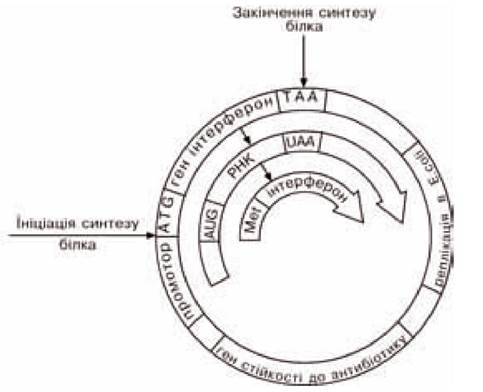
Fig. 13.2. Scheme of the recombinant plasmid encoding the synthesis of human interferon in E. coli
(according to V. G. Debabov, V. A. Livshits, 1988)
Bacteria containing such a plasmid synthesize interferon and are resistant to Antibiotics
Other classes of interferons—specifically β and γ—are currently produced in a similar manner, along with hybrid interferons composed of molecular halves derived from different interferons.
However, interferon synthesized in bacteria lacks the essential carbohydrate groups normally attached to the protein, meaning it is unglycosylated. This occurs because Prokaryotic Cells lack the requisite glycosylation enzymes.
In 1981, leukocyte interferon was synthesized in the USA using genetically engineered Yeast cells. Subsequently, β- and γ-interferons were obtained using this same approach. When incorporated into recombinant DNA and introduced into yeast cells (most commonly Saccharomyces cerevisiae), the genes encoding these interferons enable a tenfold increase in interferon biosynthesis compared to bacterial systems. Furthermore, within the yeast
cell, the interferon undergoes proper glycosylation. In addition to yeast, higher Eukaryotic cells are also employed to produce glycosylated interferons.
Today, α-, β-, and γ-interferons are successfully produced using genetically engineered strains of E. coli, yeast, and cultured insect (Drosophila) and mammalian cells. For The production of γ- and β-interferons, eukaryotic host systems are preferred because prokaryotes do not glycosylate proteins. Some companies, such as Bioferon, utilize cultured human fibroblasts *in vitro* rather than genetically engineered mutants.
Last update: 11/08/2026
Editorial and Educational Adaptation: This material has been compiled based on the primary/original source text. The project team performed an editorial review, corrected technical inaccuracies, structured sections, and adapted the content for an educational format.
What was processed:
- elimination of formatting defects (OCR errors, structural breaks, corrupted characters);
- editorial organization of content;
- standardization of terminology in accordance with academic sources;
- verification of factual statements against the original source text.
All mentions of the author, publication year, and origin of the primary text have been preserved in accordance with the source.