Principles of Biochemistry Volume 1 - A. Lehninger 1985
Biomolecules
Cells
Escherichia coli is the most well-known prokaryotic cell
Escherichia coli (Fig. 2.4) is a typical nonpathogenic bacterium that inhabits the gastrointestinal tract of humans and many higher animals. This bacterium is the most thoroughly studied of all prokaryotic, and perhaps any other, Cells. E. coli cells are about 2 µm long and slightly less than 1 µm in diameter. E. coli cells are protected by a Cell wall, lined on the inside by a thin cell membrane that encloses the Cytoplasm and the nuclear body (nucleoid), which contains a single molecule of double-stranded DNA in the form of a very long closed loop, often referred to as a ring. The E. coli DNA molecule is nearly 1000 times longer than The Cell itself and, therefore, must be very tightly packed to fit inside the nucleoid, which is no more than 1 µm long. As in all other prokaryotes, the genetic material in E. coli is not enclosed by a membrane. In addition to the main DNA molecule located in the nucleoid, the cytoplasm of most Bacteria contains very
Class="center">
Fig. 2-4. Two images of E. coli cells. A. Electron micrograph of a thin section.
In the center, two cells are visible that have just completed division but have not yet separated.
The light areas in the center of each cell are nuclear bodies, or nucleoids, containing DNA. The very dark granules in the cytoplasm are Ribosomes. B. Electron micrograph of The surface of E. coli cells, showing pili and flagella.
small circular DNA fragments called Plasmids. As we will see later, The Study of these semi-independent genetic elements, which are not linked to the main DNA molecule, has led to major new advances in genetic biochemistry and engineering today.
The outer cell wall of E. coli is covered by a sheath, or capsule, of a slimy substance. Short, Hair-like structures called pili, whose function is not yet fully understood, project outward through the sheath. Strains of E. coli and other motile bacteria also possess one or more long flagella, which act as propellers for movement in an aqueous environment. Bacterial flagella are thin, rigid, Curved Rods with a cross-section of 10-20 nm. They are attached to a Structure on the inner side of the membrane resembling an automatic transmission, which drives the Rotation of the flagella. The cell membrane is a very thin double layer (bilayer) of lipid molecules interspersed with Proteins. The cell membrane is selectively permeable and contains proteins capable of transporting nutrients into the cell and waste products out of the cell into the external environment. The cell membrane of most prokaryotes also contains important electron-transport proteins that convert the energy of oxidative processes into the chemical energy of ATP. The internal membranes of photosynthetic bacteria, derived from The Plasma Membrane, contain chlorophyll and other photosensitive pigments (Fig. 2-5).
A number of granular structural elements are found in the cytoplasm of E. coli. The most prominent of these are the intensely staining ribosomes, which in prokaryotes have a diameter of about 18 nm. Ribosomes, composed of ribonucleic acid and numerous protein molecules, carry out the synthesis of cellular proteins. Ribosomes often cluster into groups called polyribosomes, or Polysomes. The cytoplasm of many bacteria also contains granules containing stored nutrients: in some cases, these are starch, and in others, Lipids. The Cytosol—the aqueous phase of the cytoplasm—contains dissolved Enzymes, molecules that serve as building blocks and precursors of macromolecules, as well as various inorganic salts.
Even in a simple bacterium, we see a primitive division of labor within the cell. The cell wall serves as a boundary barrier that protects the cell. The cell membrane transports nutrients into the cell and waste products out of it, and also stores chemical energy in the form of ATP. A variety of enzymatic reactions take place in the cytoplasm, leading to The formation of many cellular components; ribosomes produce proteins, and the nuclear body is involved in storing and transmitting Genetic information.
Although prokaryotes are relatively simple and small compared to Eukaryotic cells, some are capable of remarkably complex activities. For example, many bacteria exhibit chemotaxis. Certain chemical compounds, especially nutrients, are attractive to these bacteria, and in their presence, the bacteria move toward them; conversely, toxic substances repel the bacteria, causing them to move in the opposite direction. Thus, bacteria possess a primitive sensory system that transmits signals to their flagella, allowing the cells to move either toward a particular attractant or away from a repellent (Fig. 2-6). Bacteria also possess a primitive memory.

Fig. 2-5. Electron micrograph of the blue-green alga (or cyanobacterium) Anabaena azollae. Numerous internal membranes are formed from the plasma membrane; they contain chlorophyll and other Photosynthetic Pigments. Cyanobacteria often associate with one another to form long chains or filaments.
The cells of some prokaryotic species tend to aggregate into groups or arrange themselves in filaments. Such formations give the impression of primitive Multicellular Organisms; however, it is known that true multicellular organisms consist only of eukaryotic cells.
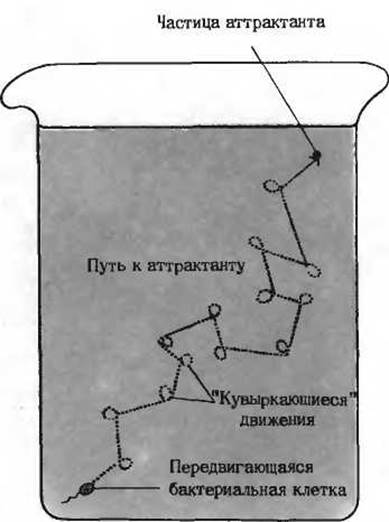
Fig. 2-6. Chemotaxis in bacteria. Motile bacteria can sense slight concentration gradients and "swim" toward attractants such as nutrients. Using one or more flagella, the cell moves along straight paths punctuated by "tumbling" motions. The bacterium moves toward an attractant (or away from a repellent) not in a straight line, but along a winding path.
Last update: 06/08/2026
Editorial and Educational Adaptation: This material has been compiled based on the primary/original source text. The project team performed an editorial review, corrected technical inaccuracies, structured sections, and adapted the content for an educational format.
What was processed:
- elimination of formatting defects (OCR errors, structural breaks, corrupted characters);
- editorial organization of content;
- standardization of terminology in accordance with academic sources;
- verification of factual statements against the original source text.
All mentions of the author, publication year, and origin of the primary text have been preserved in accordance with the source.