Principles of Biochemistry Volume 1 - A. Lehninger 1985
Biomolecules
Cells
Prokaryotes are the simplest and smallest cells
Prokaryotes include about 3,000 species of Bacteria, including organisms commonly referred to as blue-green Algae. Blue-green algae constitute a distinct family of bacteria; their modern and preferred name is cyanobacteria ("cyano" means blue). The unique status of cyanobacteria is due to their oxygen-evolving photosynthetic system, which is highly similar to the photosynthetic system of higher green plants. Some other classes of bacteria can also perform Photosynthesis, but they do not evolve oxygen. Most bacterial species are incapable of photosynthesis and obtain energy by breaking down nutrients from the environment. There are 20 different families of prokaryotes, whose Classification and names are based on their appearance (Fig. 2-3), as well as their motility, staining properties, utilization of specific nutrients, and Synthesis of specific products. Some bacteria possess pathogenic (disease-causing) properties, but most are highly beneficial. Prokaryotes also include families of very small Cells that typically parasitize inside other cells.
Class="center">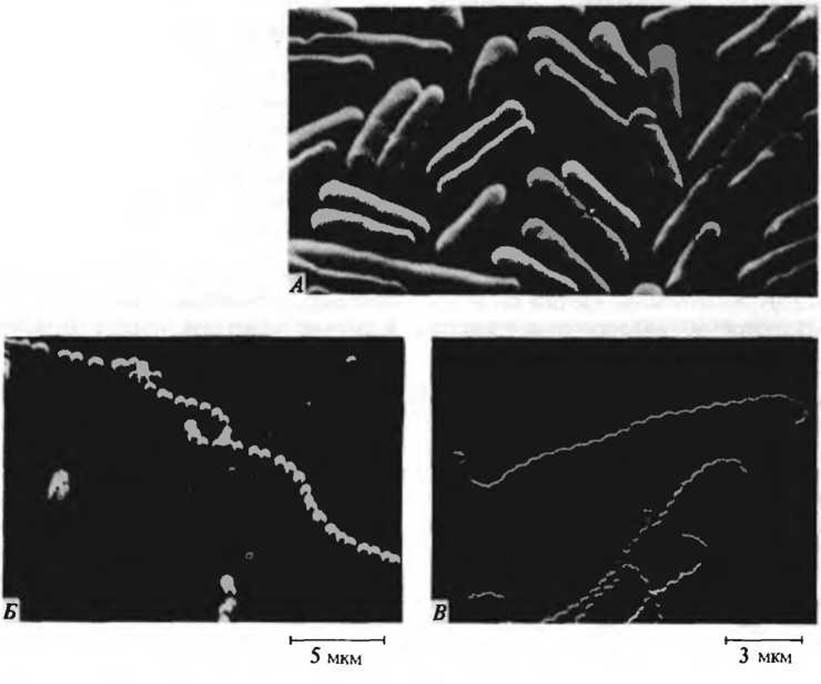
Fig. 2-3. The classification and names of some prokaryotes are based on their appearance. A. Bacilli are rod-shaped microorganisms, which include Escherichia coli, as well as pathogenic microbes that cause diphtheria, tetanus, and tuberculosis. B. Cocci are spherical bacteria. Sometimes they group together to form pairs (diplococci), clusters (staphylococci), or chains (streptococci; shown in this figure). Cocci include bacteria that cause scarlet fever, certain types of Pneumonia, and wound infections. C. Spirochetes are spiral-shaped, often very long (up to 500 µm) bacteria. The figure shows bacteria ranging from 10 to 15 µm in length. This class of microorganisms includes the CAUSATIVE AGENT OF Syphilis.
Although Prokaryotic Cells are invisible to the naked eye and less familiar to us than higher animals and plants, they constitute a highly significant portion of the Earth's biomass. Probably three-quarters of all living matter on Earth consists of microorganisms, the majority of which are prokaryotes. Furthermore, prokaryotes play a crucial role in the biological transformations of matter and energy on Earth. Photosynthetic bacteria, living in both freshwater and marine environments, absorb solar energy and use it to synthesize CARBOHYDRATES and other cellular components, which in turn serve as food for other organisms. Some bacteria can fix molecular nitrogen (N2) from the atmosphere, forming biologically useful nitrogen-containing compounds. Thus, prokaryotes serve as the starting point for many food chains in the biosphere. In addition, prokaryotes function as decomposers, as various bacteria break down organic structures in dead plants and animals, thereby returning the End products of decomposition to the atmosphere, soil, and seas, where they are reused in the biological cycles of carbon, nitrogen, and oxygen.
Prokaryotic cells are of exceptional value for research in biochemistry and molecular biology because they are structurally simple, can be easily and rapidly grown in large quantities, and have relatively simple mechanisms of reproduction and genetic transmission. Under optimal conditions at 37°C in a simple nutrient medium containing glucose, ammonium salts, and inorganic substances, bacteria divide every 20–30 min. Another important feature of prokaryotic cells is their ability to reproduce in a very simple, asexual manner. Cells grow until they double in size, then divide into two identical daughter cells, each receiving one of the two copies of the parent Cell's genetic material (DNA). Prokaryotic cells contain only a single chromosome, which is a double-stranded DNA molecule. Furthermore, genetic mutants of prokaryotes can be easily induced and then cultured. Thanks to all these properties, bacteria have played a major role in shaping our understanding of the fundamental molecular processes that mediate the transmission of Genetic information.
Last update: 06/08/2026
Editorial and Educational Adaptation: This material has been compiled based on the primary/original source text. The project team performed an editorial review, corrected technical inaccuracies, structured sections, and adapted the content for an educational format.
What was processed:
- elimination of formatting defects (OCR errors, structural breaks, corrupted characters);
- editorial organization of content;
- standardization of terminology in accordance with academic sources;
- verification of factual statements against the original source text.
All mentions of the author, publication year, and origin of the primary text have been preserved in accordance with the source.