Principles of Biochemistry Volume 1 - A. Lehninger 1985
Biomolecules
Cells
There are two major classes of cells: prokaryotic and eukaryotic
The simplest and smallest Cells of the most ancient origin are called prokaryotes; they are represented by various species of single-celled microorganisms, the Bacteria. Prokaryotes were the first cells to arise during biological evolution: fossil remains of these cells, dating back more than 3 billion years (3 ∙ 109), have been found in ancient shales in Africa (Fig. 2-2) as well as in Australia. Eukaryotic cells, which probably arose about 1 billion years later than prokaryotes, are characterized by much larger sizes, a more complex Organization, extraordinary diversity, and the capacity for differentiation. All Multicellular animals, plants, and Fungi are composed of these cells.
Class="center">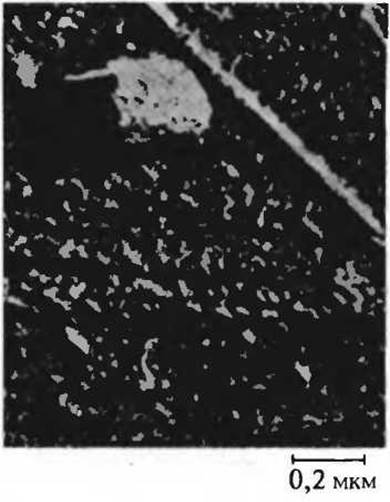
Fig. 2-2. This bacterium-like microfossil, found in South Africa during excavations of siliceous rock deposits known as 'black chert', is about 3.4 billion years old. One of the oldest fossils currently known, it has been named Eobacterium isolarum, which means 'the solitary bacterium at the dawn (of life)'.
The short straight line under this and all subsequent electron micrographs represents the scale; 1 µm is 1/10000 cm.
The terms 'prokaryote' and 'eukaryote' are derived from the Greek word karyon ('nut' or 'kernel', i.e., Nucleus). Prokaryote means 'before nucleus', and eukaryote means 'with a well-defined nucleus'. In a Introduction/4.html">Prokaryotic Cell, the genetic material is localized in a rather poorly defined, non-membrane-bounded nuclear body, or nucleoid. A Eukaryotic Cell, by contrast, contains a highly organized, very complex nucleus surrounded by a nuclear envelope consisting of two membranes. Let us now consider prokaryotic and eukaryotic cells in somewhat greater detail.
Last update: 06/08/2026
Editorial and Educational Adaptation: This material has been compiled based on the primary/original source text. The project team performed an editorial review, corrected technical inaccuracies, structured sections, and adapted the content for an educational format.
What was processed:
- elimination of formatting defects (OCR errors, structural breaks, corrupted characters);
- editorial organization of content;
- standardization of terminology in accordance with academic sources;
- verification of factual statements against the original source text.
All mentions of the author, publication year, and origin of the primary text have been preserved in accordance with the source.