Medical Genetics - V. M. Zaporozhan 2005
Introduction to Medical Genetics
Molecular Basis of Heredity
Structure and Functions of DNA
The Molecular Basis of Heredity is formed by Nucleic Acids—DNA and RNA (in some Viruses).
DNA is a polymer whose monomer is a nucleotide. Each nucleotide consists of a phosphoric acid residue, a monosaccharide (pentose) deoxyribose, and one of four nitrogenous bases: adenine (A), thymine (T), cytosine (C), or guanine (G). Adenine and guanine are purine derivatives, while thymine and cytosine are pyrimidine derivatives. The sequence of nitrogenous bases in the DNA chain determines the hereditary information encoded within its molecule. NUCLEOTIDES are joined into a chain by covalent (phosphodiester) bonds between the phosphate group of one nucleotide and the deoxyribose of the next. The carbon atoms in deoxyribose are numbered; the 5' C of one nucleotide and the 3' C of another are involved in forming the internucleotide bond. This determines the polarity of the DNA chain (Fig. 1.1): one end of the chain has a free 5' phosphate group, and the other has a 3' hydroxyl group.
A DNA molecule contains two polynucleotide chains that form a double helix. The nitrogenous bases of the nucleotides are oriented toward the interior of the helix and are bound together by Hydrogen Bonds according to THE PRINCIPLE OF complementarity, i.e., strict base pairing (A–T; G–C). There are 2 hydrogen bonds between A and T, and 3 between G and C. The strands in a DNA molecule are antiparallel: one strand runs in the 5'-3' direction along the axis, while the other runs in the 3'-5' direction.
Since the enzyme DNA polymerase can only extend a polynucleotide chain by adding nucleotides to the 3' end, DNA nucleotide sequences are conventionally written with the 5' end on the upper-left strand, designating the beginning of the molecule.
Class="center">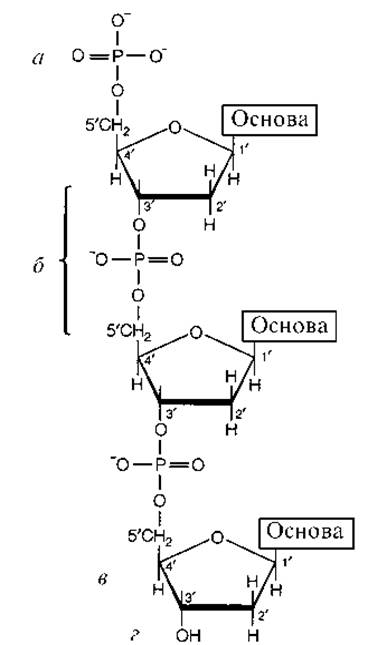
Fig. 1.1. Structure of a DNA polynucleotide chain fragment:
a — free phosphate group at the 5' end; b — phosphodiester bond; c — deoxyribose; d — free hydroxyl group at the 3' end
(5') ATGTTACAGGGC (3')
(3') TACAATGTCCCG (5')
The DNA helix is right-handed in most cases, with a diameter of 2 nm. Each turn of the helix contains 10 Base Pairs, and the length of a full turn is 3.4 nm. Major and minor grooves can be distinguished between the turns along the axis of the molecule. Within these grooves, regulatory Proteins can interact with specific DNA nucleotide sequences (Fig. 1.2).
The double-stranded complementary structure provides DNA with several essential properties.
1. The ability of the molecule to self-duplicate (Replication). The two strands separate, and a complementary strand is synthesized along each. The formation of two identical molecules ensures the transmission of hereditary information from the mother Cell to daughter Cells during division (Fig. 1.3).
2. The ability to undergo Denaturation and renaturation. Upon changes in Temperature or The chemical composition of the medium, the molecule can separate into two strands (denaturation, or melting), and upon return to physiological conditions, the double-stranded structure spontaneously restores (renaturation, or annealing). In this process, complementary single-stranded regions find each other due to the principle of complementarity. The ability of DNA to undergo denaturation and renaturation is widely used in modern molecular genetic research.
3. The ability to undergo repair—the restoration of damage that occurs within the molecular structure.

Fig. 1.2. DNA double helix: a — sugar-phosphate backbone; b — minor groove; c — major groove; d — nitrogenous bases; e — hydrogen bonds between bases
DNA is localized in the Cell Nucleus as part of Chromosomes, as well as in Mitochondria (less than 1% in humans).
The primary function of DNA is the storage of hereditary (genetic) information. Hereditary information is the data regarding The structure of all proteins and RNAs in an Organism, as well as the order of their expression during ontogenesis. The DNA molecule ensures the transmission of Genetic information to daughter cells through its capacity for replication. It also participates in the realization of hereditary information by serving as a template for RNA Synthesis and regulating its production.
Last update: 11/08/2026
Editorial and Educational Adaptation: This material has been compiled based on the primary/original source text. The project team performed an editorial review, corrected technical inaccuracies, structured sections, and adapted the content for an educational format.
What was processed:
- elimination of formatting defects (OCR errors, structural breaks, corrupted characters);
- editorial organization of content;
- standardization of terminology in accordance with academic sources;
- verification of factual statements against the original source text.
All mentions of the author, publication year, and origin of the primary text have been preserved in accordance with the source.