Genetics - A. V. Sivolob 2008
Variability of Genetic Material
Molecular Mechanisms of Mutational Variability
Induction of Mutations by Mutagenic Factors
By their nature, mutagens are classified into physical, chemical, and biological agents. When a mutagenic factor directly interacts with DNA and causes damage, it is referred to as a direct mutagenic effect. Alternatively, a mutagen may not interact directly with DNA, yet trigger a cascade of processes that ultimately result in damage (or the inhibition of its repair). In this case, we speak of an indirect mutagenic effect. Most Mutagenic Factors, regardless of their nature, exhibit both Direct and Indirect actions. Furthermore, nearly all mutagens are simultaneously carcinogens, meaning they are capable of promoting tumor development.
Chemical Mutagens represent a highly diverse group of compounds in terms of their Structure and Mechanisms of action. They can either be normal cellular metabolites—termed automutagens—or enter the Organism (Cell) from the outside as xenobiotics. Most commonly, chemical mutagens are classified according to their chemical structure or the type of reaction they undergo with DNA.
Some chemical mutagens act as base analogs. Structurally similar to normal bases, they can be utilized by Enzymes involved in nucleic acid synthesis. For example, 5-bromouracil is a thymine analog and can be incorporated into DNA in its place. However, unlike thymine, 5-bromouracil readily undergoes tautomerization; As a result, during the subsequent Replication cycle, guanine is frequently incorporated into the DNA opposite the 5-bromouracil residue.
Aromatic Compounds capable of intercalation—sliding between adjacent Base Pairs in the DNA double helix—are classified as intercalating mutagens. Examples include ethidium bromide and daunorubicin (Fig. 4.9a, b), proflavine, actinomycin D, and others. These are planar molecules whose dimensions closely resemble those of a purine-pyrimidine base pair. Upon intercalating into The Double Helix, an intercalating agent doubles the distance between adjacent base pairs (Fig. 4.9c). During replication, this insertion of an extra nucleotide at the site of intercalation leads to a frameshift mutation.
Class="center">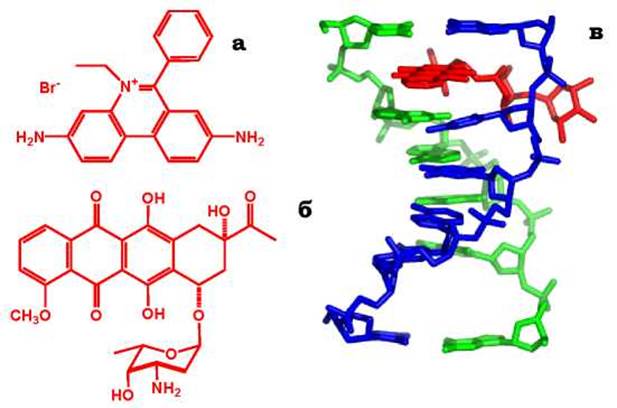
Fig. 4.9. Chemical structures of ethidium bromide (a) and daunorubicin (b), and The structure of the complex formed by the intercalated daunorubicin derivative (red) with DNA (c; generated using PyMOL, Protein Data Bank accession code 1NAB)
Various natural and synthetic substances interact with DNA to induce chemical modifications of nitrogenous bases. For instance, strong oxidizing agents, such as nitrous acid or potassium dichromate, cause Oxidative Deamination of bases. Alkylating agents (such as nitrosomethylurea and thiophosphamide) attach alkyl radicals as exocyclic groups to nitrogenous bases.
Certain chemically inert molecules entering an organism acquire mutagenic properties only after undergoing metabolic transformations—a process known as metabolic activation. Such chemical substances are called promutagens; examples include hydrophobic polycyclic aromatic Hydrocarbons and aflatoxin (a Toxin synthesized by many mucoralean Molds).
In general, DNA Damage caused by chemicals is not always the result of a direct interaction between the mutagen and the nitrogenous bases or the sugar-phosphate backbone. Frequently, chemicals participate in complex intracellular reactions that generate free radicals, which in turn damage DNA. Strong oxidizing agents, metal salts, and certain Antibiotics, such as bleomycin, can act as generators of free radicals. Other chemical mutagens that do not interact directly with DNA include inhibitors of NUCLEIC ACID METABOLISM and repair enzymes. For instance, the alkaloid caffeine is a potent inhibitor of DNA Repair systems, whereas the thymine analog 5-fluorouracil does not incorporate into DNA itself, but acts as an inhibitor of the enzyme thymidylate synthase. This results in a cellular deficiency of thymine NUCLEOTIDES, which can lead to The formation of single-stranded gaps during DNA replication.
Physical mutagenic factors include electromagnetic radiation with wavelengths below 300 nm and particulate radiation. Ionizing radiation (X-rays, gamma rays, alpha, and beta particles) induces molecular ionization—the loss or gain of electrons—leading to the formation of positively or negatively charged radicals of nucleic acid components. Chemical Reactions among these radicals cause the Cleavage of various covalent bonds, including phosphodiester and glycosidic bonds, as well as bonds within nitrogenous bases and sugars. Such processes induce both point and chromosomal Mutations of all types. In addition to its direct effect on DNA, ionizing radiation induces the generation of free hydroxyl and peroxide radicals, which amplify the direct mutagenic impact of ionizing radiation.
Among non-ionizing radiations, short-wavelength ultraviolet rays (100–280 nm) exhibit the highest mutagenic activity. This specific spectral region corresponds to the Light absorption maxima of nitrogenous bases. The absorption of UV energy leads to electron excitation—their transition to higher energy levels—which facilitates photochemical reactions between nitrogenous bases. The most common products of such reactions are pyrimidine dimers, such as those formed between adjacent thymines within the same strand (see Fig. 1.18). The long-wavelength absorption maximum of the bases lies at 260 nm, and light with wavelengths exceeding 280 nm is practically unabsorbed by DNA. The distinct mutagenic activity of long-wavelength UV radiation is attributed to the absorption of energy by other chromophores (such as certain Cofactors), followed by The transfer of electronic excitation to DNA. Furthermore, the absorbed energy can also generate free radicals via certain molecules (e.g., riboflavin).
Biological mutagenic factors include Viruses, parasites, and Bacteria. The primary cause of the mutagenic activity of viruses (Retroviruses and Introduction/6.html">DNA-containing viruses, see Chapter 5) is the integration of their DNA into the host genome. Integration within the coding or regulatory region of a Gene can induce a mutation or disrupt normal Gene Expression. Mutations can also be triggered by exogenous DNA artificially introduced into a cell. This mechanism of mutagenesis is entirely analogous to the effects of mobile genetic element transposition (Chapter 6). Additionally, an elevated overall mutation rate in Cells treated with exogenous DNA or infected with viruses is caused by the "competition" between foreign DNA and cellular DNA for the molecular machinery of repair systems.
The increase in various Selection/21.html">Types of mutations observed in somatic cells of organisms exposed to viral, bacterial, and other infections is termed infectious mutagenesis. This phenomenon is explained by a complex set of processes occurring during the interaction between the host organism and the infectious agent or parasite. Mutations may be driven by factors such as toxins secreted by bacteria and parasites, toxic metabolites, and substances synthesized by the organism during Immune Response reactions.
Last update: 11/08/2026
Editorial and Educational Adaptation: This material has been compiled based on the primary/original source text. The project team performed an editorial review, corrected technical inaccuracies, structured sections, and adapted the content for an educational format.
What was processed:
- elimination of formatting defects (OCR errors, structural breaks, corrupted characters);
- editorial organization of content;
- standardization of terminology in accordance with academic sources;
- verification of factual statements against the original source text.
All mentions of the author, publication year, and origin of the primary text have been preserved in accordance with the source.