Genetics - A. V. Sivolob 2008
Human Genetics
Genetic Aspects of Human Evolution
Reconstructing the Evolution of the biological species Homo sapiens sapiens, like any modern species, is a challenging problem that remains far from fully resolved. Potential stages of Human Evolution have been proposed based on paleontological data, comparisons of DNA sequence variations between humans and apes, and DNA sequences from various groups of modern and fossil remains of ancient humans.
According to paleontological data, the first hominids (a group including humans and great apes) appeared in Africa approximately 20 million years ago. Remains dated to 4 million years ago belong to hominids that are potential human ancestors: Kenyanthropus, Ardipithecus, and Australopithecus. The genus Homo diverged from ancient hominids approximately 2.5 million years ago, represented initially by several simultaneously existing species.
Among them, Homo erectus is considered the direct human ancestor based on the Morphological Characteristics of fossil remains. Originating in Africa, its representatives later migrated to Asia and Europe. According to the generally accepted hypothesis, the new species Homo sapiens evolved from populations of Homo erectus that inhabited Africa. Homo sapiens comprised two subspecies: Homo sapiens neanderthalensis (Neandertals, or paleoanthropids) and Homo sapiens sapiens (modern humans, or neoanthropids). Neandertals appeared approximately 400,000 years ago and went extinct 30–25,000 years ago. Modern humans emerged approximately 200,000 years ago. For some time, Neandertals and neoanthropids coexisted in shared territories.
Paleontological findings have been confirmed and refined through comparative genomic analysis of modern hominids. It was revealed that chimpanzees are our closest living relatives, while orangutans are the most evolutionarily distant. A comparison of chimpanzee and human karyotypes showed that 13 Chromosomes are completely identical in Morphology and differential banding patterns. Human chromosome 2 formed As a result of the fusion of two acrocentric chromosomes identical to those present in the chimpanzee chromosome set (which is why humans have 23 pairs of chromosomes, whereas chimpanzees and other great apes have 24). The remaining nine "non-identical" chromosomes differ only by the presence of pericentric inversions. Such karyotypic similarity is characteristic of extremely closely related species.
Even more striking information was obtained by comparing DNA and protein sequences: human and chimpanzee Gene sequences are nearly 99% identical. Such similarity is typically characteristic of "sibling species," meaning species that are morphologically indistinguishable. This even led some researchers to propose classifying chimpanzees within the genus Homo. The significant morphological differences between chimpanzees and humans are believed to stem from differences in Gene Expression, though this question remains far from settled.
Genome comparison not only establishes the genetic relatedness of various species but also, using the molecular clock method, helps determine when the Branches of the evolutionary tree diverged. The molecular clock method is based on the fact that Mutations accumulate at varying rates in different Regions of the genome. By knowing this mutation rate (and, consequently, the average time required for a single mutation to occur) for a specific genomic region, one can calculate the time needed for a given number of divergences between the analyzed genomes. Mitochondrial DNA (mtDNA) sequences and the non-recombining region of the Y chromosome are most actively used for such studies. These sequences have two major advantages: their changes arise exclusively through mutations (recombinational Variability is absent), and they are inherited uniparentally (mtDNA is passed down the maternal line, and the Y chromosome along the paternal line). For instance, it was previously believed that the ancestral branch of the modern orangutan diverged from the common hominid tree approximately 10 million years ago, followed 5 million years ago by the simultaneous split of the human, chimpanzee, and gorilla lineages. However, comparisons of human and ape mtDNA revealed that the chimpanzee and gorilla lineages diverged significantly later—at a time when human ancestors should have already existed.
Comparisons of mitochondrial DNA from modern humans and Neandertals confirmed that these two groups are more genetically closely related than chimpanzees and humans, and belong to the same species. The common ancestor of Neandertals and modern humans lived approximately 500,000 years ago. To date, there is no molecular evidence indicating whether Neandertals and neoanthropids interbred.
Class="center">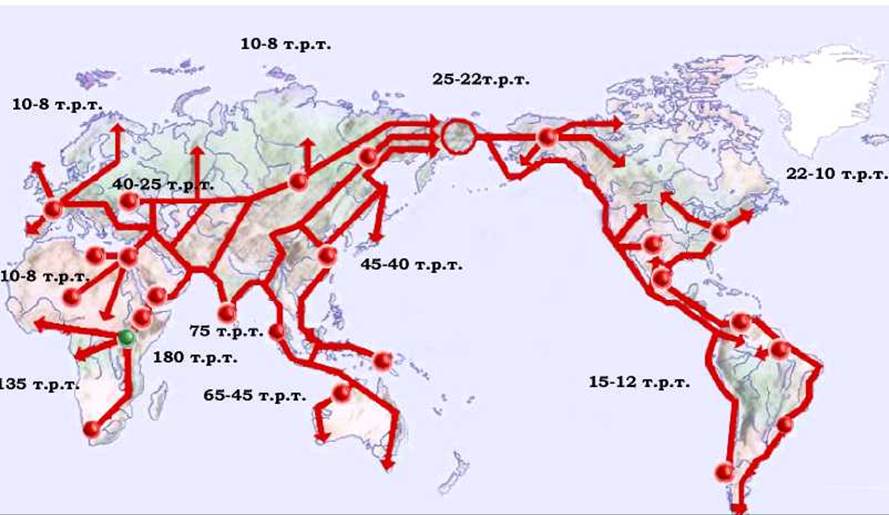
Fig. 7.8. Human migration routes over the period of 180–8 thousand years ago (kya). The green circle indicates the cradle of modern human origins. Red circles mark sites of major paleontological discoveries. (For details, see http://www.bradshawfoundation.com)
DNA analysis data (which corroborate modern paleontological findings) indicate that modern humans arose approximately 180,000 years ago in a single region of East Africa and subsequently populated the globe. DNA sequence analysis has also helped map the primary human migration routes over the past 150,000 years (Fig. 7.8). Furthermore, comparisons of mtDNA and the Y chromosome demonstrated that all known variants of these sequences (both modern and from fossil remains) arose through successive single-nucleotide substitutions, meaning all these variants can be traced back to a single ancestral sequence. Mitochondrial DNA analysis indicates that all modern humans descend from a single female (so-called "mitochondrial Eve"), while Y-chromosome analysis shows that the entire human Lineage descends from a single male ("Y-chromosomal Adam"). It should be noted that although these common ancestors of all humanity originated in East Africa, they lived at different times: mitochondrial Eve lived roughly 160,000 years ago, whereas Y-chromosomal Adam lived approximately 60,000 years ago.
The existence of common "ancestors" for all humanity and the discrepancy in the times they lived can be explained by stochastic events: a vast number of lineages originating from other ancestors simply died out. The fact is that several times in its history, the human species was on the brink of extinction. For instance, the Toba volcanic eruption 74,000 years ago triggered the onset of an ice age. As a result of this cataclysm, the total human population on Earth plummeted to about 10,000, and humanity survived as scattered, small isolated groups. Repeatedly passing through such "bottlenecks" (see Chapter 8) may explain why, by chance, descendants survived from only one female and one male.
METABOLISM/35.html">Selection/41.html">Review Questions and Tasks
1. Characterize the subject matter and objectives of Human Genetics.
2. Discuss the disadvantages and advantages of humans as a genetic model.
3. Describe the Main Features of the Organization OF THE human nuclear genome and karyotype.
4. List the types of structural genomic variants in humans. How is genomic polymorphism utilized in medical genetics and forensic medicine?
5. How is the pedigree analysis method used to determine Inheritance patterns in humans? What standard symbols are used to graphically represent a genealogical tree?
6. Which key pedigree characteristics indicate autosomal inheritance patterns? What about Sex-Linked Inheritance patterns?
7. How does environmental factor influence the manifestation of multifactorial traits? Describe the threshold model.
8. Which Methods in human genetics are used to distinguish Environmental Effects from genotype influences on trait expression? Define the terms concordance and discordance.
9. Using the data provided in Table 7.3, calculate the heritability coefficient for Epilepsy.
10. How can diseases be classified based on THE CONTRIBUTION OF hereditary versus environmental factors to The Development of pathological conditions?
11. Classification of Hereditary diseases. Provide Examples of monogenic (gene) hereditary disorders.
12. What are the Main characteristics of chromosomal hereditary disorders?
13. Name the trisomies and monosomies that are viable in humans.
14. What are the existing microdeletion syndromes and imprinting disorders?
15. Explain the causes of pathological conditions resulting from maternal-fetal incompatibility.
16. Describe the key features that distinguish Cancer from other hereditary diseases.
17. In which cellular processes do Proto-oncogenes, tumor suppressor genes, and Mutator Genes participate?
18. How exactly do the chromosome sets of humans and chimpanzees differ? How appropriate is it to classify humans and chimpanzees as "sibling species"?
19. Application of the molecular clock method in human evolution research. Where and when, according to genetic studies, did anatomically modern humans originate?
20. How can it be explained that all modern humans share common ancestors?
Last update: 11/08/2026
Editorial and Educational Adaptation: This material has been compiled based on the primary/original source text. The project team performed an editorial review, corrected technical inaccuracies, structured sections, and adapted the content for an educational format.
What was processed:
- elimination of formatting defects (OCR errors, structural breaks, corrupted characters);
- editorial organization of content;
- standardization of terminology in accordance with academic sources;
- verification of factual statements against the original source text.
All mentions of the author, publication year, and origin of the primary text have been preserved in accordance with the source.