Human Anatomy and Physiology - I. V. Gayvoronsky 2011
Anatomy and Physiology of the Digestive System
Pharynx
The Pharynx is a funnel-shaped organ where chewed food mixed with saliva enters from the Oral Cavity.
This organ is attached to the base of The Skull and continues into the Esophagus at the level of the seventh cervical vertebra (Fig. 7.9). On average, the length of the pharynx is 12–14 cm. It serves as the intersection point for the digestive and respiratory tracts. The lateral Regions of the organ are adjacent to the neurovascular bundle of the neck, which includes the common carotid artery, Internal jugular vein, and Vagus nerve.
Class="center">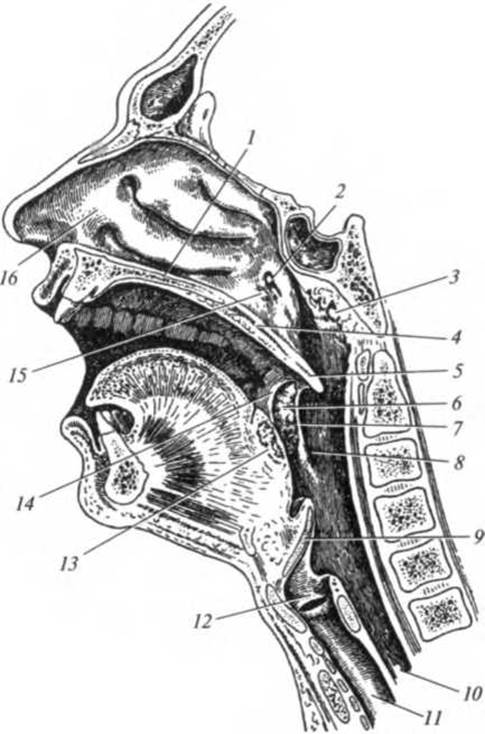
Fig. 7.9. Pharynx:
1 — hard palate; 2 — pharyngeal opening of the auditory tube; 3 — pharyngeal tonsil; 4 — soft palate; 5 — uvula; 6 — palatine tonsil; 7 — palatopharyngeal arch; 8 — oropharynx; 9 — epiglottis; 10 — esophagus; 11 — Trachea; 12 — Larynx; 13 — lingual tonsil; 14 — palatoglossal arch; 15 — tubal tonsil; 16 — Nasal cavity
According to its anatomical Location, the pharynx is divided into three parts:
1) nasal part (nasopharynx), pars nasalis;
2) oral part (oropharynx), pars oralis;
3) laryngeal part (laryngopharynx), pars laryngea.
The pharynx has the following walls: superior (roof), posterior, anterior, and two lateral. It should be noted that the anterior wall is present only in the laryngopharynx. In the first two sections, it is practically absent due to communications with the nasal and oral cavities.
The nasal part is located behind the nasal cavity and communicates with it via the choanae. Air passes through them into the pharynx. The epithelium of the nasopharynx is structurally similar to that of the nasal cavity (ciliated). The auditory (Eustachian) tube opens into the nasopharynx, connecting the tympanic cavity with the pharynx. It serves to ventilate the latter and equalize the pressure in the tympanic cavity with atmospheric pressure. Therefore, nasal breathing is essential for the normal functioning of the Organ of Hearing.
The oral part is located posterior to the fauces. The fauces represent a relatively small space bounded by two pairs of palatine arches laterally, the soft palate superiorly, and the ROOT of the Tongue inferiorly. The oropharyngeal space is bounded on one side by the level of the soft palate and on the other by the entrance to the larynx. Its epithelium is stratified squamous non-keratinized, the same as in the oral cavity. It is precisely here that the digestive and respiratory tracts cross.
The laryngeal part is the narrowest section of the pharynx. It is bordered anteriorly by the posterior wall of the larynx and continues inferiorly into the esophagus. The epithelium of the laryngeal part is stratified squamous non-keratinized.
Food passes from the oral cavity through the oropharynx and laryngopharynx into the esophagus, while air from the nasal cavity flows into the nasopharynx, oropharynx, and larynx. One of the cartilages of the larynx, the epiglottis, prevents food from entering the respiratory tract. It acts as a unique valve.
The wall of the pharynx consists of three membranes: mucous, muscular, and adventitial.
Special lymphoid formations belonging to The Immune System, known as Tonsils, are located in the mucous membrane of the pharynx:
✵ palatine tonsil, tonsilla palatina (paired), located between the two palatine arches;
✵ tubal tonsil, tonsilla tubaria (paired), situated near the pharyngeal opening of the auditory tube;
✵ lingual tonsil, tonsilla lingualis (unpaired), lying on the root of the tongue;
✵ pharyngeal tonsil, tonsilla pharyngealis, seu adenoida (unpaired), — on the superior wall of the pharynx.
Together they form the Waldeyer's pharyngeal lymphoid ring. The function of this ring is to neutralize microorganisms entering the pharynx with food and air, as well as to participate in immune processes. Externally, these Organs are covered by a mucous membrane that dips into their substance, forming folds or tonsillar crypts. Lymphoid nodules are located within the substance of the tonsils beneath the epithelium and contain A large number of immune Cells — lymphocytes. It should be noted that with age, the tonsils lose their Functions. Their size decreases, sometimes leading to complete disappearance (atrophy). In adults, only the palatine tonsils remain clearly visible.
Beneath the mucous membrane, in place of the submucosa, lies a layer of Connective Tissue called the pharyngobasilar fascia. It is through this fascia that the pharynx is attached to the Base of the skull.
The muscular layer of the pharynx is represented by striated musculature, the contraction of which facilitates the propulsion of the food bolus into the esophagus. There are two groups of pharyngeal Muscles:
1) Constrictor muscles: superior, middle, and inferior; they are arranged circularly and overlap one another like shingles;
2) elevator Muscles of the pharynx: stylopharyngeus and palatopharyngeus; they lie longitudinally and are less developed than the constrictors.
Externally, the pharynx is covered by an adventitia, which restricts the mobility of the organ.
Thus, the pharynx serves to conduct food from the oral cavity into the esophagus and air from the nasal cavity into the larynx. In addition, due to the presence of the Waldeyer's lymphatic ring, it protects the body against the penetration of pathogenic Bacteria and Viruses.
Last update: 08/08/2026
Editorial and Educational Adaptation: This material has been compiled based on the primary/original source text. The project team performed an editorial review, corrected technical inaccuracies, structured sections, and adapted the content for an educational format.
What was processed:
- elimination of formatting defects (OCR errors, structural breaks, corrupted characters);
- editorial organization of content;
- standardization of terminology in accordance with academic sources;
- verification of factual statements against the original source text.
All mentions of the author, publication year, and origin of the primary text have been preserved in accordance with the source.