MEDICAL BIOLOGY, HUMAN ANATOMY, PHYSIOLOGY AND PATHOLOGY - Ya.I. Fedonyuk 2010
ANATOMY, PHYSIOLOGY, PATHOLOGY
SECTION 3. ANATOMICAL AND PHYSIOLOGICAL ASPECTS OF BODY FUNCTION SELF-REGULATION
ENDOCRINE GLANDS AND THEIR PATHOLOGY
PARATHYROID GLANDS
The Parathyroid glands (glandulae parathyroideae) are located on the posterior surfaces of the thyroid lobes (Fig. 3.72). There are two superior and two inferior parathyroid glands. They are round or oval in shape, with a total mass of about 0.9 g. Each parathyroid gland is covered by its own fibrous capsule. Endocrine Cells, or parathyrocytes, form trabeculae and come into contact with Blood capillaries.
Class="center">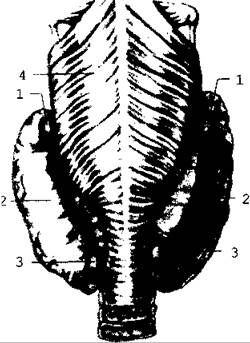
Fig. 3.72. Parathyroid glands
The parathyroid glands produce parathyroid hormone (parathormone), which acts as an antagonist to thyroid Calcitonin. They regulate calcium METABOLISM in the Body. Parathormone promotes the release of calcium from Bone tissue and its reabsorption from the distal renal tubules of the nephron. This helps to increase calcium levels in Blood Plasma. Calcium plays a crucial role in the function of excitable structures. Normally, the blood calcium level is 2.25-2.75 mmol/L. The concentration of parathormone, in turn, depends on the blood calcium level: when it decreases, parathormone production increases, and when it increases, it decreases. Parathormone secretion is stimulated by the sympathetic Nervous system.
There are two main functional Disorders of the parathyroid glands: hypoparathyroidism (decreased function) and hyperparathyroidism (increased function).
Hypoparathyroidism is a condition associated with insufficient secretion of parathyroid hormone, characterized by marked disturbances in Calcium and phosphorus metabolism. Typical of hypoparathyroidism are attacks of tetany—involuntary, painful tonic Muscle spasms that involve symmetrical groups of limb flexors and, in severe cases, facial Muscles. During convulsive attacks, the hands are clenched, and the arms are drawn in. Spasmodic contractions of the respiratory and pharyngeal muscles can lead to asphyxia. In addition to convulsions, dental destruction, Hair loss, and weight loss are observed.
Hyperparathyroidism is characterized by the mobilization (leaching) of mineral salts from bones and the deposition of calcium in the Blood Vessels, Kidneys, and Heart. Due to hypercalcemia (elevated blood calcium levels) and metastatic myocardial calcification, heart rate slows down, potentially leading to cardiac arrest. Bone resorption processes outweigh Bone Formation, causing the bones to become soft, deformed, and sometimes fragile.
Last update: 08/08/2026
Editorial and Educational Adaptation: This material has been compiled based on the primary/original source text. The project team performed an editorial review, corrected technical inaccuracies, structured sections, and adapted the content for an educational format.
What was processed:
- elimination of formatting defects (OCR errors, structural breaks, corrupted characters);
- editorial organization of content;
- standardization of terminology in accordance with academic sources;
- verification of factual statements against the original source text.
All mentions of the author, publication year, and origin of the primary text have been preserved in accordance with the source.