MODERN BOTANY - P. RAVEN - 1990
SECTION IV. DIVERSITY
CHAPTER 13. FUNGI
Mycorrhizae
Some Fungi play a key role in the mineral Nutrition of vascular plants. Seedlings of many forest tree species grown in a sterile nutrient solution and then transplanted into meadow soil will grow poorly or even die from lack of nutrients, although the substrate is sufficiently rich in them (Fig. 13-38). However, if a very small amount (0.1% by volume) of forest soil containing the appropriate fungi is added to the soil around the roots of the seedlings, growth normalizes. This is due to mycorrhiza ("fungus-ROOT"), a close, mutually beneficial Symbiosis between roots and fungi.
Class="center">Fig. 13-38. Mycorrhiza and tree nutrition. Nine-month-old eastern white pine (Рinus strobus) seedlings kept for two months in a sterile nutrient solution and then transplanted into prairie soil. Left — seedlings transplanted without additional Treatment. Right — seedlings grown for two weeks on forest soil with fungi prior to transplantation

Mycorrhizae are known in the majority of vascular plant groups. Only a few families of flowering plants do not form them or do so very rarely, for example, Brassicaceae and Cyperaceae. The dense, very thin roots of members of the Proteaceae probably function similarly to mycorrhizae in other plants.
Many plants can develop normally without mycorrhizae if well supplied with essential elements, especially phosphorus; however, under limited availability of these minerals, they grow poorly without them or die. The involvement of mycorrhizae in the direct transport of phosphorus from the soil to the roots has been proven experimentally. In turn, the plant supplies the symbiotic fungi with CARBOHYDRATES. One of the most remarkable properties of mycorrhizae is their ability, under certain circumstances, to function as a "bridge" for The transfer of photosynthates, phosphorus, and possibly Other Compounds from one plant forming the symbiosis to another. This phenomenon, which is likely of great importance in nature, requires further research.
Endomycorrhiza
Mycorrhizae are of two main types: endo- and ectotrophic (endomycorrhiza and ectomycorrhiza, respectively). The former is much more widespread and is found in approximately 80% of all vascular plants. The fungal component belongs to the Zygomycetes, with fewer than 100 species of fungi forming this symbiosis worldwide, meaning that the relationship between the symbionts is not strictly specific. Fungal hyphae penetrate the Cells of the root cortex, where they form coils, swellings, or分支 (Fig. 13-39), and also spread through the surrounding soil. Two characteristic types of intracellular hyphal structures are vesicles and arbuscles ("little trees"), which is why endomycorrhizae are often referred to as vesicular-arbuscular mycorrhizae.
Fig. 13-39. Endomycorrhiza. The zygomycete Glomus versiforme in association with leek (Allium porrum) roots. A. General view of a flattened root with vesicles. B. Vesicles in the root. C. Arbuscles in the root. They predominate in the Cytology/cytology/16.html">Early stages of symbiosis; vesicles become widespread in the cells later

Such mycorrhizae play a special role in the tropics, where soils tend to be positively charged and retain phosphates so strongly that their availability for plant growth is greatly reduced (see Appendix to Chapter 26). At the same time, most temperate soils are negatively charged. Since poor farmers in the tropics often cannot afford fertilizers, endomycorrhizae serve as the primary supplier of phosphates for the crops they cultivate (Fig. 13-40). A better understanding of the symbiont relationships in The formation of this mycorrhiza will undoubtedly help reduce The amount of fertilizer (especially phosphorus) applied in agriculture to obtain high yields and effectively manage pastures and other plant communities. The commercialization of specific strains of endomycorrhizal fungi for soil inoculation is increasingly becoming a likely and promising method for increasing crop yields.
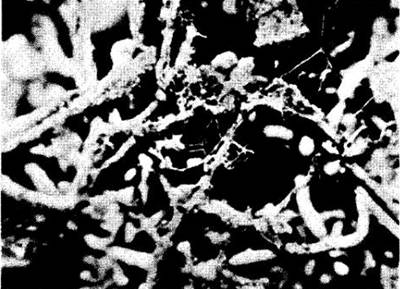
Fig. 13-40. A network of roots and fungi from a decomposing leaf in the Amazonian forest. This Structure allows the penetration of more than 5 cm to capture less than one-thousandth of the nutrients reaching the forest floor. Mycorrhizal fungi return the majority of nutrients brought in by fallen leaves to plant roots. When a tropical forest is logged, this connection is disrupted, and the soil typically loses its fertility quite rapidly
Ectomycorrhiza
Ectomycorrhizae are characteristic of certain families of trees and shrubs mainly in temperate zones (Fig. 13-41), particularly Fagaceae, Salicaceae, and Pinaceae, as well as some groups of tropical trees growing in dense stands dominated by one or a few species. Trees growing near the altitudinal tree line in various PARTS OF THE globe frequently form ectomycorrhizae, such as pines in northern latitudes, eucalypts in Australia, and Nothofagus (see Fig. 29-8). Ectomycorrhiza appears to increase tree resistance to harsh, cold, and dry conditions near the limits of their survival.
Fig. 13-41. Ectomycorrhiza on rootlets of western hemlock (Tsuga heterophylla). In this case, the fungus typically forms a sheath of hyphae around the rootlet. Hormones secreted by them stimulate root branching. This growth pattern and the fungal sheath determine the characteristic appearance of ectomycorrhizae (thickened, highly branched structures). Thin strands extending from the mycorrhizal complex are rhizomorphs, bundles of hyphae functioning as an extension of The Root System

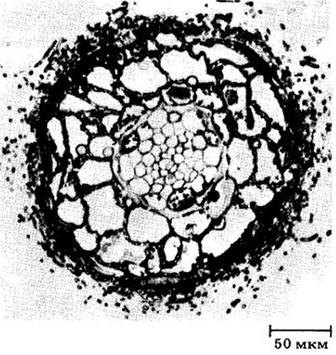
In ectomycorrhizae, fungi surround the roots but do not penetrate their living cells (Fig. 13-42). The mycelium extends far into the soil, playing an important role in transferring organic carbon to the plant. Root hairs are often absent; their function is apparently performed by hyphae. Ectomycorrhizae are formed mainly by Basidiomycetes, but sometimes also by Ascomycetes, including truffles. About 5,000 species of ectomycorrhizal fungi are known, some of which are highly specific to their plant symbiont.
Fig. 13-42. Cross section of a pine ectomycorrhizal rootlet. Fungal hyphae lie primarily in the intercellular spaces of the cortical cells
Other types of Mycorrhizae
Two special types of mycorrhizae are characteristic of the Ericaceae and several related groups, as well as the Orchidaceae. In the first case, the fungus can make up to 80% of the total mass of the mycorrhiza. It forms a dense aggregation of hyphae around the root, with fine lateral hyphae penetrating the root cortical cells. Although maintaining such a massive fungal biomass is energetically costly for the plant, this relationship likely underlies the ability of heaths and related plants to colonize nutrient-poor, acidic soils (members of this family are particularly common in such habitats). Both Ascomycetes and Basidiomycetes form mycorrhizae with Ericaceae. In some cases, fungi form a mantle around the root Tissues while also penetrating inside the tissues themselves; in others, they reside entirely intracellularly.
Ericaceous mycorrhiza appears to be essential for supplying the plant with nitrogen rather than phosphorus, which is particularly important in acidic soils where members of this family frequently grow. It is also possible that it enhances the tolerance of certain Ericaceae to heavy metals, which may occur in such soils either naturally or As a result of acid rain.
Orchid seeds in nature germinate only in the presence of appropriate fungi. These mycorrhizal relationships are truly unique, as the fungi supply the plants with carbon from within, at least at the seedling stage. These associations are formed predominantly by basidiomycetes (likely over 100 species).
Mycorrhizae and the Evolution of Vascular Plants
Examination of the remains of the earliest vascular plants (for details, see Chapters 17 and 18) has shown that endomycorrhizae were just as common in them as in modern plants. This discovery led K. Pirozynski and D. Malloch to suggest that The Emergence of mycorrhiza during evolution may have been the decisive factor that enabled plants to colonize land. Given the poorly developed soils at the time of this colonization, it is plausible that mycorrhizal fungi (possibly zygomycetes) formed The basis of Plant Mineral Nutrition, particularly for phosphorus uptake. Similar relationships can be demonstrated in modern pioneer plants growing on extremely nutrient-deficient soils, such as slag heaps. Species with endomycorrhizae have a significantly higher survival rate in these environments. Thus, it is quite possible that the land was conquered not by a single Organism, but by an entire symbiotic complex akin to a lichen.
Last update: 07/08/2026
Editorial and Educational Adaptation: This material has been compiled based on the primary/original source text. The project team performed an editorial review, corrected technical inaccuracies, structured sections, and adapted the content for an educational format.
What was processed:
- elimination of formatting defects (OCR errors, structural breaks, corrupted characters);
- editorial organization of content;
- standardization of terminology in accordance with academic sources;
- verification of factual statements against the original source text.
All mentions of the author, publication year, and origin of the primary text have been preserved in accordance with the source.