BIOLOGY Volume 2 - A Guide to General Biology - 2004
14. TRANSPORT IN ANIMALS
14.8. Functions of blood in mammals
Blood performs A wide variety of vital Functions. In the list below, the first four functions are associated exclusively with the plasma.
1. Transport of soluble Organic compounds (Digestion products) from the Small Intestine to various PARTS OF THE body where these substances are stored or assimilated (utilized), as well as from storage sites to the areas where they are needed. An example is The transport of glucose from the Liver (where it is stored in the form of Glycogen) to the Muscles to generate energy.
2. Transport of soluble metabolic end-products destined for excretion to the excretory Organs. For instance, urea produced in the liver is transported to the Kidneys, from which it is excreted in the urine, while carbon dioxide generated during tissue Respiration by all Cells is transported to the Lungs and eliminated from the body.
3. Transport of Hormones from their sites of synthesis (Endocrine glands) to target organs, such as the transport of Insulin from the Pancreas to the liver. This is one of the mechanisms of chemical (humoral) Regulation of the body.
4. Redistribution of heat within the body, specifically transferring it from deep-seated organs to the surface. This helps maintain a constant body Temperature.
5. Transport of oxygen from the lungs to all parts of the body and carbon dioxide in the opposite direction. Red Blood Cells play a crucial role in these processes.
6. Defense against disease, which involves three mechanisms:
a) blood clotting involving platelets and fibrinogen; this prevents excessive blood loss and The entry of pathogens into the body;
b) phagocytosis, carried out by neutrophils, monocytes, and macrophages, which engulf and digest Bacteria that have invaded the blood and other Tissues;
c) immune defense mediated by Antibodies and lymphocytes (neutralization of a broad spectrum of foreign agents).
7. Maintenance of a constant osmotic pressure and pH of the internal environment due to The activity of Plasma Proteins. Plasma proteins and Hemoglobin contain both acidic and basic Amino Acids, allowing them to bind or release hydrogen ions in response to pH fluctuations and thereby minimize these changes. In other words, blood acts as a buffer.
14.8.1. Oxygen transport
Oxygen is transported by the protein hemoglobin (Hb), which is contained within red blood cells. Each hemoglobin molecule is formed by four polypeptide chains (globins), making it a tetramer with quaternary Structure (section 3.5.3). Each globin chain (monomer) is bound to its own heme pigment group, which gives blood its characteristic red color (Fig. 14.27). Each heme group contains a single ferrous iron atom (Fe II) and is capable of loosely binding a single oxygen molecule:
Class="center">
(In biochemistry, the standard designation for oxyhemoglobin is HbO2.)
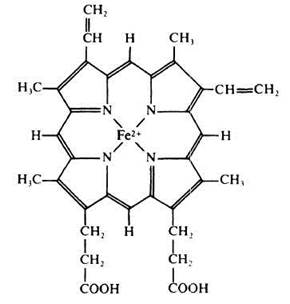
Fig. 14.27. Heme molecule.
The binding of oxygen to hemoglobin to form oxyhemoglobin occurs at high oxygen concentrations, such as those found in the alveolar capillaries of the lungs. When this concentration drops, as observed in the capillaries of metabolically active tissues, the bond between oxygen and hemoglobin becomes weak; oxygen is released and diffuses in dissolved form into the surrounding cells. The release of oxygen from hemoglobin is called dissociation.
The amount of oxygen that can bind to hemoglobin is determined by its concentration, or partial pressure. (The term partial pressure is used for gases instead of concentration.) Partial pressure is the contribution made to the total pressure of a gas mixture by one of its components. Consequently, the more oxygen there is in the air, the higher its partial pressure. This value is still commonly expressed in millimeters of mercury (mmHg). For example, atmospheric pressure at sea level is 760 mmHg. Oxygen accounts for approximately 1/5 of atmospheric air; therefore, its partial pressure at sea level is 760 x 1/5 = 152 mmHg.
Dissociation curves
The higher the concentration (partial pressure) of oxygen in the environment, the greater the saturation of hemoglobin with oxygen, meaning the more hemoglobin in the blood is converted into oxyhemoglobin. The degree of hemoglobin saturation at various partial pressures of oxygen can be measured and plotted on a graph. One might expect a simple linear relationship, where the graph would be a straight line. However, this is not the case, as confirmed by Fig. 14.28. The curve has an S-shaped, or sigmoid, profile and is known as the oxyhemoglobin dissociation curve.

Fig. 14.28. Oxyhemoglobin dissociation curve.
An analysis of this curve shows that at an oxygen partial pressure of about 30 mmHg, only 50% of the hemoglobin is in the form of oxyhemoglobin. Complete saturation (100%) rarely occurs in nature. The sigmoidal shape of the curve is of great physiological significance. Its steep section means that within this range of partial pressure, even a slight drop in the surrounding environment will significantly decrease the degree of blood oxygenation. In other words, oxyhemoglobin will dissociate and release oxygen into solution, where it can diffuse down its concentration gradient. This is precisely what happens in actively respiring organs perfused with blood1.
The Bohr Effect
As the partial pressure of carbon dioxide increases, the oxyhemoglobin dissociation curve shifts to the right. This phenomenon is known as the Bohr effect (Fig. 14.29). Such a shift is physiologically advantageous. Referring to Fig. 14.29, we can see that the vertical line corresponding to 29 mmHg (the partial pressure corresponding to 50% saturation for the middle of the three curves) intersects the curves plotted for different CO2 partial pressures (15, 40, and 70 mmHg) at different heights: lower as the graph moves further to the right. Consequently, the higher the CO2 concentration in the medium, the lower the hemoglobin oxygen saturation—meaning the more readily oxyhemoglobin dissociates, releasing oxygen.
Carbon dioxide is a metabolic byproduct of respiration. The more intense the respiration, the faster CO2 accumulates; that is, the higher the metabolic rate, the greater the partial pressure of CO2. In the body, this precisely matches the conditions of maximal oxygen demand. Thus, the physiological benefit of the Bohr effect is that when CO2 accumulates, oxyhemoglobin releases oxygen more readily right where it is needed the most.

Fig. 14.29. Oxyhemoglobin dissociation curves at various carbon dioxide partial pressures, illustrating the Bohr effect.
Carbon dioxide exerts this effect because, upon dissolving in Water, it combines with it to form a weak acid:

The released hydrogen ions bind to hemoglobin (see Section 14.8.4), reducing its oxygen-carrying capacity.
14.6. (a) Temperature also affects oxyhemoglobin dissociation. Taking into account The Effect of carbon dioxide, describe how this dissociation should proceed with increasing temperature; explain the physiological benefit of the observed change.
(b) The oxyhemoglobin dissociation curve varies depending on the animal species. For example, compared to humans, it is shifted to the right in small mammals. Explain the reason for this.
14.7. Analyze Fig. 14.30. The fetal oxyhemoglobin dissociation curve is shifted to the left compared to that of the mother. Explain why.

Fig. 14.30. Fetal and maternal oxyhemoglobin dissociation curves in the goat.
14.8. The oxyhemoglobin dissociation curve of the llama, which inhabits the Andes (South America) at an altitude of about 5000 m above sea level, lies to the left of that of most other mammals (Fig. 14.31). How can this be explained?

Fig. 14.31. Oxyhemoglobin dissociation curves in the llama and other mammals.
1 In tissues, oxygen exists not in a gaseous state, but in a dissolved («liquid») form; therefore, the term «partial pressure» is used purely by convention instead of concentration. This is convenient because the physical meaning of both concepts is identical, and when analyzing the gas exchange of the Organism as a whole (ambient air—lungs—blood—tissues), the specific details of gas transitions between solution and air do not play a critical role. — Translator's Note.
Last update: 06/08/2026
Editorial and Educational Adaptation: This material has been compiled based on the primary/original source text. The project team performed an editorial review, corrected technical inaccuracies, structured sections, and adapted the content for an educational format.
What was processed:
- elimination of formatting defects (OCR errors, structural breaks, corrupted characters);
- editorial organization of content;
- standardization of terminology in accordance with academic sources;
- verification of factual statements against the original source text.
All mentions of the author, publication year, and origin of the primary text have been preserved in accordance with the source.