BIOCHEMISTRY - L. Stryer - 1984
VOLUME 3
Part IV INFORMATION
CHAPTER 28. THE REGULATION OF GENE EXPRESSION IN THE PHENOTYPE
28.11. Repressors and Activators Determine the Development of Temperate Phages
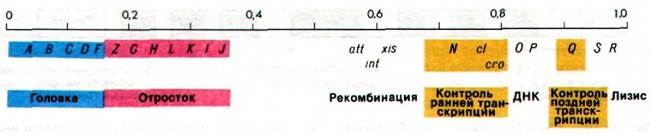
Let us now turn to The Role of transcriptional repressors and activators in regulating The life cycle of bacteriophage lambda ( ). A mature viral particle consists of a linear double-stranded DNA molecule (48 kb) packaged within a protein coat. There are two pathways of viral development: it can either destroy the host Cell or become a component of it (hence the term "temperate"). In the lytic pathway, full expression of phage genes takes place, leading to bacterial lysis and The production of approximately 100 progeny Viral Particles. Alternatively, The Development of phage can follow the lysogenic pathway, in which its DNA becomes covalently linked to the host cell DNA at a strictly defined site (site-specific integration). This recombination process, which involves the circular phage DNA molecule , is discussed below (Section 30.16). When the phage DNA integrates with the host cell DNA, most phage Functions are switched off. Phage DNA in this state is called a prophage, and the host cell containing the prophage is called a lysogenic bacterium. The prophage replicates in the lysogenic bacterium as part of the cellular chromosome, typically for many generations. In the lysogenic state, lytic functions remain silent but are not lost (Fig. 28.17). Many agents that disrupt normal METABOLISM/36.html">DNA Replication in the host cell induce the prophage, causing it to enter the lytic pathway.
Class="center">Fig. 28.17. Genetic Map of phage  . Only selected genes are shown. Upon entering the bacterial cell, the linear double-stranded DNA converts into a circular form
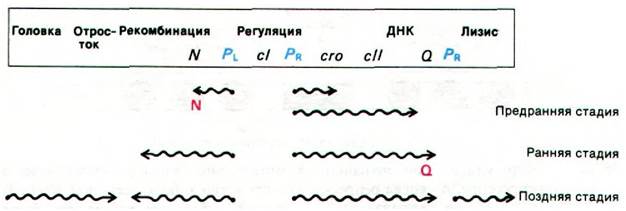
First, let us examine the expression of phage genes during the lytic pathway. The goal of development—producing a numerous progeny—is achieved through the sequential Transcription of viral genes. Initially, Proteins required for DNA Replication and recombination are produced, followed by the HEAD and tail Proteins of the viral particle and proteins necessary for host cell lysis. The strict chronological order of these events is of critical importance; premature destruction of the host cell is clearly disadvantageous to the virus. Gene Expression during lytic development occurs in three stages: pre-early, early, and late (Fig. 28.18). During the pre-early stage, RNA Synthesis begins from two promoters, PL and PR. One of the resulting transcripts serves as a template for the synthesis of protein N, which plays a vital regulatory role. In the absence of protein N, pre-early transcripts terminate at one of two termination sites. Protein N prevents transcription termination at these sites and thus ensures the further expression of phage X genes. Protein N initiates the early stage. At this time, proteins required for phage DNA replication and recombination are synthesized. In addition, the Q gene is transcribed during the early stage. Protein Q is another important regulatory element of phage gene expression. It is essential for the transition to the late stage. During the late stage, genes required for The formation of the phage head and tail and for host cell lysis are transcribed. Protein Q, much like protein N, suppresses transcription termination. In short, the sequential regulation of lytic development is carried out by two proteins—positive regulators encoded by the N and Q genes. Their action consists in enabling RNA polymerase to continue transcription past several termination sites.
Fig. 28.18. Three Stages of Transcription during the lytic development cycle of phage . Protein N is produced in the pre-early stage and activates the early stage. Protein Q is then synthesized in turn, which activates the late stage
The lysogenic cycle comprises three stages: ESTABLISHMENT OF THE lysogenic state, Maintenance of the lysogenic state, and induction (exit from the lysogenic state). Establishing the prophage state requires that the viral DNA integrates with the host cell DNA and that the viral lytic functions are inactivated. These processes are highly complex and not yet fully understood. Maintaining the prophage state, by contrast, is a relatively straightforward process. A. Dale Kaiser demonstrated that out of all the prophage genes, only the cI gene is expressed. This gene encodes the repressor, which binds to two operator sites, OL and OR (Fig. 28.19). The binding of the repressor to OL directly prevents the transcription of early genes to the left. In particular, protein N is not synthesized, thereby blocking the lytic pathway. By binding to OR, the repressor prevents the expression of the cro and Q genes to the right. Thus, when the repressor is bound to OL and OR, the entire phage genome remains silent, except for the cI gene encoding the repressor. As will be discussed shortly, the repressor itself controls The activity of the cI gene, thereby regulating its own concentration. Inactivation of the repressor permits the transcription of genes involved in the lytic process. The prophage is excised from the host cell chromosome, and lytic functions are expressed.
28.12. Two Lambda Phage Operators Contain a Series of Repressor Binding Sites
The repressor was isolated and studied in detail by Mark Ptashne. The monomer, with a mass of 26 kDa, exists in equilibrium with oligomers. It is specifically the oligomers that bind to DNA. Two operator sites—OL and OR—are recognized by the same repressor. The cI gene encoding this repressor is located between OL and OR
(Fig. 28.19). Each of these operators contains three binding sites for the repressor. Nuclease Digestion studies have shown that these binding sites consist of 17-base-pair sequences separated from one another by AT-rich regions 3 to 7 Base Pairs long. The base sequences of all these repressor binding sites are similar but not identical. The recognized sequence is 5'-TATCACCGG-3' or something very similar. Like the lac operator, these operator sites exhibit partial twofold Symmetry.
Fig. 28.19. Schematic diagram of the operator sites OL and OR and adjacent genes. OL1 and OR1 have the highest affinity for the repressor. cI is the repressor gene. The left transcript initiates at the N gene, and the right transcript initiates at the cro gene

The strongest repressor binding sites in the OL and OR operators are located closest to THE START OF the first structural gene of the Operon. The promoter region of the N gene is located within OL, whereas the promoter of the cro gene lies within OR. As in the lactose and arabinose operons, the binding of the repressor to these operators prevents RNA polymerase from binding to the corresponding promoter, thereby halting the initiation of transcription. The binding of the repressor to two sites in OL and OR blocks the promoter more effectively than binding to a single site alone.
28.13. The Repressor Regulates Its Own Synthesis
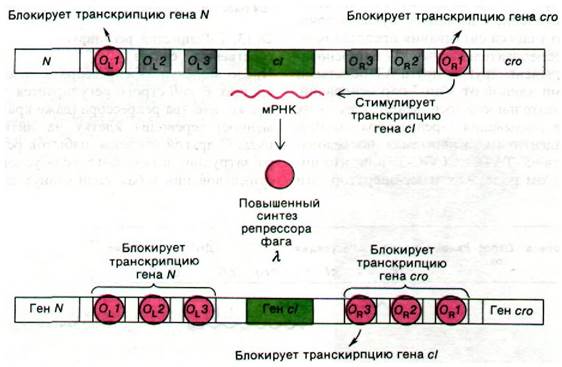
The number of repressor molecules in lysogenic E. coli Cells is strictly regulated. A decrease in The amount of repressor (even a transient one) switches The Cell to the lytic pathway. Conversely, an excess of repressor makes it difficult for the phage to escape if its living conditions within the bacterium become unfavorable. How is the concentration of the repressor regulated? Recent studies have shown that this repressor regulates its own synthesis. To accomplish this, the repressor binds to the OR3 operator site, which is located closest to the cI gene, and turns off the transcription of this gene (Fig. 28.20). Conversely, binding of the repressor to OR1 enhances Transcription of the cI gene. Recall that the affinity of the repressor for OR1 is higher than for OR3. Thus, transcription of the cI gene is enhanced
at low repressor concentrations and repressed at high concentrations of the same protein. In other words, expression of the cI gene is a self-regulating system.
This feedback-loop regulation tends to maintain the repressor concentration at a level that keeps the rest of the phage genome unexpressed. How, then, can the phage escape the lysogenic state? The lytic cycle is triggered by a drop in the number of repressor molecules; the repressor content must fall to a level sufficient only for the transcription of the cro gene. The newly synthesized Cro protein binds to OR3 and represses transcription of the cI gene.
Fig. 28.20. Self-regulation of repressor concentration. A – when repressor levels are low, it binds to OR1 and stimulates transcription of the cI gene. B – as the concentration of the repressor increases, it binds to OR3 and inhibits further transcription of the cI gene
Crucially, OR3 has a higher affinity for the Cro protein than OR1 does. Consequently, a small amount of Cro protein suppresses the Synthesis of the repressor without turning off the synthesis of Cro itself. As a result, the repressor can no longer direct the course of events. From this point onward, the chain of reactions leading to lysis is irreversibly triggered. Thus, the delicate interplay of just a few proteins and operator sites determines the developmental pathway of the phage. It would be fascinating to discover whether certain regulatory systems, such as multiple operator sites with varying protein affinities, have a more general significance in the Regulation of Prokaryotic cell development.
Last update: 06/08/2026
Editorial and Educational Adaptation: This material has been compiled based on the primary/original source text. The project team performed an editorial review, corrected technical inaccuracies, structured sections, and adapted the content for an educational format.
What was processed:
- elimination of formatting defects (OCR errors, structural breaks, corrupted characters);
- editorial organization of content;
- standardization of terminology in accordance with academic sources;
- verification of factual statements against the original source text.
All mentions of the author, publication year, and origin of the primary text have been preserved in accordance with the source.