Medical Genetics - V. M. Zaporozhan 2005
Genetic map of human chromosomes
Examples OF GENES ENCODING CERTAIN TRAITS AND COMMON HUMAN DISEASES (ACCORDING TO OMIM MORBID MAP)
Class="center">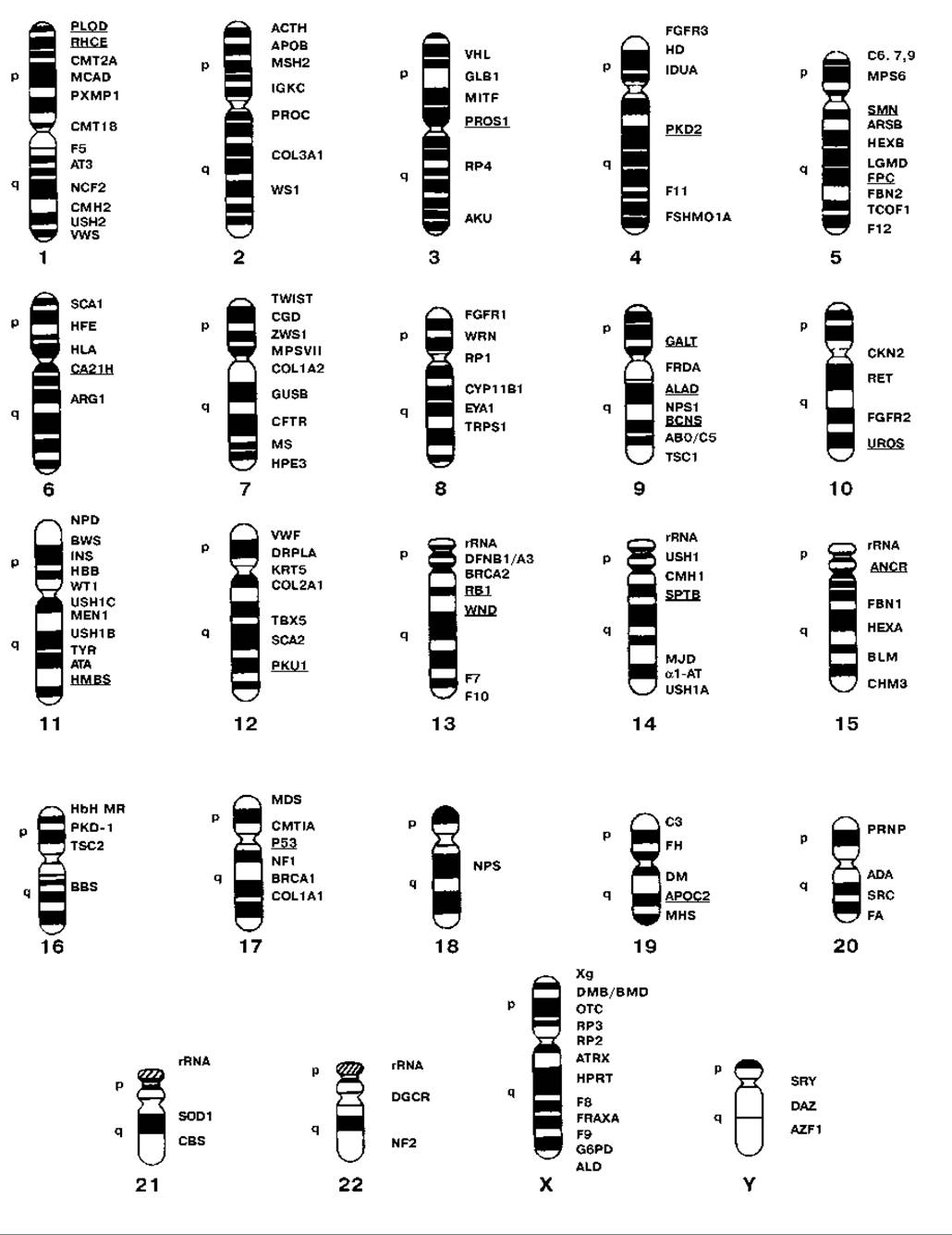
|
a1-AT (AAT) — 14q32.1 |
— alpha-1 antitrypsin deficiency |
|
AB0 — 9q34 |
— ABO Blood Groups |
|
ACTH — 2p23.3 |
— adrenocorticotropic hormone deficiency |
|
ADA — 20q 13.11 |
— severe combined immunodeficiency (SCID), adenosine deaminase (ADA) deficiency |
|
ALAD — 9q34 |
— acute hepatic porphyria |
|
HMBS — 11q 23.3 |
— acute intermittent porphyria |
|
AKU — 3q21-q23 |
— alkaptonuria |
|
ALD — Xq28 |
— adrenoleukodystrophy |
|
PKD1 — 16p 13.3-p 13.12 |
— Polycystic Kidney Disease, adult type 1 |
|
PKD2 — 4q21-q23 |
— polycystic kidney disease, adult type 2 |
|
APOB — 2p24 |
— abetalipoproteinemia |
|
APOC2 — 19q 13.2 |
— hyperlipoproteinemia, type Ib |
|
ARG1 — 6q23 |
— argininemia |
|
ARSB — 5q11-13 |
— mucopolysaccharidosis, type VI, Maroteaux–Lamy syndrome |
|
ANCR — 15q 11-q13 |
— Angelman syndrome |
|
ATA — 11q22.3 |
— ataxia-telangiectasia |
|
AT3 — 1q23-q25 |
— antithrombin III deficiency |
|
ATRX — Xq13 |
— alpha-thalassemia/mental retardation syndrome |
|
AZF1 — Yq11 |
— azoospermia factor, azoospermia ( Sertoli Cell-only syndrome ) |
|
BBS2 — 16q21 |
— Bardet–Biedl syndrome 2 |
|
BLM — 15q26.1 |
— Bloom syndrome |
|
BRCA1 — 17 q21 |
|
|
BRCA2 — 13q12.3 |
— familial breast/ovarian cancer 2 |
|
BWS — 11p 15.5 |
— Beckwith–Wiedemann syndrome |
|
C3 — 19p 13.2-13.3 |
— Complement component 3 deficiency |
|
C5 — 9q34.1 |
— complement component 5 deficiency |
|
C6 — 5p13 |
— complement component 6 deficiency |
|
C7 — 5p13 |
— complement component 7 deficiency |
|
C9 — 5p13 |
— complement component 9 deficiency |
|
CA21H — 6p21.3 |
— congenital adrenal hyperplasia due to 21-hydroxylase deficiency |
|
CBS — 21q22.3 |
— homocystinuria |
|
UROS — 10q25.2-q26.3 |
— congenital erythropoietic porphyria |
|
CFTR — 7q31.2 |
— cystic fibrosis |
|
CKN2 — 10q 11 |
— Cockayne syndrome 2, late onset |
|
CMH1 — 14q12 |
— familial hypertrophic cardiomyopathy, type 1 |
|
CMH2 — 1q32 |
— familial hypertrophic cardiomyopathy, type 2 |
|
CMH3 — 15q22.1 |
— familial hypertrophic cardiomyopathy, type 3 |
|
CMT1A — 17p 11.2 |
— Charcot–Marie–Tooth disease, type 1A |
|
CMT1B — 1q22 |
— Charcot–Marie–Tooth disease, type 1B |
|
CMT2A — 1p36.2 |
— Charcot–Marie–Tooth disease, types 2A1 and 2A2 |
|
COL1A1 — 17 q21.31-q22 |
— Collagen type I alpha1 chain, Osteogenesis Imperfecta |
|
COL1A2 — 7q22.1 |
— collagen type I alpha2 chain, osteogenesis imperfecta |
|
COL2A1 — 12q13.11-q13.2 |
— collagen type II, Stickler syndrome |
|
COL3A1 — 2q31 |
— collagen type III alpha1 chain, Ehlers–Danlos syndrome type III and IV |
|
CYP11B1 — 8q21 |
— congenital adrenal hyperplasia due to 11-beta-hydroxylase deficiency |
|
DAZ — Yq11 |
— deleted in azoospermia (Sertoli cell-only syndrome) |
|
DFNB1/A3 — 13q11-q 12 |
— nonsyndromic sensorineural deafness, autosomal dominant |
|
DM - 19q13.2-q13.3 |
— myotonic dystrophy |
|
DMD/BMD — Xp21.2 |
— dystrophin, Duchenne and Becker muscular dystrophy |
|
DRPLA — 12p13.3 |
— dentatorubral-pallidoluysian atrophy |
|
PLOD — 1p36.3-p36.2 |
— Ehlers–Danlos syndrome, type VI |
|
EYA1 — 8q13.3 |
— branchio-oto-renal syndrome |
|
F5 — 1q23 |
— coagulation factor V, hemorrhagic diathesis |
|
F7 — 13q34 |
— coagulation factor VII, factor VII deficiency |
|
F8 — Xq28 |
— coagulation factor VIII, hemophilia A |
|
F9 — Xq27.1-q27.2 |
— coagulation factor IX, Christmas disease, hemophilia B |
|
F10 — 13q34 |
— coagulation factor X, factor X deficiency |
|
F11 — 4q3.5 |
— coagulation factor XI, factor XI deficiency |
|
F12 — 5q33-qter |
— coagulation factor XII, factor XII deficiency |
|
FPC — 5q21-q22 |
— familial adenomatous polyposis of the colon, Gardner syndrome |
|
FBN1 — 15q21.1 |
— fibrillin-1, Marfan Syndrome |
|
FBN2 — 5q23-q31 |
— fibrillin-2, congenital contractural arachnodactyly |
|
FGFR1 — 8p 11.2-p 11.1 |
— fibroblast growth factor receptor 1, Pfeiffer syndrome |
|
FGFR2 — 10q26 |
— fibroblast growth factor receptor 2, Crouzon, Pfeiffer, and Apert syndromes |
|
FGFR3 — 4p16.3 |
— fibroblast growth factor receptor 3, Achondroplasia, Thanatophoric Dysplasia, Hypochondroplasia |
|
FH — 19p 13.2 |
— familial hypercholesterolemia |
|
FRAXA (FRM1) — Xq27.3 |
— fragile X syndrome |
|
FRDA — 9q13 |
— Friedreich ataxia |
|
FSHMD1A — 4q35 |
— facioscapulohumeral muscular dystrophy |
|
GALT — 9p 13 |
— galactosemia |
|
BCNS — 9q31 |
— basal cell nevus syndrome, Gorlin syndrome |
|
GLB1 — 3p21.33 |
— GM1-gangliosidosis |
|
G6PD — Xq28 |
— glucose-6-phosphate dehydrogenase, glucose-6-phosphate dehydrogenase deficiency |
|
GUSB — 7q21.11 |
— mucopolysaccharidosis type VII, Sly syndrome |
|
HBB — 11p15.5 |
— beta-globin Gene, beta-thalassemia |
|
HD — 4p16.3 |
— Huntington's chorea |
|
HEXA — 15q23-q24 |
— hexosaminidase A, GM2-gangliosidosis (Tay–Sachs disease) |
|
HEXB — 5q13 |
— hexosaminidase B, Sandhoff disease |
|
HFE — 6p21.3 |
— hemochromatosis |
|
HPRT — Xq26-q27.2 |
— hypoxanthine-guanine phosphoribosyltransferase, Lesch–Nyhan syndrome |
|
HLA — 6p21.3 |
|
|
HPE3 — 7q36 |
— holoprosencephaly 3 |
|
IDUA — 4p16.3 |
— mucopolysaccharidosis type I, Hurler syndrome |
|
IGKC — 2p12 |
— immunoglobulin kappa light chain, kappa light chain deficiency |
|
DGCR — 22q 11.2 |
— DiGeorge syndrome |
|
INS — 11p15.5 |
— Insulin-dependent Diabetes Mellitus, rare form |
|
KRT5 — 12q13 |
— epidermolysis bullosa simplex, Köbner type |
|
LGMD7 — 5q31 |
— limb-girdle muscular dystrophy |
|
MCAD — 1p3 |
— medium-chain acyl-CoA dehydrogenase, medium-chain acyl-CoA dehydrogenase deficiency |
|
MDS — 17р 13.3 |
— Miller–Dieker lissencephaly syndrome |
|
MEN1 — 11q13 |
— multiple endocrine neoplasia type 1 |
|
MHS — 19q13.1 |
— malignant hyperthermia 1 |
|
MITF — 3p14.1-р12.3 |
— Waardenburg syndrome, type 2A |
|
MJD — 14q24.3-q31 |
— Machado–Joseph disease, spinocerebellar ataxia type 3 |
|
MPS6 — 5q11—q 13 |
— Maroteaux–Lamy syndrome, several forms |
|
MSH2 — 2p22-p21 |
— hereditary nonpolyposis Colorectal Cancer, type 1 |
|
NCF2 — 1q25 |
— chronic granulomatous disease due to NCF2 deficiency |
|
NF1 — 17q11.2 |
— neurofibromatosis type 1, von Recklinghausen disease |
|
NF2 — 22q12.2 |
— neurofibromatosis type 2, bilateral acoustic neuroma |
|
NPD — 11p15.4—p 15.1 |
— Niemann–Pick disease, types A and B |
|
NPC — 18q11-q12 |
— Niemann–Pick disease, types C and D |
|
NPS1 — 9q34.1 |
— nail-Patella syndrome |
|
OTC — Xp21.1 |
— Ornithine transcarbamylase, ornithine transcarbamylase deficiency |
|
Р53 — 17p 13.1 |
— p53 protein, Li–Fraumeni syndrome |
|
PKU1 — 12q24.1 |
— phenylketonuria |
|
PROC — 2q13-q14 |
— protein C, Thrombophilia due to protein C deficiency |
|
PROS1 — 3p 11.1—q11.2 |
— protein S, coagulopathy |
|
PRNP — 20p12-pter |
— prion protein, Creutzfeldt–Jakob disease |
|
PWS — 15q11 |
— Prader–Willi syndrome |
|
PXMP1 — 1p22-p21 |
— Zellweger syndrome, type 2 |
|
RB1 — 13q14.1-q14.2 |
— retinoblastoma |
|
RET — 10q 11.2 |
— medullary thyroid carcinoma, multiple endocrine neoplasia 2A and 2B, familial Hirschsprung disease |
|
RHCE — 1p36.2-p34 |
— Rhesus factor, Rh-null syndrome (amorphic type) |
|
RP1 — 8q11-q13 |
— retinitis pigmentosa 1 |
|
RP2 — Xp11.3 |
— retinitis pigmentosa 2 |
|
RP3 — Xp21.1 |
— retinitis pigmentosa 3 |
|
rRNA |
— ribosomal RNA |
|
SCA1 — 6p23 |
— spinocerebellar ataxia 1 |
|
SCA2 — 12q24 |
— spinocerebellar ataxia 2 |
|
SPTB — 14q22 -q23.2 |
— spherocytosis, type 1 |
|
SMN — 5q12.2-q13.3 |
— spinal muscular atrophy, types 1-4 |
|
SOD1 — 21q22.1 |
— AMYOTROPHIC LATERAL SCLEROSIS due to superoxide dismutase deficiency, familial form |
|
SRY — Yp11.3 |
— Testis-determining factor, gonadal dysgenesis, XY type |
|
TBX5 — 12q24.1 |
— Holt–Oram syndrome |
|
TCOF1 — 5q32-q33.1 |
— Treacher Collins syndrome (Franceschetti syndrome) |
|
TRPS1 — 8q24.12 |
— tricho-rhino-phalangeal syndrome, types I and III |
|
TSC1 — 9q34 |
— tuberous sclerosis 1 |
|
TSC2 — 16p13.3 |
— tuberous sclerosis 2 |
|
TYR — 11q14-q21 |
— oculocutaneous albinism, types 1A and 1B |
|
USH1A — 14q32 |
— Usher syndrome, type 1A |
|
USH1B — 11q13.5 |
— Usher syndrome, type 1B |
|
USH1C — 11p 15.1 |
— Usher syndrome, type 1C |
|
USH2 — 1q41 |
— Usher syndrome, type 2A |
|
VWS — 1q32-q41 |
— Van der Woude syndrome |
|
VHL — 3p26-p25 |
— von Hippel–Lindau syndrome |
|
VWF — 12p13.3 |
— von Willebrand disease |
|
WND — 13q14.3-q21.1 |
— Wilson disease |
|
WRN — 8p12—p 11.2 |
— Werner syndrome |
|
WS1 — 2q35 |
— Waardenburg syndrome, type 1 |
|
WT1 — 11p13 |
— Wilms Tumor 1 |
|
ZWS1 — 7q21-q22 |
— Zellweger syndrome, type 1 |
Last update: 11/08/2026
Editorial and Educational Adaptation: This material has been compiled based on the primary/original source text. The project team performed an editorial review, corrected technical inaccuracies, structured sections, and adapted the content for an educational format.
What was processed:
- elimination of formatting defects (OCR errors, structural breaks, corrupted characters);
- editorial organization of content;
- standardization of terminology in accordance with academic sources;
- verification of factual statements against the original source text.
All mentions of the author, publication year, and origin of the primary text have been preserved in accordance with the source.