BIOCHEMISTRY - L. Stryer - 1984
VOLUME 2
PART III. BIOSYNTHESIS OF MACROMOLECULE PRECURSORS
CHAPTER 20. BIOSYNTHESIS OF MEMBRANE LIPIDS AND STEROID HORMONES
20.15. Hepatic Cholesterol Synthesis Is Inhibited by Dietary Cholesterol
Class="center">Fig. 20.15. Synthesis of glycocholate, a major Bile acid

20.16. Cholesterol and Other Lipids Are Transported to Target Organs by Various Lipoproteins
Cholesterol, triacylglycerols, and other Lipids are transported through Body Fluids by a family of Lipoproteins classified by density in order of increasing density (Table 20.1): chylomicrons, very-low-density lipoproteins (VLDL), low-density lipoproteins (LDL), and high-density lipoproteins (HDL). These lipoproteins consist of a hydrophobic lipid core surrounded by Polar Lipids and an apolipoprotein shell. To date, eight types of apolipoproteins have been isolated and characterized: apo-A-I, apo-A-II, apo-B, apo-C-I, apo-C-II, apo-C-III, apo-D, and apo-E. These complexes solubilize highly hydrophobic lipids. Furthermore, the Proteins embedded in these complexes carry signals that regulate the uptake of specific lipids into target Tissues and their efflux from those tissues.
Table 20.1. Plasma Lipoproteins
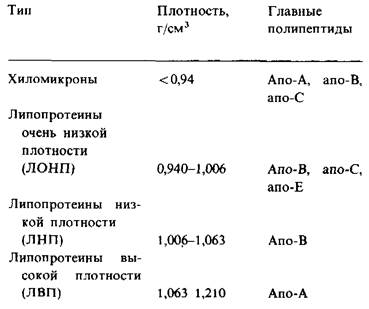
Plasma lipoproteins are synthesized and secreted by The Liver and intestine. Chylomicrons, the largest lipoproteins, transport dietary triacylglycerols, cholesterol, and other lipids from the intestine to adipose tissue and the liver. They have a very low density (<0.94 g/cm3) due to their high triacylglycerol content, and they contain less than 2% protein. Triacylglycerols within chylomicrons are hydrolyzed within minutes by lipases in the capillaries of adipose tissue and other peripheral tissues. Cholesterol-enriched chylomicron remnants, known as remnant particles, are taken up by the liver. Very-low-density lipoproteins are synthesized primarily in the liver. VLDLs deliver newly synthesized endogenous triacylglycerols to adipose tissue. VLDLs that fail to reach adipose tissue are converted into low-density lipoproteins, which are rich in cholesterol esters. Most of the cholesterol in LDL is in the form of linoleate esters—a polyunsaturated fatty acid. The Role of LDL is to deliver cholesterol to peripheral tissues and regulate de novo cholesterol synthesis within them, an aspect we will examine below. High-density lipoproteins are synthesized in the liver and are rich in Phospholipids and cholesterol. One of the Functions of HDL is to transport cholesterol from peripheral tissues back to the liver.
20.17. Low-Density Lipoprotein Receptors Play a Key Role in Regulating Cholesterol Metabolism
Cholesterol is a component of all Introduction/5.html">Eukaryotic Cell membranes and is essential for the growth and survival of higher organisms. However, excess cholesterol can be detrimental due to atherosclerosis, which involves the deposition of cholesterol ester plaques. Clearly, Cholesterol METABOLISM must be tightly regulated. The regulatory mechanisms in the liver—the primary site of cholesterol synthesis—have already been discussed: dietary cholesterol decreases both the activity and The amount of 3-hydroxy-3-methylglutaryl-CoA reductase, The enzyme catalyzing the rate-limiting step of biosynthesis. Studies on cultured human fibroblasts conducted by Michael Brown and Joseph Goldstein shed light on cholesterol regulation in other cell types. As a rule, Cells outside the liver and intestine obtain cholesterol from Blood serum rather than synthesizing it de novo. More specifically, low-density lipoproteins are the principal source of cholesterol. The cellular uptake of LDL-bound cholesterol involves the following steps:
1. LDL binds to a specific receptor on The Plasma Membrane of extrahepatic cells. LDL receptors are localized in specialized regions called coated pits that contain clathrin (Section 29.32).
2. The receptor-LDL complex enters The Cell via endocytosis; that is, The cell membrane invaginates near the complex and its edges fuse to form an endocytic vesicle (Fig. 20.16).
Fig. 20.16. Endocytosis of LDL bound to its specific receptor On the surface of cultured human fibroblasts (LDL rendered visible by ferritin labeling). A — electron micrograph showing LDL-ferritin (dark dots) bound to a coated pit on the cell surface; B — this region invaginates during endocytosis to form an endocytic vesicle

3. Vesicles containing LDL fuse with Lysosomes, which harbor a diverse array of hydrolytic Enzymes. The protein component of LDL is hydrolyzed to free Amino Acids, while the cholesterol esters within LDL are hydrolyzed by lysosomal acid lipase.
4. The released unesterified cholesterol can be utilized for membrane biosynthesis or re-esterified for intracellular storage. Cholesterol activates acyl-CoA:cholesterol acyltransferase, the enzyme catalyzing this reaction. Re-esterified cholesterol is associated predominantly with oleate or palmitoleate—monounsaturated Fatty acids (i.e., fatty acids with a single double bond)—unlike the cholesterol esters in LDL, which are enriched in polyunsaturated linoleic acid.
The cellular cholesterol content in cells actively engaged in LDL uptake is regulated through two pathways. First, the released cholesterol suppresses the synthesis of 3-hydroxy-3-methylglutaryl-CoA reductase, thereby inhibiting de novo cholesterol synthesis. Second, the LDL receptor itself is subject to feedback regulation. In fibroblasts, the half-life of the LDL receptor is approximately one day. If the cell contains an excess of cholesterol, the synthesis of new LDL receptors is halted, thereby blocking the influx of additional cholesterol from plasma lipoproteins.
Last update: 06/08/2026
Editorial and Educational Adaptation: This material has been compiled based on the primary/original source text. The project team performed an editorial review, corrected technical inaccuracies, structured sections, and adapted the content for an educational format.
What was processed:
- elimination of formatting defects (OCR errors, structural breaks, corrupted characters);
- editorial organization of content;
- standardization of terminology in accordance with academic sources;
- verification of factual statements against the original source text.
All mentions of the author, publication year, and origin of the primary text have been preserved in accordance with the source.