BIOCHEMISTRY - L. Stryer - 1984
VOLUME 2
PART II GENERATION AND STORAGE OF METABOLIC ENERGY
CHAPTER 17. FATTY ACID METABOLISM
17.7. Carnitine Transports Long-Chain Activated Fatty Acids into the Mitochondrial Matrix
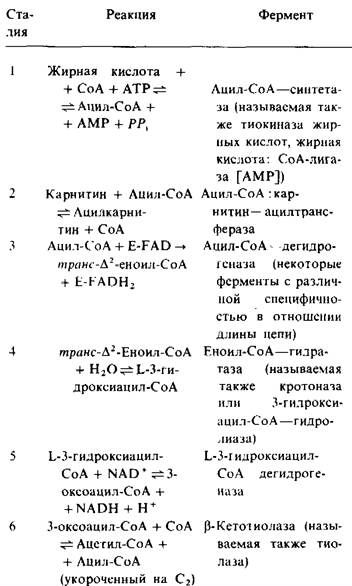
Fatty acids are activated on the outer mitochondrial membrane and oxidized in the mitochondrial matrix. Being a long-chain molecule, acyl-CoA cannot readily cross The inner mitochondrial membrane, requiring a specialized transport mechanism. Carnitine serves as the carrier that transports long-chain activated fatty acids across the inner mitochondrial membrane. The acyl group is transferred from the sulfur atom of CoA to the hydroxyl group of carnitine, forming acylcarnitine, which then diffuses across the inner mitochondrial membrane. On the matrix-facing side of the membrane, the acyl group is transferred back to CoA. This reaction is thermodynamically favorable because the O-acyl bond in carnitine possesses a high group-transfer potential. These transacylation reactions are catalyzed by acyl-CoA:carnitine acyltransferase.
Class="center">
One might expect that individuals with a defect in this transferase or with carnitine deficiency would exhibit impaired long-chain Fatty acid oxidation. Such a defect was indeed discovered in identical twins who had suffered from painful Muscle cramps since early childhood. These pains were alleviated by fasting, exercise, and the consumption of a high-fat diet—all three of which are conditions where fatty acid oxidation serves as the primary energy-yielding process. The Enzymes of Glycolysis and Glycogenolysis were normal. Triacylglycerol lipolysis was also within the normal range, as evidenced by elevated plasma concentrations of unesterified fatty acids following fasting. Analysis of muscle biopsy samples revealed that long-chain fatty acid (acyl-CoA) synthetase was fully active. Furthermore, the METABOLISM of medium-chain fatty acids (C8 and C10) proceeded normally. It is well known that medium-chain acyl-CoAs do not require carnitine to cross the mitochondrial matrix. This case clearly demonstrates that a disruption in the translocation of a metabolite between cellular compartments can be a cause of disease.
17.8. Each Cycle of Fatty Acid Oxidation Generates Acetyl-CoA, NADH, and FADH2
Saturated acyl-CoA is degraded through a repeating sequence of four reactions: oxidation involving flavin adenine dinucleotide (FAD), Hydration, oxidation involving NAD+, and thiolysis involving CoA. In the process, the fatty acid chain is shortened by two carbon atoms, generating FADH2, NADH, and acetyl-CoA. David Green, Severo Ochoa, and Feodor Lynen made major contributions to elucidating this reaction sequence, naming it the β-oxidation pathway.
The first reaction in each degradation cycle of acyl-CoA is its oxidation by acyl-CoA dehydrogenase, leading to The formation of enoyl-CoA with a trans-double bond between C-2 and C-3.
Ацил-СоА + E-FAD → транс-∆2- -Еноил-СоА + E-FADH2.
Interestingly, the dehydrogenation of acyl-CoA closely parallels the dehydrogenation of succinate in The Tricarboxylic Acid Cycle. In fact, the first three reactions in each cycle of fatty acid breakdown closely resemble the final Stages of the tricarboxylic acid cycle:
Ацил-СоА → Енол-СоА → Гидроксиацил- СоА → Оксоацил-СоА
Сукцинат → Фумарат → Малат → Оксалоацетат.
The next step is the hydration of the double bond between C-2 and C-3, catalyzed by enoyl-CoA hydratase.
транс-∆2-Еноил-СоА + Н2O → L-3-гидроксиацил-СоА.
The hydration of enoyl-CoA is stereospecific, much like the hydration of fumarate and aconitate. Hydration of the trans-∆2 double bond yields exclusively the L-isomer of 3-hydroxyacyl-CoA. The enzyme also hydrates the cis-∆2 double bond, but in this case, the reaction product is the D-isomer. We will return briefly to this point
when discussing the Oxidation of Unsaturated fatty acids.
The hydration of enoyl-CoA is followed by the second oxidation reaction, in which the hydroxyl group at C-3 is converted into an oxo group, generating NADH. This reaction is catalyzed by L-3-hydroxyacyl-CoA dehydrogenase, which exhibits absolute Specificity for the L-isomer of the hydroxyacyl substrate.
L-3-гидроксиацил-СоА + NAD+ ⇄ 3-оксоацил-СоА + NADH + Н+.
The preceding reactions resulted in The oxidation of the methylene group at C-3 to an oxo group. The final stage involves the thiolytic Cleavage of 3-oxoacyl-CoA by the thiol group of a second molecule of CoA, yielding acetyl-CoA and an acyl-CoA shortened by two carbon atoms. This thiolytic cleavage is catalyzed by β-ketothiolase.
3-Оксоацил-СоА + HS—СоА ⇄ Ацетил-СоА + Ацил-СоА.
(n углеродов) (n — 2 углеродов)
The shortened acyl-CoA then undergoes the next cycle of oxidation, beginning with the reaction catalyzed by acyl-CoA dehydrogenase. Beta-ketothiolase, hydroxyacyl dehydrogenase, and enoyl-CoA hydratase possess broad specificity with respect to the length of the acyl group.
17.9. Complete Oxidation of Palmitate Yields 129 ATP
We can calculate the energy yield from the oxidation of a fatty acid. In each reaction cycle, acyl-CoA is shortened by two carbons, yielding one molecule each of FADH2, NADH, and acetyl-CoA.
Сn-ацил-СоА + FAD + NAD+ + Н2O + СоА → Сn-2-ацил-СоА + FADH2 + NADH + Ацетил-СоА + Н+.
The breakdown of palmitoyl-CoA (C16-acyl-CoA) requires seven cycles. In the seventh cycle, C4-oxoacyl-CoA is cleaved by thiolysis into two molecules of acetyl-CoA. Consequently, the overall stoichiometry for the oxidation of palmitoyl-CoA is as follows:
Пальмитоил-СоА + 7FAD + 7NAD+ + 7СоА + 7Н2O → 8 Ацетил-СоА + 7FADH2 + 7NADH + 7Н+.
Oxidation of each of these NADH molecules via the Respiratory Chain generates three ATP molecules, whereas the oxidation of each FADH2 yields two ATP molecules because electrons enter the chain at the level of coenzyme Q. Recall that the oxidation of acetyl-CoA in the tricarboxylic acid cycle yields 12 ATP. Therefore, the total number of ATP molecules generated from the oxidation of palmitoyl-CoA is: 14 from the 7 FADH2, 21 from the 7 NADH, and 96 from the 8 acetyl-CoA molecules, totaling 131. Two high-energy phosphate bonds are consumed to activate palmitate when ATP is cleaved to AMP and 2Pi. Thus, the net ATP yield from the Complete oxidation of palmitate is 129 molecules.
The Efficiency of Energy storage during fatty acid oxidation can be determined from The amount of ATP produced and the Standard Free energy of palmitic acid oxidation to CO2 and H2O, measured calorimetrically. The standard Free energy of Hydrolysis for 129 ATP is −940 kcal (129 × −7.3 kcal). The standard free energy of palmitate oxidation is −2340 kcal. Consequently, the energy storage efficiency resulting from fatty acid oxidation under standard conditions is approximately 40%, which is comparable to the values for glycolysis, the tricarboxylic acid cycle, and Oxidative Phosphorylation.
Table 17.2. Key Reactions in Fatty Acid Oxidation
Last update: 06/08/2026
Editorial and Educational Adaptation: This material has been compiled based on the primary/original source text. The project team performed an editorial review, corrected technical inaccuracies, structured sections, and adapted the content for an educational format.
What was processed:
- elimination of formatting defects (OCR errors, structural breaks, corrupted characters);
- editorial organization of content;
- standardization of terminology in accordance with academic sources;
- verification of factual statements against the original source text.
All mentions of the author, publication year, and origin of the primary text have been preserved in accordance with the source.