BIOCHEMISTRY - L. Stryer - 1984
VOLUME 1
PART I. CONFORMATION AND DYNAMICS
CHAPTER 6. INTRODUCTION TO ENZYMOLOGY
6.18. Sequential Model of Allosteric Interaction
Allosteric interactions can also be described using the sequential model developed by Daniel Koshland. In its simplest form, the model is based on three postulates.
1. Each subunit can exist in one of two possible conformational states (R or T).
2. Substrate binding alters the conformation of the specific subunit to which it attaches. The conformation of the other subunit does not change significantly in the process.
3. Conformational changes induced by substrate binding at one subunit can either increase or decrease the substrate affinity of another subunit within the same enzyme molecule.
According to the sequential model, The process of substrate binding by an allosteric enzyme proceeds as illustrated in Fig. 6.24. Binding is cooperative if the RT form has a higher affinity for the substrate than the TT form.
Class="center">Fig. 6.24. Sequential model of cooperative substrate binding by an allosteric enzyme. The unliganded Active Site of the RT form has a higher affinity for the substrate than the active sites of the TT form
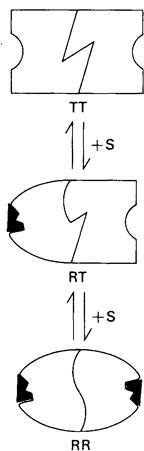
The simple sequential model of interaction differs from the concerted model in several respects. First, the sequential model does not assume an equilibrium between the R and T forms in the absence of the substrate. Instead, substrate attachment induces the transition from T to R. Second, the conformational transition from T to R in different enzyme subunits occurs sequentially rather than in a concerted manner. The hybrid RT form plays an important role in the sequential model, whereas the concerted model rules out the existence of an RT hybrid form. The concerted model is based on the premise that Symmetry plays a crucial role in subunit interactions within Oligomeric Proteins and therefore assumes that symmetry is conserved during allosteric transitions. By contrast, the sequential model is built on the assumption that subunits can interact even when they are in different conformational states. Finally, another difference is that in the concerted model, homotropic interactions must always be positive, whereas in the sequential model they can be either positive or negative. Whether the second substrate molecule will bind to the enzyme more or less tightly than the first depends on The Nature of the structural changes triggered by the attachment of the first substrate molecule.
Which of the models is correct? Some allosteric proteins are well described by the concerted model, whereas others appear to follow the sequential model. However, There is a group of allosteric proteins to which neither model applies. It is hypothesized that these proteins possess more than two conformational states (beyond R and T). Consequently, describing the allosteric properties of such proteins requires more complex models.
6.19. Hydrogen Bonds, Electrostatic, and van der Waals Interactions in Enzyme-Substrate Complexes
Reversible molecular interactions in biological systems are mediated by Three types of forces. The folding of macromolecules into complex structures, the binding of a substrate to an enzyme, and intercellular interactions—in short, all molecular interactions in biological systems—are driven by The formation of Hydrogen Bonds, as well as electrostatic and Structure/103.html">Van der Waals interactions. These three primary types of noncovalent bonds differ in their geometry, energy, and Specificity. Moreover, although their behavior is heavily influenced by the Presence of Water, this effect manifests itself differently in each case. Let us examine each of these major bond types in detail.
6.20. Charged Substrates Can Bind to Oppositely Charged Enzyme Groups
A charged group on a substrate can interact with an oppositely charged group on the enzyme. The strength of such an electrostatic interaction is determined by Coulomb's law:
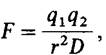
where q1 and q2 are the charges of the respective groups, r is the distance between them, and D is the Dielectric Constant of the medium. Electrostatic Interactions are strongest in a vacuum (where D = 1) and weakest in a medium such as water (where D = 80).
An example of electrostatic interaction is the binding of glycyl-L-Tyrosine to Carboxypeptidase A, a proteolytic enzyme that cleaves C-terminal amino acid residues. The negatively charged terminal carboxyl group of the dipeptide substrate interacts with the positively charged guanidinium group of an Arginine residue on the enzyme. The distance between these two oppositely charged groups is 2.8 Å:
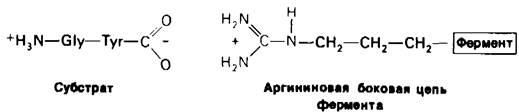
This type of interaction is also referred to as an ionic bond, salt bond, salt bridge, or ion pair. All these terms have the same meaning: an electrostatic interaction between oppositely charged groups. Electrostatic interactions can occur between a negatively charged substrate and the positively charged side chain of a Lysine or arginine residue. If the pK values of the imidazole group of a Histidine residue or the terminal amino group of a polypeptide chain render them positively charged at a given medium pH, they can also function as potential binding sites for a negatively charged substrate. Conversely, if the substrate carries a positive charge, the potential binding sites are the negatively charged carboxyl groups of aspartate and glutamate, as well as the terminal carboxyl group of the polypeptide chain.
Last update: 06/08/2026
Editorial and Educational Adaptation: This material has been compiled based on the primary/original source text. The project team performed an editorial review, corrected technical inaccuracies, structured sections, and adapted the content for an educational format.
What was processed:
- elimination of formatting defects (OCR errors, structural breaks, corrupted characters);
- editorial organization of content;
- standardization of terminology in accordance with academic sources;
- verification of factual statements against the original source text.
All mentions of the author, publication year, and origin of the primary text have been preserved in accordance with the source.