Protein Chemistry. Structure, Properties, Research Methods - Shendryk A.N. 2022
Protein Structure
Protein Structure
Determination of the Structure of C-Terminal Residues in Peptide Chains
Peptide chain sequencing begins with the identification of terminal Amino Acids. In a linear (unbranched) peptide, every macromolecule contains exactly two such residues: the N- and C-terminal amino acids. In Proteins with branched peptide chains, their number may be greater. The following techniques are used to determine the C-terminal residue.
> Treatment of the protein (peptide) with hydrazine. It reacts with the carbonyl group of each peptide bond, cleaving it to form acylhydrazide derivatives of all amino acid residues except the C-terminal one. The C-terminal residue remains unmodified because its α-COOH group is not involved in a peptide bond.
Class="center">
To identify the C-terminal α-amino acid(s), it is extracted from the mixture of acylhydrazides and its Structure is determined using physicochemical Analytical Methods. Alternatively, another approach can be used: treating the solution with benzaldehyde. It reacts with acylhydrazides to form Water-insoluble Schiff bases that precipitate out, while the free amino acids remain in solution.
> Enzymatic Cleavage of the C-terminal amino acid using carboxypeptidase, a digestive enzyme secreted by the mammalian gastric mucosa. This enzyme selectively cleaves C-terminal residues in peptide chains. To determine The structure of the C-terminal amino acid by this method, one studies The kinetics of the accumulation of amino acids released during Enzymatic Hydrolysis within the reaction products. Since the enzyme cleaves successive terminal amino acids (not only those present in the original protein, but also the newly exposed ones following cleavage), the STRUCTURE OF THE initial peptide's C-terminal amino acid can be determined from its rate of accumulation or The amount of amino acid formed at the initial stage of the reaction. Ideally, The amino acid that occupies the C-terminal position in the original protein will accumulate at the maximum rate (reaching the highest concentration). The second, third, and subsequent amino acids from the C-terminus will accumulate at progressively lower rates.
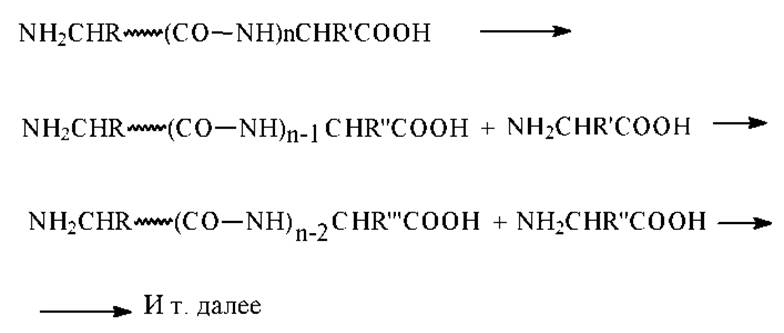
This approach allows for the Determination of the sequence of several (up to 10 or more) amino acid residues in a peptide chain starting from its C-terminus.
This method was proposed by Lensson in 1949. It has several limitations that often complicate the Determination of C-terminal structures. The main drawbacks include:

> Differences in the cleavage rates of various amino acids under identical conditions. Aromatic residues are cleaved most readily, followed by amino acids with long aliphatic chains, and then those with short chains.
> Very slow cleavage rates for dicarboxylic and diamino acids.
> Proline and hydroxyproline are not cleaved at all.
> The cleavage rate depends on the structure of the penultimate Amino Acid and the overall conformation of the protein molecule.
All of this frequently necessitates additional verification of the data obtained via the carboxypeptidase method. For instance, if the enzyme fails to cleave a C-terminal amino acid, it remains ambiguous whether the terminus is blocked or simply consists of proline (or hydroxyproline).
Last update: 06/08/2026
Editorial and Educational Adaptation: This material has been compiled based on the primary/original source text. The project team performed an editorial review, corrected technical inaccuracies, structured sections, and adapted the content for an educational format.
What was processed:
- elimination of formatting defects (OCR errors, structural breaks, corrupted characters);
- editorial organization of content;
- standardization of terminology in accordance with academic sources;
- verification of factual statements against the original source text.
All mentions of the author, publication year, and origin of the primary text have been preserved in accordance with the source.