Pharmacognosy with the Basics of Plant Biochemistry - Kovalyov V. M. 2004
Special Section
Alkaloids
Medicinal plants and raw materials containing quinolizidine alkaloids
LANCEOLATE THERMOPSIS HERB — HERBA THERMOPSIDIS,
LANCEOLATE THERMOPSIS SEEDS — SEMINA THERMOPSIDIS
Lanceolate thermopsis, mouse pea — Thermópsis lanceolata R. Br., fam. Fabaceae
Lanceolate thermopsis; the name originates from the Greek thermos (lupine) and opsis (appearance), meaning "resembling a lupine"; Latin lanceolatus, -a means lanceolate, from lanceta (lancet).
A perennial herbaceous plant, 50–150 cm in height.
Stems are simple or branched, slightly pubescent. Leaves are alternate, trifoliate, on short petioles, with oblong-lanceolate leaflets 3–6 cm long and 5–12 mm wide, almost glabrous above, covered with appressed hairs beneath, featuring two large ovate-lanceolate stipules. Flowers are gathered in whorls forming a loose terminal raceme consisting of 2–6 whorls. Corolla is papilionaceous, yellow. The color of stems and leaves is grayish-green. Fruit is a pod, oblong-linear, flat, dark brown. Seeds are smooth, shiny, hard, 2.5–5.7 mm long, 0.5–3 mm thick, black, less frequently brownish.
Distribution. Grows in Siberia, the Baikal and Trans-Baikal regions — in steppes, foothills, lowlands, on sandy and saline soils; sometimes weeds crops.
Harvesting. The herb is harvested during the budding phase and at the beginning of flowering, prior to fruit formation. Both flowering and vegetative shoots are cut at a height of 3–5 cm above the ground, which ensures bud survival and Vegetative Reproduction. This can be done annually. Mature pods are harvested in September–November.
Dried in the sun, or during inclement weather — under a canopy, in attics, or in dryers at a Temperature of 50–60 °C.
Class="center">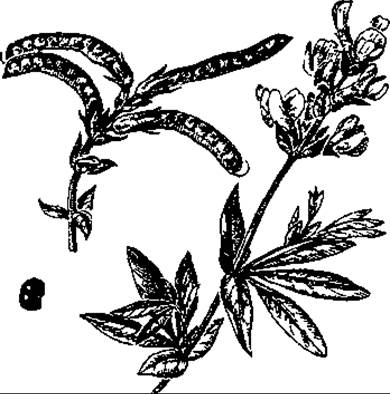
Seeds serve as an independent raw material. They are harvested during the period of full maturity, cleaned, and dried. The plant is poisonous.
Chemical composition of the raw material. The herb contains up to 2.5% Alkaloids, primarily thermopsine, its isomer anagyrine, homothermopsine, cytisine, methylcytisine, pachycarpine, as well as the glycoside thermopsilancin. Of all the alkaloids, homothermopsine is the most hydrogenated compound.
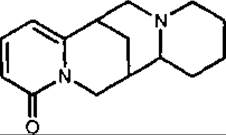
Thermopsine and anagyrine isomers
The herb also contains Flavonoids, saponins, Tannins, resins, mucilages, traces of essential oil, and ascorbic acid.
The seeds contain alkaloids, among which the cytisine content must be at least 2.5%. Pure cytisine is obtained at pharmaceutical manufacturing plants.
Biological activity and application. Thermopsis herb has served as a substitute for imported senega and ipecac roots as expectorant (emetic) agents. Dry thermopsis extract, cough tablets, dry adult cough mixture, and herb infusion are used as expectorants. Their activity is due to the presence of alkaloids and saponins. In small doses, thermopsis preparations stimulate the respiratory center, whereas in large doses, they induce vomiting and paralyze the centers of the Medulla Oblongata and Brain. Codtermops, a combined preparation of thermopsis extract with codeine, is used for coughs. Cytiton is a cytisine-based preparation exhibiting analeptic activity.
ALTERNATE-FLOWERED THERMOPSIS HERB — HERBA THERMOPSIDIS ALTERNIFLORAE
Alternate-flowered thermopsis — Thermópsis alterniflóra Rgl. et Schmalh., fam. Fabaceae
Alternate-flowered thermopsis
A perennial herbaceous plant, up to 90 cm in height. Stems are sparsely branched, pubescent. Leaves are alternate, palmately trifoliate, with two stipules. Leaflets are oblong-elliptic, up to 6 cm long and 2.5 cm wide. Inflorescence is a terminal raceme 3–9 cm long. Flowers are yellow, papilionaceous. Fruits are oblong-elliptic pods.
Distribution. An endemic species of the mountainous Regions of the Western Tien Shan; often forms dense thickets.
Harvesting. During the budding phase and early flowering, the above-ground mass is mowed, chopped in a silage cutter into pieces 2–6 cm long, spread in a thin layer on an asphalted area or canvas, and turned 2–3 times a day. Drying can also be carried out in dryers at 50–70 °C. The plant is poisonous.
Alternate-flowered thermopsis herb is processed at pharmaceutical industry enterprises to obtain cytisine (alkaloid content of at least 1%).
Biological activity and application. Cytiton (0.15% cytisine solution) stimulates the respiratory center in asphyxia, Shock states, intoxication, and respiratory arrest. Tabex tablets, which contain cytisine, are prescribed for smoking cessation.
PACHYCARPOUS SOPHORA HERB — HERBA SOPHORAE PACHYCARPAE
Pachycarpous sophora — Sophóra pachyearpci L., fam. Fabaceae
Pachycarpous sophora (Russian: софора толстоплодная); the name originates from the latinized Arabic name of one of the cassia species — *sofera*; and the latinized *pachycarpus, -a* — thick-fruited, derived from the Greek *pachus* — thick and *karpos* — fruit.
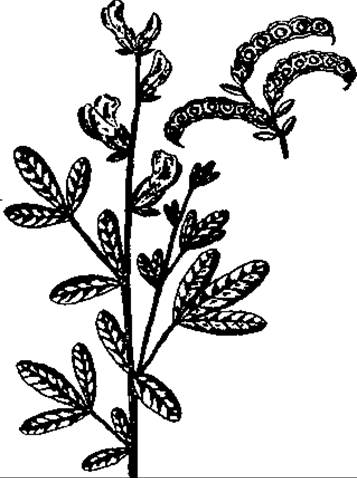
The plant is a perennial herbaceous species with several erect, silky-pubescent stems branching upwards, 60-80 cm in length. Leaves are alternate, petiolate, odd-pinnate, up to 18 cm long, with 6-12 pairs of elliptic leaflets up to 25 mm long and 10 mm wide, light green on both sides, and pubescent with appressed hairs. Flowers are bisexual, zygomorphic, gathered in spike-like elongated terminal racemes; the corolla is papilionaceous, cream-colored, up to 15 mm long. The fruit is a thick, club-shaped legume.
Distribution. Found in the plains and foothills of southern Kazakhstan, Uzbekistan, Turkmenistan, and Tajikistan. It is an agricultural weed.
Harvesting. The herb is cut with a sickle or knife at a height of 5-10 cm above the ground throughout the growing season, excluding the fruiting stage. The fruits contain alkaloids with a different therapeutic effect. Dried in the sun or in driers. The plant is poisonous.
Chemical COMPOSITION OF THE raw material. The herb and seeds contain quinolizidine alkaloids (2-3%). The main alkaloid is pachycarpine (at least 0.5%) — a colorless, thick, oily liquid that rapidly darkens and resinifies in the air; pachycarpine salts are crystalline. In addition, its optical isomer sparteine, sophorocarpine, anabazine, methylcytisine, and pachycarpine oxide are present. The raw material also contains flavonoids such as kaempferol, quercetin, genistein (0.08%), and organic acids.
Biological activity and application. Pachycarpine hydroiodide belongs to ganglionic blockers. It is used to stimulate labor activity and reduce Blood loss in the postpartum period. It improves Muscle Function in myopathy.

FIR CLUBMOSS HERB — HERBA SELAGINIS (HERBA HUPERZIAE)
Fir clubmoss — Huperzia selаgo (L.) Bernh. ex Schrank et Mert., syn. Lycopodium selago L., fam. Huperziaceae
Fir clubmoss (Russian: плаун баранец, баранец обыкновенный) is named in honor of the botanist Huperz; *selaqo* is the latinized Celtic name of the plant.
The plant is evergreen, spore-bearing, herbaceous, perennial, 5-25 cm high, with poorly developed roots (rhizoids). Stems are erect or ascending, branched, densely covered with linear-lanceolate, entire or finely serrate leaves featuring a white marginal band, papillar outgrowths, acute tips, spreading or upward-pointing, and arranged obliquely in eight longitudinal rows. Sporangia are located in the upper or middle part of the stem in the leaf axils. They are globular, grooved, and set on short stalks. Spores are very minuscule. Leaf-covered bulbils develop at the apex of stems and shoots, which fall off in autumn. It sporulates in June.
Distribution. Fir clubmoss grows in the tundra, northern forest zones, and corresponding alpine belts of more southern latitudes, often alongside *Lycopodium annotinum*. It is a rare plant in Ukraine, growing in shady forests and on rocks in the Carpathians and Polissia.
Harvesting. The raw material base is very limited. Even small annual harvests severely deplete natural resources. The plant should be harvested carefully, without damaging the roots and main shoots. The green and yellowing PARTS OF THE shoots are cut with a sharp knife after sporulation. To preserve natural stocks, at least five shoots must be left on each clump. Re-harvesting is permissible after 6-10 years. Fir clubmoss is listed in the Red Data Book of Ukraine. Its collection is permitted only under license, in compliance with harvesting regulations. Artificial drying is carried out at a temperature of 50 °C or in well-ventilated attics.
Chemical composition of the raw material. The herb contains alkaloids (0.4-1.1%): selagine, lycopodine, pseudoselagine. Among other classes of natural compounds, flavonoids of the quercetin group are known.
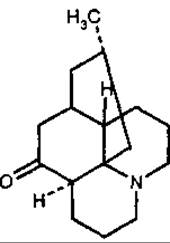
Lycopodine
Biological activity and application. A 5% decoction of the clubmoss herb is used for the Treatment of chronic alcoholism in inpatient settings under the strict supervision of a physician. After taking the decoction, alcohol consumption causes nausea, vomiting, severe salivation, sweating, muscle tremors, a drop in blood pressure, and pulse changes. The Essence of the treatment consists in developing a conditioned reflex aversion to alcohol. Overdose and unskilled use of fir clubmoss preparations can lead to severe poisoning and even death.
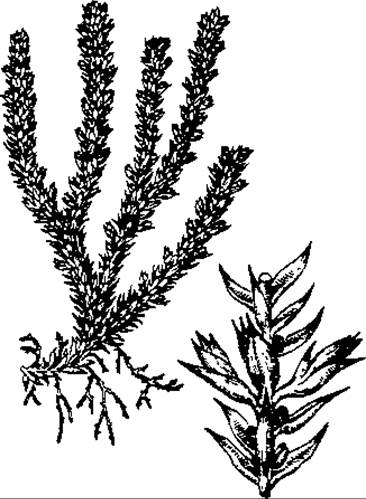
SECURINEGA SHOOTS — CORMІ SECURINEGAE
Bushy securinega — Securinega suffruticósa (Pall.) Rehd., fam. Euphorbiaceae
Semishrubby securinega (Russian: секуринега полукустарниковая, секуринега ветвицветковая); derived from the Latin *securis* — axe and *nego* — to resist.
The plant is a dioecious shrub up to 1.5 m tall, with straight, thin, glabrous branches. In cultivation and regions with severe winters, it is a subshrub that annually freezes back almost to the ROOT collar. Young shoots are ribbed, light yellow or brownish-brown; leaves are 1.5-7 cm long with stipules, alternate, entire, glabrous, short-petiolate, elliptic or elliptic-lanceolate, less commonly obovate. Flowers are unisexual, axillary, with a simple cup-shaped perianth, yellowish-green or green. The fruit is a three-celled capsule containing six seeds. Seeds are smooth, obtusely trihedral, with a thin seed coat. The plant is poisonous.
Distribution. It grows in the Primorye and Khabarovsk Territories and in eastern Transbaikalia. Securinega has been cultivated in botanical gardens and parks as an ornamental plant for nearly 200 years. It is cultivated in Ukraine, Russia, and Moldova.
Harvesting. Natural thickets are not used for raw material production. Slightly woody annual shoots are harvested from cultivated plants 2–3 times per season as they regrow, starting from the onset of flowering until fruiting. They are dried under a canopy in the open air, or preferably in dryers at a temperature of 50–60 °C.

Chemical composition of raw Materials. The main alkaloid is securinine. Its highest concentration (about 0.3%) accumulates in the leaves, whereas the fruits contain significantly fewer alkaloids. In addition to securinine, seven other alkaloids have been identified: suffruticodin, suffruticonine, allosecurinine, dihydrosuffruticonine, and securinols A, B, and C. The Diversity of alkaloids is due to the spatial arrangement of rings A, B, C, and D, as well as the presence of hydroxy and methoxy groups in rings A and C. When substituents are present, the double bond in ring C is absent.
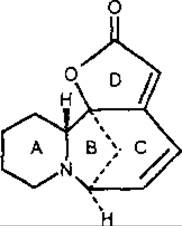
Securinine
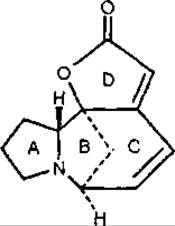
Norsecurinine
Biological activity and application. Securinine nitrate is used as a tonic for asthenic conditions, paralysis, neurasthenia, and erectile dysfunction caused by functional nervous disorders, as well as a Central Nervous system stimulant. It serves as a substitute for strychnine, produced from readily available raw materials with lower toxicity.
Last update: 06/08/2026
Editorial and Educational Adaptation: This material has been compiled based on the primary/original source text. The project team performed an editorial review, corrected technical inaccuracies, structured sections, and adapted the content for an educational format.
What was processed:
- elimination of formatting defects (OCR errors, structural breaks, corrupted characters);
- editorial organization of content;
- standardization of terminology in accordance with academic sources;
- verification of factual statements against the original source text.
All mentions of the author, publication year, and origin of the primary text have been preserved in accordance with the source.