Pharmacognosy with the Basics of Plant Biochemistry - Kovalyov V. M. 2004
Special Part
Alkaloids
Isoquinoline Alkaloids (Tyrosine Group)
Isoquinoline and its derivatives form the backbone of a vast number of natural compounds, including plant Alkaloids. The molecules of these alkaloids contain a tetrahydroisoquinoline residue, and much less frequently, a 3,4-dihydroisoquinoline residue. Plants belonging to the orders Papaverales, Rutales, Ranunculales, Geraniales, Plumbaginales, Myrtiflorae, and Rosales are particularly rich in them. Over 1,000 isoquinoline alkaloids from 27 families have been identified, which are grouped into 12 types. The types of isoquinoline alkaloids used in medicine are listed in Table 15.
Biogenetically, isoquinoline alkaloids are derived from the aromatic amino acid phenylalanine or its hydroxy derivative, Tyrosine. Tyrosine serves as the precursor to important opium alkaloids.
Class="center">Types of Isoquinoline Alkaloids
Table 15
Alkaloid Type |
Alkaloid Example |
Selected Plant Sources |
Benzylisoquinoline |
Papaverine Rotundine |
Opium poppy Papaver somniferum Smooth stephania Stephana glabra |
Aporphine |
Glaucine Stepharine Magnoflorine |
Yellow horned poppy Glaucium flavum Smooth stephania Stephana glabra Plants of the Ranunculaceae family |
Protoberberine |
Berberine Hydrastine Palmatine |
Barberry Berberis vulgaris Goldenseal Hydrastis canadensis Found in numerous families |
Benzophenanthridine |
Chelidonine Sanguinarine Chelerythrine Nitidine Gindarin |
Greater celandine Chelidonium majus Macleaya spp. Zanthoxylum spp. (Rutaceae) Smooth stephania Stephania grabra |
Protopine |
Protopine (fumarine) Allocryptopine |
Greater celandine Chelidonium majus Common fumitory Fumaria officinalis |
Morphinane (phenanthreneisoquinoline) |
Morphine, codeine, thebaine |
Opium poppy Papaver somniferum Birthwort Aristolochia clematitis |
Emetine |
Emetine, psychotrine, cephaeline |
Ipecac Cephaelis ipecacuanha |
Phthalideisoquinoline |
Bicuculline |
Bleeding Heart Dicentra cucullana (Fumariaceae) |
Bisbenzylisoquinoline bases |
Tubocurarine Tetrandrine Dauricine, thalicarpine |
Strychnos spp. Meadow-rue Thalictrum spp. Daurian moonseed Menispermum dahuricum |
During Biosynthesis, tyrosine is first oxidized to 3,4-dihydroxyphenylalanine (DOPA), followed by decarboxylation to yield dopamine. Dopamine then reacts with a carbonyl compound, closing the isoquinoline heterocyclic ring. In the simplest case, pyruvic acid acts as the carbonyl compound, condensing with dopamine to form tetrahydroisoquinoline. In most cases, dopamine reacts with 3,4-dihydroxyphenylpyruvic acid—a carbonyl derivative of tyrosine—resulting in The formation of tricyclic benzylisoquinoline-type isoquinoline alkaloids. Through various subsequent biochemical transformations, these give rise to new structural modifications of high complexity.
Biosynthesis of Isoquinoline Alkaloids

Further elaboration of benzylisoquinolines proceeds via Condensation and intramolecular rearrangements. In certain cases, the aromatic rings of benzylisoquinolines condense to form tetracyclic aporphine-type isoquinoline alkaloids. When additional cyclization occurs at the nitrogen atom, protoberberine-type alkaloids are formed, which incorporate both isoquinoline and quinolizidine cores within their tetracyclic structures. Following further molecular rearrangements and modifications of protoberberine, isoquinoline alkaloids of the protopine and benzophenanthridine types are produced.
Benzylisoquinoline type. Alkaloids belonging to this group may feature a tetrahydroisoquinoline core (norlaudanosine) or an isoquinoline core (papaverine).
Papaverine is a potent antispasmodic agent, first isolated from opium, where it occurs at a concentration of about 1%. Biogenetically, it derives from dopamine, bypassing the norlaudanosoline stage.
Papaverine is a weak base due to the absence of a methyl radical at C-1 and the methylation of all four hydroxyl groups. For medical use, papaverine is produced synthetically. Synthetic analogs of papaverine—such as No-Spa, Dibazol, and Tifen—are widely used as antispasmodic agents.
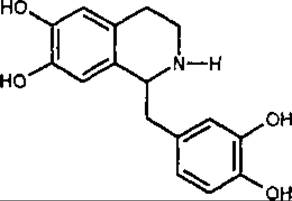
Norlaudanosoline
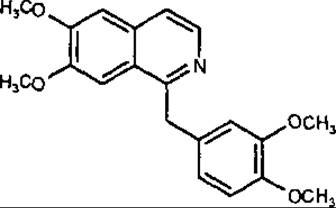
Papaverine
The aporphine type features a Skeleton containing both isoquinoline and phenanthrene moieties. All alkaloids of this type are optically active. They are widely distributed across the families Berberidaceae, Lauraceae, Magnoliaceae, Menispermaceae, Nymphaeaceae, Papaveraceae, Ranunculaceae, and Rutaceae. Pharmacological activity has been demonstrated for glaucine (antitussive, antispasmodic), magnoflorine (hypotensive and curarimimetic), and boldine (antitussive).

Glaucine
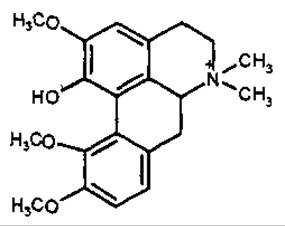
Magnoflorine
Protoberberine type. Derivatives of this group possess a protoberberine or tetrahydroprotoberberine skeleton. Two molecules of tyrosine serve as their biosynthetic precursors.

Protoberberine

Tetrahydroprotoberberine

Berberine
Alkaloids are predominantly localized in plants of the families Berberidaceae, Convolvulaceae, Menispermaceae, Papaveraceae, Ranunculaceae, and Rutaceae. Berberine, narcotoline, hydrastine, palmatine, and bicuculline, which belongs to phthalideisoquinoline derivatives, are of pharmacological significance.
Berberine is a typical quaternary ammonium base that exists only in solutions. Its salts are yellow in color. It is used in medicine as a choleretic agent. Berberine exhibits spasmolytic activity, helps reduce pain syndrome, enhances Bile secretion, acts as a sedative, lowers Blood pressure, slows down heart rate, and causes uterine contractions.
Narcotine constitutes a significant portion of opium alkaloids (about 10%). It stimulates the respiratory center, potentiates the analgesic effect of morphine, and possesses no narcotic properties.
Hydrastine is a compound isolated from goldenseal (*Hydrastis canadensis*, Ranunculaceae); it acts as a hemostatic agent.
Palmatine is found in plants of the families Berberidaceae, Papaveraceae, Ranunculaceae, Lauraceae, etc.; it exhibits several types of pharmacological activity: antiarrhythmic, inotropic, analgesic, and antibacterial.
Bicuculline is a phthalideisoquinoline alkaloid localized in plants of the genus *Dicentra* (Papaveraceae). It increases blood pressure, alters the amplitude of heart contractions, and inhibits the action of acetylcholinesterase in the Brain.
Protopine type. Alkaloids of this type are commonly found in plants of the family Papaveraceae and sporadically in the families Rutaceae and Berberidaceae.

Protopine
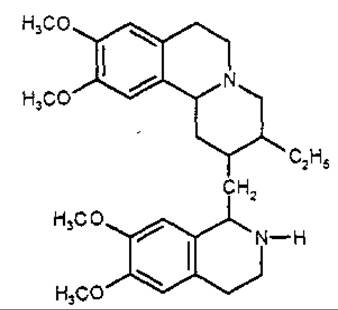
Emetine
Emetine type. Alkaloids of this type are known as ipecac ROOT alkaloids (*Radix Ipecacuanhae*) and form a distinct biogenetic group. Their synthesis approaches the formation of tetrahydroprotoberberine with the attachment of an iridoid Structure at C-9. The final product of biosynthesis, from which other derivatives are formed, is the isoquinolinelridoid glycoside — ipecoside.
Emetine and cephaeline are the main alkaloids of ipecac (*Cephaelis ipecacuanha*, Rubiaceae). They were isolated by Pelletier and Magendie in 1817, their structure was investigated in the 1940s, and emetine was synthesized in the laboratory of A. P. Orekhov in 1950.
Different subspecies of ipecac raw material contain varying amounts of alkaloids. Brazilian root contains 2-2.4%, with emetine accounting for 60-75%. Raw material from *Cephaelis acuminata* yields rhizomes with 2-3.5% alkaloids, where the share of emetine is 30-50%.
Due to the presence of these alkaloids, ipecac raw material and preparations reflexively induce coughing, and in large doses, vomiting. Expectorant preparations from ipecac are produced abroad. In addition, ipecac roots possess strong antiprotozoal action and exhibit antitumor activity.
Morphinan type. Morphinan alkaloids number more than 40 representatives from the families Papaveraceae, Menispermaceae, Euphorbiaceae, Liliaceae, and Melanthiaceae.
Morphine is the main alkaloid of opium and has a phenolic character. The products of biochemical transformations of morphine are thebaine and codeine.
The morphine molecule contains a methylated tertiary nitrogen, which determines its basic properties. The alkaloid forms salts with acids, and phenolates with alkalis via the phenolic hydroxyl group. Methylation of morphine yields codeine, ethylation yields ethylmorphine, acylation yields heroin, and the elimination of two Water molecules yields apomorphine. Similarly, semi-synthesis from codeine produces derivatives of dihydrocodeinone — thecodine and hydrocodone.
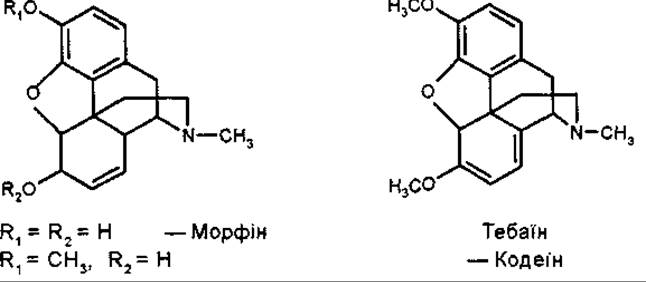
Morphine is a narcotic analgesic prescribed to patients in cases where other painkillers are ineffective. Abuse of morphine leads to drug dependence (morphinism), which is accompanied by profound psychological disorders and damage to all Internal Organs.
During the research of opiate receptors, endorphins and enkephalins were discovered — endogenous substances with morphine-like action. They are pentapeptides whose Spatial Structure resembles that of morphine. Endorphins induce euphoria. They are being studied with the aim of creating non-toxic painkillers.
Codeine is the methyl ether of morphine. It is found in opium in small doses (about 0.5%). The alkaloid is obtained by semi-synthesis. Compared to morphine, it has a methoxyl group instead of a phenolic hydroxyl group, which leads to a weaker depressant effect on the Central Nervous system. It is not used independently as an analgesic. It is used for coughs. In therapeutic doses, it causes mild euphoria; prolonged use may lead to drug dependence.
Bisbenzylisoquinoline alkaloids. Bisbenzylisoquinoline bases are dimers formed by two benzylisoquinoline molecules connected by one, two, or three oxygen (ether) bridges. The Diversity of alkaloids in this group is due to the varying positions of the oxygen bridges within the molecule. In bimolecular alkaloids, the benzylisoquinoline residue can be genetically linked to Other types of isoquinoline structures (e.g., aporphines, benzazepines, pavines, etc.). They are most widely distributed in plants of the families Menispermaceae, Berberidaceae, Magnoliaceae, Annonaceae, Ranunculaceae, and Combretaceae.
Curare alkaloids have a bisbenzylisoquinolone-type structure. Curare, or South American arrow poison, was obtained from a mixture of extracts derived from the bark or stems of Strychnos spp. (Loganiaceae) and Chondrodendron tomentosum (Menispermaceae). The term curare originates from the Indigenous words “woorari” or “urari”, meaning “poison”.
Curare is imported in the form of crude dry extract for the isolation of d-tubocurarine.

d-Tubocurarine
In the late 19th century, curare found application in medicine. Muscle relaxants such as tubocurarine chloride and curarine chloride are obtained from it and used during surgical operations and for certain neurological disorders accompanied by convulsions. The alkaloid cycleanine, isolated from Stephania glabra, is structurally similar to tubocurarine.
Many dimeric isoquinoline alkaloids exhibit antitumor activity (methyldauricine, tetrandrine, thalmine, thalidasine, etc.). Thalicarpine has been isolated from the herb of Thalictrum dasycarpum (Ranunculaceae) and is being studied as a therapeutic agent for neoplasms. Fetidine, obtained from Thalictrum foetidum, has demonstrated significant hypotensive effects in experimental studies. It is better tolerated by patients than rauwolfia alkaloids and produces fewer side effects.
Dauricine, derived from the rhizomes of daurian moonseed (Rhizomata Menispermi), exerts a spasmolytic effect, lowers blood pressure, and reduces blood Cholesterol levels, making the crude drug widely used in Tibetan and Chinese medicine.
Last update: 06/08/2026
Editorial and Educational Adaptation: This material has been compiled based on the primary/original source text. The project team performed an editorial review, corrected technical inaccuracies, structured sections, and adapted the content for an educational format.
What was processed:
- elimination of formatting defects (OCR errors, structural breaks, corrupted characters);
- editorial organization of content;
- standardization of terminology in accordance with academic sources;
- verification of factual statements against the original source text.
All mentions of the author, publication year, and origin of the primary text have been preserved in accordance with the source.