Pharmacognosy with the Basics of Plant Biochemistry - Kovalyov V. M. 2004
Special Part
Alkaloids
Medicinal plants and raw materials containing pyridine-piperidine alkaloids
LOBELIA HERB — HERBA LOBELIAE
Indian tobacco — Lobelia inflata L., fam. Lobeliaceae
Lobelia, Indian tobacco; the plant is named after M. de l'Obel (1538–1616), a Dutch physician and botanist who lived in England and for some time directed the royal botanical garden; Latin inflatus, -a, -um — inflated, derived from inflare — to blow up.
An annual herbaceous plant with an erect, quadrangular, slightly branched, pubescent stem 40–70 cm high, containing milky juice. Leaves are alternate, glabrous, dark green. Flowers are small, light green, bilabiate, arranged in short racemes. The fruit is a bilocular, inflated, silvery capsule with a persistent calyx. Seeds are numerous, small, elongated, pitted, and brown.
Distribution. Grows wild and is cultivated in the USA and Canada. It was formerly cultivated in Russia.
Chemical composition of the raw material. The herb contains 14 Alkaloids (0.25–0.4%), the main one being lobeline, along with lobelanin, lobelanidin, isolobeline, etc.
Biological activity and application. Lobeline hydrochloride, an analeptic drug, is manufactured from lobelia herb. Abroad, lobeline is used to treat Bronchial Asthma and Chronic Bronchitis; it is a component of smoking cessation medications (Lobesil).
In homeopathy, the entire fresh flowering plant is used for psoriasis, bronchial asthma, and rheumatic joint pain.
Class="center">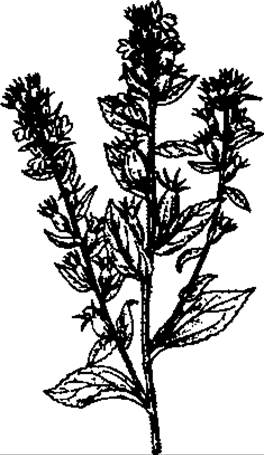
Quinolizidine alkaloids
At later stages of piperidine alkaloid Biosynthesis, $\Delta$-piperideine can undergo Condensation, cyclization, oxidation, and other reactions. As a result, a variety of bi-, tri-, and tetracyclic piperidine derivatives are formed. Among these, the most characteristic are molecules with a mono- or biconsondensed quinolizidine core.
The "Lysine" pathway leads to The formation of the piperidine ring without the intermediate stage of $\Delta$-piperideine synthesis. For instance, the bicyclic core of simpler quinolizidine alkaloids of the lupanine type is synthesized via the 5-aminopentanal intermediate.
The "acetate" pathway of piperidine ring formation is characteristic of The biosynthesis of coniine-type alkaloids.
Alkaloids of the quinolizidine group are synthesized from lysine or the corresponding amine, cadaverine. They belong to the norlupinane (quinolizidine) group or lupin alkaloids, which form numerous derivatives. The quinolizidine ring is present in The Structure of alkaloids of other types (protoberberine, certain indole alkaloids, and ipecac ROOT alkaloids). They are found in many species of medicinal plants. Lupanine was first isolated from lupine (Lupinus spp., Fabaceae).
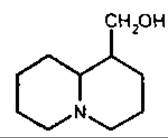
Norlupinane
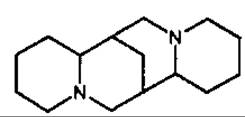
Lupanine
Sparteine is an alkaloid with high pharmacological activity due to its effect on Nerve Impulse transmission at synapses. It is used abroad as an antiarrhythmic agent. It has been found in many families: Berberidaceae (Leontice), Chenopodiaceae (Anabasis), Papaveraceae (Chelidonium), Ranunculaceae (Aconitum), Monimiaceae (Peumus boldus). The raw material for obtaining sparteine sulfate is Scotch broom — Sarothamnus scoparius, Fabaceae. Alongside the common L(-)-sparteine, D(+)-sparteine (pachycarpine), obtained from plants of the genus Sophora spp., Fabaceae, is sometimes encountered.
Pachycarpine affects sympathetic ganglia, leading to a decrease in the sensitivity of the chromaffin tissue of the Adrenal Glands to chemical stimuli. Pachycarpine increases Muscle tone and enhances Muscle contraction in myopathy, and possesses The ability to block N-cholinoreactive systems. It is used for peripheral vascular spasms.

Sparteine and pachycarpine isomers
Cytisine is an analeptic agent whose pharmacological activity approaches that of nicotine. It is found in plants of the family Fabaceae: in the genera broom (Cytisus spp.), thermopsis (Thermopsis spp.), golden chain (Laburnum spp.), and greenweed (Genista spp.). It is used as a smoking cessation aid (Tabex).
Securinine exhibits analeptic activity. It is used for asthenic conditions, neurasthenia with rapid fatigue, vascular insufficiency and hypotension, chronic alcoholism, cardiac weakness, and paresis or flaccid paralysis following infectious diseases.
Last update: 06/08/2026
Editorial and Educational Adaptation: This material has been compiled based on the primary/original source text. The project team performed an editorial review, corrected technical inaccuracies, structured sections, and adapted the content for an educational format.
What was processed:
- elimination of formatting defects (OCR errors, structural breaks, corrupted characters);
- editorial organization of content;
- standardization of terminology in accordance with academic sources;
- verification of factual statements against the original source text.
All mentions of the author, publication year, and origin of the primary text have been preserved in accordance with the source.