Pharmacognosy with the Basics of Plant Biochemistry - Kovalyov V. M. 2004
Special Part
Phenolic Compounds
Simple Phenols and Their Derivatives
Phenols and their derivatives
This group includes phenol and its derivatives that lack side carbon chains. Based on the number of hydroxyl groups, simple phenols are classified into mono-, di-, and trihydric phenols.
Class="center">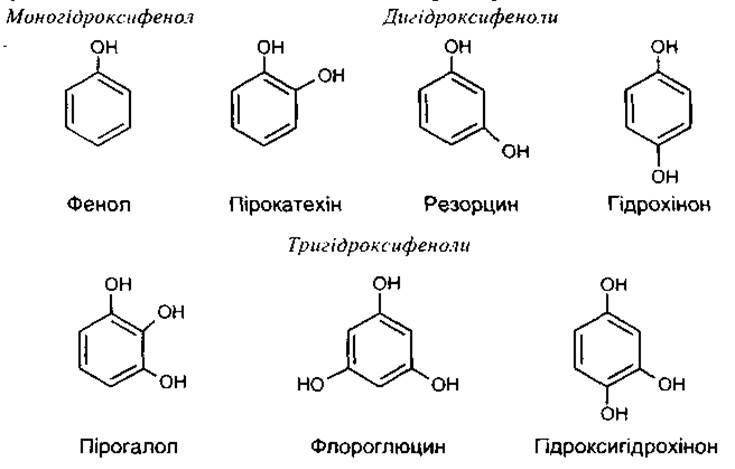
Simple phenols occur relatively rarely in plants in a free state, but many of their derivatives are found as Glycosides or as constituents of plant products such as Essential Oils, resins, Tannins, etc.
In plants, phenol is present in minimal amounts in the leaves of tobacco (Nicotiana tabacum), willow bark (Salix spp.), pine needles and cones (Pinus sylvestris), and black currant leaves (Ribes nigrum). Less commonly, phenol derivatives are the major constituents of essential oils—for instance, thymol (2-isopropyl-5-methylphenol) and its isomer carvacrol, which are found in the essential oils of thyme (Thymus spp.) and oregano (Origanum vulgare).
Pyrocatechol is found in tea leaves (Thea sinensis), onion husks (Allium cepa), and other plants.
Hydroquinone and methylhydroquinone occur in plants in both free and glycosidic forms as arbutin and methylarbutin. They are widespread in members of the Ericaceae, Rosaceae, Saxifragaceae, Asteraceae, and Tiliaceae families.
Pyrogallol is found in small amounts in sequoia cones and serves as a structural fragment of tannins. It is a strong reducing agent and is used in dermatology to treat psoriasis, eczema, and other Skin conditions.
Phloroglucinol is found in sequoia cones and onion husks, as well as in glycosidic form in citrus peel. Phloroglucinol derivatives (aspidinol) occur in the rhizomes of male fern (Dryopteris filix-mas) and serve as precursors of hop acids in hop strobiles (Humulus lupulus).
Phenolic alcohols and phenolic aldehydes
Phenolic alcohols (C6–C1 Structure) feature an alcoholic group in their molecular framework and differ in the number of phenolic hydroxyls, which may be free or methylated. These compounds are rarely found in higher plants; among them, salicylic, gentisic, coniferyl, and sinapyl alcohols are the most widespread.
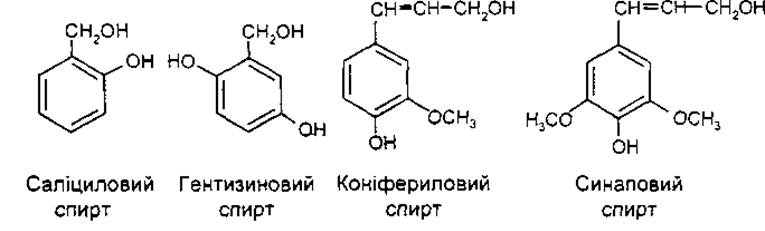
Salicylic alcohol (saligenin) is the aglycone of the glycoside salicin, which is found in the bark of willow species (Salix spp., Salicaceae). It exhibits anti-inflammatory and local anesthetic properties.
Gentisic alcohol is the aglycone of the glycoside salireposide, isolated from the leaves of the aspen Populus tremula (Salicaceae).
Coniferyl alcohol plays a major role as a biochemical precursor of Lignin. It also occurs in the glycosidic form as coniferin.
Sinapyl alcohol (syringin aglycone) is one of the key components in lignin Biosynthesis in gymnosperms. It is also the aglycone of the glycoside syringin, found in the bark, leaves, and fruits of lilac (Syringa vulgaris, Oleaceae).
More well-known phenolic aldehydes include vanillin, piperonal, salicylic aldehyde, and anisic aldehyde.
Vanillin (3-methoxy-4-hydroxybenzaldehyde) occurs in glycosidic form in the pods of Vanilla planifolia (Orchidaceae); it is also produced semi-synthetically from eugenol. Vanillin is used as a flavoring agent to improve the odor of medicines.
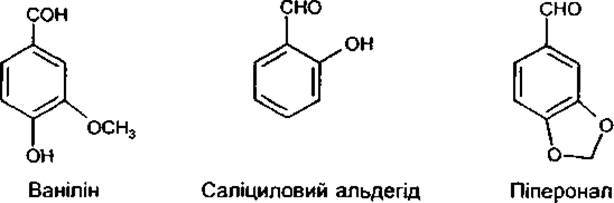
Salicylic aldehyde (o-hydroxybenzaldehyde) is found in the essential oil of Filipendula ulmaria (Rosaceae) and other plants.
Piperonal (3,4-methylenedioxybenzaldehyde) is found in the essential oil derived from the flowers of black locust (Robinia pseudoacacia, Fabaceae) or violets (Viola spp., Violaceae). It has a pleasant aroma and is used in perfumery and cosmetics.
Phenolic acids
Phenolic acids are compounds containing phenolic hydroxyl groups and a carboxyl group attached to an aromatic ring. Derivatives of benzoic and cinnamic acids are of the greatest importance. In plants, they occur in a free state as well as in the form of depsides and glycosides. (An ester bond formed between the phenolic hydroxyl of one phenolic carboxylic acid molecule and the carboxyl group of another molecule is called a depside bond, and compounds containing such a bond are termed depsides.)
Phenolic acids are present in many plants; however, there is no single species of medicinal plant material where they serve as the primary biologically active components. Phenolic acids are primarily accompanying substances that contribute to the therapeutic efficacy of total plant extracts. Specific biological activity has been established for certain phenolic acids.
Benzoic acid derivatives
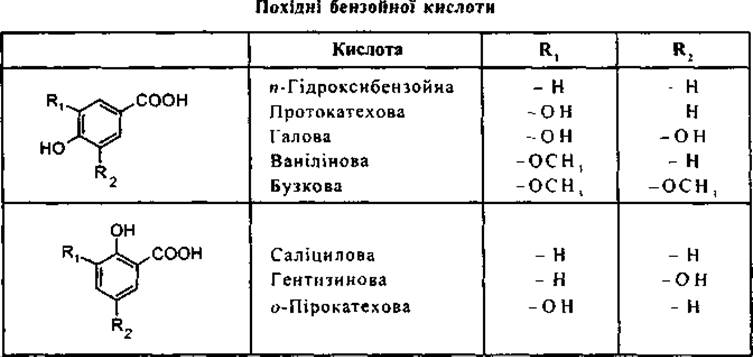
Among this group, protocatechuic, hydroxycatechuic, gentisic, and free gallic acids are the most commonly found in plants. Vanillic, syringic, and n-hydroxybenzoic acids are constituents of lignin. Salicylic and pyrocatechuic acids are relatively less widespread.
Salicylic acid (o-hydroxybenzoic acid) most frequently occurs as a methyl ester in certain essential oils or bound in glycosides. Methyl salicylate acts as a biologically active substance in several types of plant Materials, such as wild pansy herb (Herba Violae tricoloris), senega ROOT (Radices Senegae), and meadowsweet flowers (Flores Ulmariae).
Gallic acid (3,4,5-trihydroxybenzoic acid) has been found in plants both in a free state and as a depside—m-digallic acid. Gallic acid and its depsides are components of hydrolyzable tannins and are frequently encountered in the free state. It exhibits anti-inflammatory, antimicrobial, and antiviral properties, among others.
Phenolcarboxylic acids with a side chain, particularly cinnamic acid derivatives, are of practical interest.
In the biogenesis of hydroxycinnamic acids, the principal precursor is The amino acid phenylalanine. Through deamination mediated by the enzyme phenylalanine ammonia-lyase, cinnamic acid is synthesized in the plant, while subsequent hydroxylation and methylation yield various hydroxy and methyl derivatives.
Biosynthesis of certain hydroxycinnamic acids
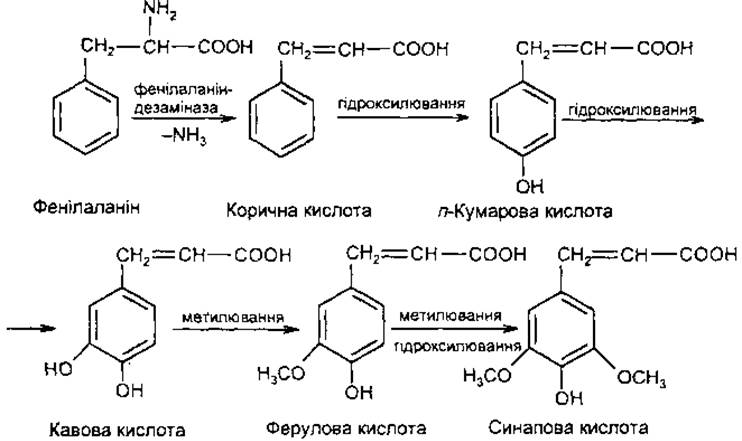
Two stereoisomers of o-hydroxycinnamic acid are known: one possesses a trans-configuration and is termed coumaric acid, while the other possesses a cis-configuration and is termed coumarinic acid. Only coumaric acid can exist in the free state, for instance, in various aloe species. Coumarinic acid undergoes cyclization into the lactone coumarin, which has been identified in numerous plants.
Caffeic acid (3,4-dihydroxycinnamic acid) is widely distributed in nature. It frequently forms dimers (pseudodepsides). For example, chlorogenic acid is a pseudodepside of caffeic and quinic acids. Among the tridepsides of caffeic acid, isochlorogenic acid and cynarin are particularly noteworthy. Caffeic acid possesses mild bacteriostatic properties and exhibits anti-inflammatory, hepatoprotective, and immunotropic activities.
The methyl esters of caffeic acid—ferulic and sinapic acids—are found in higher plants. Ferulic acid occurs in plants both in the free state and as part of esters; it exhibits choleretic, antimicrobial, antifungal, and hepatoprotective effects, and inhibits erythrocyte aggregation. It is widespread in the family Araceae.
Among alicyclic acids, quinic and shikimic acids sometimes accumulate in significant quantities in plants. For instance, cinchona bark (Cortex Chinae) contains up to 9% quinic acid. Quinic acid serves as an important intermediate in plant METABOLISM, frequently occurring within depsides. Thus, the presence of the depside chicoric acid, or 2,3-dicaffeoylquinic acid, is characteristic of the Asteraceae family. Some researchers associate this compound with the biological activity of preparations derived from Echinacea, chicory, and other plants. The chicoric acid content in Echinacea raw material ranges from 0.6% to 2.1%. In the Russian Pharmacopoeia, the quality of purple coneflower herb (Herba Echinaceae purpureae) is evaluated based on the content of hydroxycinnamic acids calculated as chicoric acid. Literature References also highlight the antimicrobial and immunostimulatory effects of chicoric acid.
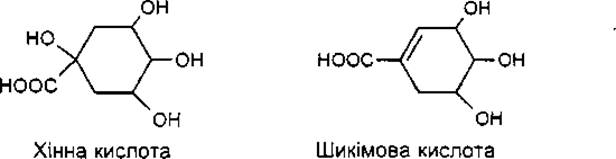
Shikimic acid was first isolated from the fruits of star anise (Illicium verum, fam. Araceae). It plays a crucial role in The biosynthesis of aromatic Amino Acids, cinnamic acids, Flavonoids, and other Phenolic Compounds. When introduced into plant Tissues, quinic and shikimic acids are readily converted into phenolic compounds.
Information regarding plant materials and preparations containing simple phenolic compounds is provided in Appendix Table 4.
Phenolic Glycosides
Simple phenols, phenolic alcohols, aldehydes, and their derivatives occur in plants predominantly as glycosides with glucose, as well as with xylose and arabinose.
Arbutin (ß-D-glucopyranoside of hydroquinone). It was first isolated from bearberry leaves. Its content in plants varies widely—from 0.5% to 20%: Arctostaphylos uva-ursi—5–12%, Vaccinium vitis-idaea—4–8%, Vaccinium myrtillus—0.5–15%, Bergenia crassifolia—15–20%. Arbutin exerts an antiseptic effect on the Urinary Tract. Hydrolytic breakdown of arbutin to hydroquinone occurs exclusively in an alkaline urine environment. Gallic acid derivatives, such as hydrolyzable tannins, inhibit The activity of arbutin.
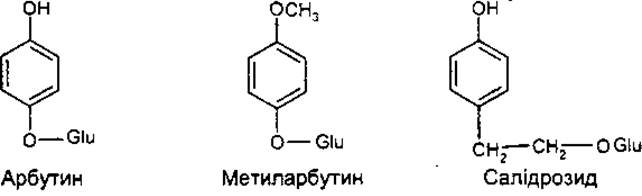
Methylarbutin (ß-D-glucopyranoside of methylhydroquinone). This glycoside frequently accompanies arbutin in plants. It undergoes Hydrolysis with greater difficulty, which is why leaves containing methylarbutin do not darken upon drying. The glycoside content depends on geographical regions and origin; for instance, in southern regions, The ratio of arbutin to methylarbutin in the raw material is 1:1, whereas in northern regions, arbutin predominates in plants.
Salidroside, or rhodioloside (ß-D-glucopyranoside of n-hydroxyphenylethanol), has been isolated from the rhizomes of Rhodiola rosea L., Crassulaceae. It serves as a biologically active substance in roseroot raw material and exhibits adaptogenic activity.

Echinacoside
Echinacoside is a glycosidic derivative of 3,4-dihydroxyphenylethanol containing rhamnose and two glucose residues, one of which is bonded to caffeic acid. Found in Echinacea spp., it acts on one of the links of The Immune System and activates phenocytosis.
Last update: 06/08/2026
Editorial and Educational Adaptation: This material has been compiled based on the primary/original source text. The project team performed an editorial review, corrected technical inaccuracies, structured sections, and adapted the content for an educational format.
What was processed:
- elimination of formatting defects (OCR errors, structural breaks, corrupted characters);
- editorial organization of content;
- standardization of terminology in accordance with academic sources;
- verification of factual statements against the original source text.
All mentions of the author, publication year, and origin of the primary text have been preserved in accordance with the source.