Biochemistry: The Chemical Reactions of Living Cells, Volume 2 - D. Metzler 1980
Coenzymes: specialized natural reagents
Bound biotin acting as a prosthetic group
Mechanism of biotin action
It might seem surprising that carboxylation reactions require a coenzyme. However, if these reactions were not coupled with ATP Cleavage, the equilibrium would be heavily shifted toward decarboxylation. As a result of coupling with ATP cleavage, carboxylation can proceed spontaneously. For example, the experimentally determined apparent Equilibrium Constant $K'$ for the carboxylation of propionyl-CoA to S-methylmalonyl-CoA at pH 8.1 and 28°C is expressed by the following equation [5]:
Class="center">
The Role of biotin is to couple ATP cleavage with carboxylation. This is achieved through a two-stage process in which the intermediate carboxybiotin is formed. There is only one biotin-containing enzyme that does not require ATP. Propionibacteria contain a carboxyltransferase that reversibly transfers a carboxyl group from methylmalonyl-CoA to Pyruvate, yielding oxaloacetate and propionyl-CoA. ATP is not required in this reaction because free HCO3- does not serve as a substrate. Nevertheless, biotin still acts as a carrier of the carboxyl group here. Table 8-2 lists the Functions of biotin in ATP-dependent carboxylation and transcarboxylation reactions.
Table 8-2 Biotin-dependent ß-carboxylation (Type S5A Reaction)a

The Structure of biotin (Box 8-B) suggested that bicarbonate could reversibly attach to the vitamin at the 2'-position. However, this turned out not to be the case. The key to elucidating The Mechanism of biotin action was found by F. Lynen and co-workers [6] through The Study of a "model reaction." They demonstrated that purified rat ß-methylcrotonyl-CoA carboxylase catalyzes the carboxylation of free biotin by bicarbonate (H14CO-3) in the presence of ATP. While carboxylated biotin is extremely labile, its Treatment with diazomethane yields a more stable dimethyl ester, which is a derivative of N-1'-carboxybiotin:

This means that the carboxylated form of biotin is N-1'-carboxybiotin. ATP cleavage is required at the initial stage to attach CO2 and HCO3- to biotin. A radioactive label from 14CO2 was also successfully incorporated into biotin covalently bound at the active sites of Enzymes, and Treatment of the enzymes with diazomethane followed by Trypsin and Pepsin Hydrolysis yielded a product identified as N-1'-carboxybiocytin. To complete the catalytic action of the enzyme, it is only necessary to transfer the carboxyl group from carboxybiotin to the substrate being carboxylated. The proposed mechanism of biotin action is now supported by data on the enzymatic transfer of the carboxyl group from chemically synthesized carboxybiotin to specific substrates [7].
Biotin-dependent enzymes, at least in some cases, can dissociate into separate subunits. For example, acetyl-CoA carboxylase from E. coli can dissociate into three fragments: 1) a biotin carboxyl carrier protein (molecular weight 22,000) containing covalently bound biotin, 2) biotin carboxylase (a dimer with a Molecular Weight of 100,000), and 3) transcarboxylase (also a dimer with a molecular weight of 90,000). Biotin carboxylase is required to catalyze the initial ATP-dependent carboxylation of the biotin attached to the biotin carboxyl carrier protein. Transcarboxylase contains an acetyl-CoA-binding site and catalyzes The transfer of the carboxyl group from bound carboxybiotin to acetyl-CoA to form pyruvate. It appears significant that biotin is attached to the protein at the end of a flexible "arm" (1.6 nm long), which allows biotin to move from the Active Site of the carboxylase to the active site of the transcarboxylase.
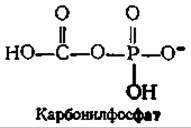
There are A number of important questions concerning both the mechanism of carboxybiotin synthesis catalyzed by the biotin carboxylase subunit and the mechanism of the transcarboxylase reaction. The fact that 18O from labeled bicarbonate is incorporated into Pi released from ATP in the first reaction indicates The formation of carbonyl phosphate as an intermediate resulting from a nucleophilic attack of ATP by the HCO3- ion. The carboxyl group of this reactive anhydride is then transferred to biotin via an attack on the N-1' position of biotin. This two-stage sequence is essentially of the S7C type (Table 7-2). Indirect evidence supporting The intermediate formation of carbonyl phosphate is the ability of biotin carboxylase to accelerate the transfer of the phosphoryl group from carbamoyl phosphate, a carbonyl phosphate analog, to ADP:

This reaction is analogous to the Reversal of the stage at which carbonyl phosphate is believed to be formed from ATP and bicarbonate.
Another possibility is that the terminal phosphate group of ATP is transferred to biotin to form an enol phosphate [step a in equation (8-6)], which reacts with bicarbonate (step b) in a manner analogous to the phosphoenolpyruvate carboxylase reaction (equation 7-80):

Cleavage of the enol phosphate in step b via attack by the HCO3- ion creates a highly nucleophilic center at N-1'. Simultaneously, a reactive carbonyl phosphate intermediate could be formed, capable of reacting with N-1'.
The carboxyl group of carboxybiotin is presumably transferred to the final products as a result of a nucleophilic attack on the carbonyl carbon by an enolate anion:
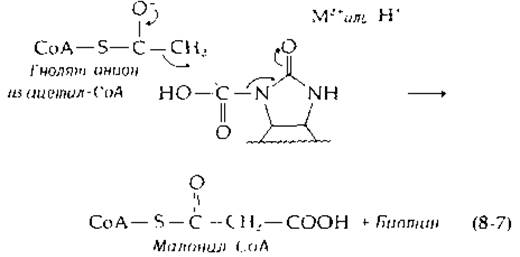
In the carboxyltransferase reaction (Table 8-2), the transfer of tritium from 3-3H-pyruvate to propionyl-CoA was observed. Based on this, it can be suggested that the 2'-carbonyl group of biotin may act as a proton-acceptor group during the Formation of the transient enolate ion [7a].
The transcarboxylation stage requires the presence of a specific protein-bound divalent metal ion, usually Mn2+. This circumstance has made it possible to investigate the binding geometry of substrates relative to Mn2+ using relaxation Methods (EPR and NMR) [8–10]. The role of the metal may primarily consist in facilitating the enolization of the carboxyl acceptor. However, in the case of pyruvate carboxylase, Analysis of the effect of bound Mn2+ on 13C relaxation times in the substrate showed that the distance between the carbonyl carbon and Mn2+ is ~0.7 nm. This distance is too large to suggest the formation of a direct coordination bond between the metal and the carbonyl oxygen. Another rather appealing explanation is the assumption of bond formation between the metal and the carbonyl group of biotin, as shown in equation (8-7); the result (which could also be caused by hydrogen bonding with a proton) would be an enhancement of biotin's properties as a leaving group in the substitution reaction [11].
Box 8-B
Biotin

By 1901, it was established that Yeast growth requires some additional unknown substance, which was named bios. Eventually, bios was shown to be a mixture of pantothenic acid, Inositol, and a third component designated as biotin. By the 1930s, this same vitamin was recognized through two other effects: as a growth and Respiration-stimulating factor for Rhizobium trifolii, which inhabits clover ROOT nodules, and as vitamin H. This vitamin must be supplied in the diet of rats to prevent the dermatitis and paralysis that develop when they are fed large amounts of raw egg white. The Isolation of the pure vitamin was a heroic endeavor completed by Kögl in 1935. In one experiment, 1.1 mg of crystalline biotin was obtained from 250 kg of dry egg yolk (representing 1.4% of the total biotin content in the starting material).
Isomers and Derivativesa. The biotin molecule contains three chiral centers and therefore exists in eight stereoisomers. Of these, only one, dextrorotatory (+)-biotin, exhibits biological activityb. Biotin is readily oxidized to sulfoxide.

and to the sulfone

Desthiobiotin, in which the sulfur atom is removed and replaced by two hydrogen atoms, can replace the requirement for biotin in certain organisms and apparently lies on one of the biotin Biosynthesis pathwaysв. Oxybiotin, in which the sulfur atom is replaced by oxygen, is active in many organisms, but only partially active in some. No data on The conversion of oxybiotin to biotin have been published, and oxybiotin itself can function adequately in at least some enzymes.
Daily requirement. It is considered that 0.15–0.3 mg of biotin per day is sufficient for an adult human.
а Langer В. W., Jr., Gyоrgy Р. (1968). In: The Vitamins, 2nd ed., (W. H. Sebrell, Jr, Harris R. S., eds.), vol. 2, p. 294—322, Academic Press, New York
б DeTitta G. T., Edmonds I. W., Stallings W., Donohue J. (1976). J. Am. Chem Soc, 98, 1920—1926.
в Parry R. J., Kunitani M. G. (1976). J. Am. Chem. Soc, 98, 4024—4025.
Last update: 06/08/2026
Editorial and Educational Adaptation: This material has been compiled based on the primary/original source text. The project team performed an editorial review, corrected technical inaccuracies, structured sections, and adapted the content for an educational format.
What was processed:
- elimination of formatting defects (OCR errors, structural breaks, corrupted characters);
- editorial organization of content;
- standardization of terminology in accordance with academic sources;
- verification of factual statements against the original source text.
All mentions of the author, publication year, and origin of the primary text have been preserved in accordance with the source.