Biochemistry: The Chemical Reactions of Living Cells, Volume 2 - D. Metzler 1980
Coenzymes: specialized natural reagents
Bound biotin acting as a prosthetic group
Other properties of biotin-dependent enzymes
Most biotin-dependent carboxylases are large Proteins. For instance, the Pyruvate carboxylase protomer containing a biotin molecule has a Molecular Weight of 410,000. In the presence of citrate, an allosteric activator, the protomer polymerizes to form a "large form" with a molecular weight of 4∙106—8∙106. From 10 to 20 protomers associate to form filaments 400 nm long and 7—10 nm thick. Only this polymerized form exhibits enzymatic activity. Acetyl-CoA carboxylase from chicken and rat Liver shares similar properties: the monomer (molecular weight 410,000) associates into polymers with a molecular weight of 8∙106.
Like acetyl-CoA carboxylase from E. coli, transcarboxylase from propionic acid Bacteria is a large (molecular weight ~ 792,000) and complex enzyme. The molecule of this enzyme consists of 18 subunits and contains 6 biotin molecules and 6 Metal Ions, which include both Co2+ and Zn2+ [12].
Recently, three more biotin-dependent Enzymes have been discovered. Carbamoyl phosphate synthetase of E. coli [13, 13a] is required for pyrimidine synthesis; it catalyzes the following reaction:
Class="center">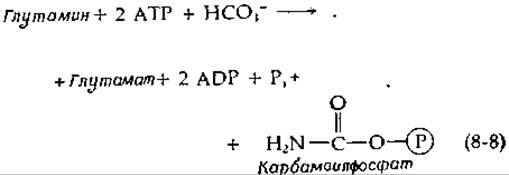
It is likely that one ATP molecule is utilized to generate the carboxybiotin intermediate, whereas the second molecule phosphorylates the carboxyl group and, in addition, apparently facilitates the Cleavage of the glutamine amide bond.
Yeast (Saccharomyces cerevisiae) are unable to synthesize biotin and require an unusually large amount of this vitamin when urea, allantoin, allantoic acid, or certain Other Compounds serve as the sole nitrogen source for growth. This is due to the fact that before urea undergoes Hydrolysis to NH3 and CO2, it must be carboxylated [equation (8-9)] by means of a biotin-containing enzyme, urea carboxylase [13]:
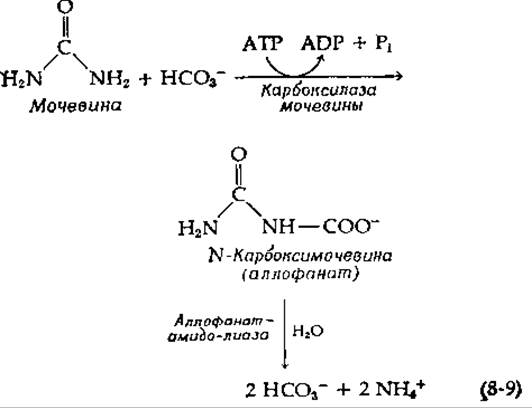
In Candida utilis, both the carboxylase and hydrolase activities reside in a single enzyme: urea amidolyase [15].
Last update: 06/08/2026
Editorial and Educational Adaptation: This material has been compiled based on the primary/original source text. The project team performed an editorial review, corrected technical inaccuracies, structured sections, and adapted the content for an educational format.
What was processed:
- elimination of formatting defects (OCR errors, structural breaks, corrupted characters);
- editorial organization of content;
- standardization of terminology in accordance with academic sources;
- verification of factual statements against the original source text.
All mentions of the author, publication year, and origin of the primary text have been preserved in accordance with the source.