Biochemistry: The Chemical Reactions of Living Cells, Volume 2 - D. Metzler 1980
Coenzymes: Specialized Natural Reagents
Bound biotin acting as a prosthetic group
The vitamin biotin, found in Tissues, is tightly bound to Proteins via a covalent linkage. The first evidence for this came from work [4], the authors of which isolated a biotin-containing substance, biocytin (ε-N-biotinyl-L-Lysine), from autolysates of rapidly growing Yeast:
Class="center">
We now know that the lysine residue of biocytin was originally part of a protein chain within the Active Site of biotin-containing Enzymes. Thus, in their functioning forms, the bicyclic ring system of biotin is attached to the protein via a flexible "arm".
Biotin acts as a carboxyl group carrier in a series of β-carboxylation reactions of type 5.B (Table 7-1). The first indication of this function was provided by data on the ability of aspartate to partially substitute for biotin in stimulating the growth of Torula cremoris yeast. It was known that aspartate is formed by Transamination from oxaloacetate, which in turn could be formed by the β-carboxylation of Pyruvate. Subsequent studies showed that biotin is required in the ATP-dependent reaction between pyruvate and the bicarbonate ion:
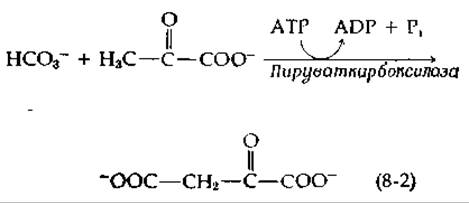
Other biotin-dependent carboxylases act on acetyl-CoA, propionyl-CoA, and β-methylcrotonyl-CoA, utilizing HCO3 to attach a carboxyl group at the positions indicated by arrows in the structural formulas shown below:

Note that although the carboxylation of β-methylcrotonyl-CoA is not strictly a β-carboxylation (Chap. 7, Section K,3), the presence of the C = C double bond conjugated with the carbonyl group renders the double bond isoelectronic with β-carboxylation.
Last update: 06/08/2026
Editorial and Educational Adaptation: This material has been compiled based on the primary/original source text. The project team performed an editorial review, corrected technical inaccuracies, structured sections, and adapted the content for an educational format.
What was processed:
- elimination of formatting defects (OCR errors, structural breaks, corrupted characters);
- editorial organization of content;
- standardization of terminology in accordance with academic sources;
- verification of factual statements against the original source text.
All mentions of the author, publication year, and origin of the primary text have been preserved in accordance with the source.