Biochemistry of Amino Acids - A. Meister 1961
Intermediary Metabolism of Amino Acids
Arginine, Ornithine, and Citrulline
In 1932, Krebs and Henseleit [268] proposed the following reaction cycle to explain urea formation:
Class="center">
This scheme was in good agreement with experimental data concerning the catalytic effect of Ornithine and citrulline on Urea formation in Liver slices. The results of isotope studies on intact animals [269–271] confirmed in broad outlines The Mechanism of urea synthesis postulated by the Krebs-Henseleit hypothesis. The presence of all or most of the reactions of this cycle has been demonstrated in Neurospora, Escherichia coli, Penicillium, and various lactic acid Bacteria [239, 272, 273, 275–277]. Arginase, known since 1904 [274, 278], occurs in many mammalian Tissues, particularly in The Liver and mammary gland [279–283]. This enzyme is activated by certain divalent Metal Ions (Co++, Ni++, Fe++, Mn++) [284–286]. It exhibits some activity toward octopine [287], a-N-benzoylspermidine [288], L-a-ureido-δ-guanidinovaleric acid [289], agmatine [290], and canavanine [291], but is inactive toward a-keto-δ-guanidinovaleric acid [292], ε-guanidinocaproic acid [293], S-N-methylarginine [294], y-guanidinobutyric acid [294], and Arginine phosphate [295]. The Hydrolysis of canavanine yields canaline and urea (p. 49).
While The conversion of arginine into urea and ornithine was established many years ago, the mechanisms by which ornithine is converted into citrulline and citrulline into arginine have only recently been elucidated. The formation of arginine from citrulline can take place in Cell-free liver and Kidney preparations [296, 297]. It has been found that this conversion proceeds more actively in the presence of aspartic or glutamic acid. Subsequent studies by Ratner and her coworkers [298–306] showed that The Biosynthesis of arginine from citrulline requires the obligatory participation of aspartic acid and adenosine triphosphate. The reaction proceeds in two steps with the formation of an intermediate compound, L-argininosuccinic acid [307]. The Enzymatic Cleavage of L-argininosuccinic acid yields arginine and fumaric acid. This sequence of reactions is represented by the following equations:

Canavaninosuccinic acid, the canavanine analogue of argininosuccinic acid, has been detected in Chlorella [308, 309]. Canavaninosuccinic acid is formed via reactions analogous to those leading to the synthesis of argininosuccinic acid; mammalian enzyme systems are likewise capable of synthesizing and cleaving canavaninosuccinic acid [310, 311]. Interestingly, pig kidney preparations catalyze The transfer of the amidine group from canavanine to ornithine to form canaline and arginine; this reaction is reversible. Kidney-derived fractions also effect the transfer of the amidine group of canavanine to Glycine, yielding guanidinoacetic acid (glycocyamine) [311] (p. 321). Thus, arginine, canavanine, and guanidinoacetic acid can serve as Donors of the amidine group, whereas ornithine, canaline, and glycine act as its acceptors. Lysine can likewise function as an amidine group acceptor, being thereby converted into homoarginine [1087]. It has been suggested that these reactions proceed via a common enzyme-amidine intermediate complex [1087, 1088].
An enzyme found in the Cells of Streptococcus faecalis and S. equinus cleaves canavanine, with the uptake of hydrogen, into guanidine and homoserine [312]:
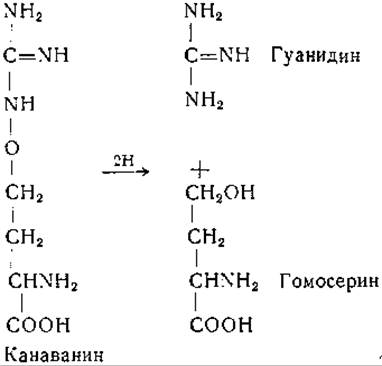
Mammalian liver is capable of synthesizing citrulline at a very high rate. Synthesis and hydrolysis of a certain amount of arginine probably take place in the liver; citrulline, synthesized exclusively in the liver, is transported via the bloodstream to the Kidneys, where arginine synthesis and hydrolysis occur. Plasma arginine is presumably formed predominantly in the kidneys, which synthesize it from citrulline while containing relatively little arginase compared to the liver. The Enzymes responsible for the synthesis and cleavage of argininosuccinic acid are present in the mammalian liver and kidneys, as well as in Yeast and Neurospora. The enzyme that cleaves this compound has been found in Chlorella, Escherichia coli, jack beans, and pea seeds [313].
The synthesis of citrulline from ornithine was first discovered by Borsook and Dubnoff in liver homogenates [314]. Cohen and coworkers [315–319, 323, 327, 328] investigated this transformation in detail and demonstrated that citrulline synthesis is possible in a soluble enzyme system isolated from the liver in the presence of ATP, Mg ions, CO2, NH3, and certain a-N-acyl derivatives of glutamic acid. It was established that the reaction proceeds in two steps. The first reaction yields an intermediate product containing a carbamyl group [320–322]; as Jones and her coworkers later showed [49], this intermediate is carbamyl phosphate. These reactions, which have been carried out using enzyme preparations from mammalian tissues and bacteria, can be represented as follows:

In the mammalian liver enzyme system, the first reaction requires the presence of an N-acyl derivative of glutamic acid, apparently N-acetylglutamic acid. This issue requires further investigation [324–326, 1089].
There is no data in the literature concerning the formation of carbamic acid during urea synthesis. Carbamic acid can be formed non-enzymatically from ammonia and CO2, but it must be borne in mind that the concentration of ammonia in mammalian tissues is presumably very low (p. 173). A number of observations indicate that the amide group of glutamine is rapidly converted into urea (see [107, 1080] and p. 174); whether this conversion necessarily involves The intermediate formation of ammonia has not yet been definitively established.
If ornithine is replaced by aspartic acid In the second reaction given above, carbamylaspartic acid is formed [49, 50, 327, 1090]. This compound is known to be a precursor of orotic acid (p. 314).
Investigations concerning the mechanism of arginine cleavage without the participation of arginase have been carried out using various microorganisms. The possibility of similar reactions occurring in animal tissues cannot be ruled out. The first step of arginine degradation is catalyzed by an enzyme termed arginine desimidase [329–332]:
Arginine + H2O → Citrulline + NH3.
This system differs from the arginine-synthesizing enzyme system described above. Arginine desimidase has been separated from the enzyme that carries out citrulline cleavage. The conversion of citrulline into ornithine, CO2, and NH3 takes place in the presence of inorganic phosphate, Mg ions, and adenylic acid or adenosine diphosphate. The fact that ATP is generated in this system led to the suggestion that the reaction proceeds via the formation of a phosphorylated citrulline derivative [333–339]. In this reaction, arsenate can substitute for inorganic phosphate, Mg ions, and the nucleotide. This transformation, designated as the citrulline phosphorylase reaction, apparently proceeds via the phosphoroclastic cleavage of citrulline to yield ornithine and carbamyl phosphate. It has been shown that the phosphoric acid residue is transferred from carbamyl phosphate to adenosine diphosphate [49]. Consequently, the cleavage of citrulline involves the same reaction as its synthesis. It is interesting to note that the probable role of carbamyl phosphate and citrulline phosphate was suggested by several investigators even before the Formation of the former compound as an active intermediate had been established [337–340].
In addition to its role in The Urea Cycle, ornithine participates in other metabolic processes: it is converted into Proline (p. 349) and, in the Organism of birds, conjugates with benzoic acid (p. 267). According to some reports, ornithine serves as a precursor of the pyrrolidine ring of nicotine in the tobacco plant [341] (see, however, p. 411).
Sakagami [342] cites experimental data indicating the possible existence in Proteins of linkages involving the guanidine group of arginine. Such a linkage would presumably be readily hydrolyzable by acid. There are indications that arginine may be the precursor of the guanidine groups of streptomycin [343].

Fig. 12. Summary scheme of the transformations of arginine, ornithine, and citrulline.
An amino acid oxidase from turkey liver has been described; this enzyme appears to exhibit a relatively specific action toward L-diamino acids—arginine, lysine, and ornithine—converting them into the corresponding a-keto acids [344].
Last update: 06/08/2026
Editorial and Educational Adaptation: This material has been compiled based on the primary/original source text. The project team performed an editorial review, corrected technical inaccuracies, structured sections, and adapted the content for an educational format.
What was processed:
- elimination of formatting defects (OCR errors, structural breaks, corrupted characters);
- editorial organization of content;
- standardization of terminology in accordance with academic sources;
- verification of factual statements against the original source text.
All mentions of the author, publication year, and origin of the primary text have been preserved in accordance with the source.