Human Biochemistry, Volume 2 - Murray R. 1993
Structure, Function, and Replication of Information Macromolecules
Recombinant DNA Technology
Selected Practical Applications of Recombinant DNA Technology
ISOLATION OF A specific Gene from an entire genome requires a technique capable of finding a single target of interest among millions of similar elements. Identifying a regulatory sequence just 10 NUCLEOTIDES long requires a sensitivity equivalent to detecting 1 element out of 3 x 10⁸. Sickle-Cell Anemia is caused by the substitution of a single base pair in The Genome, i.e., 1 element out of 3 x 10⁹. Today's level of development in Introduction/32.html">Genetic Engineering Methods is sufficient to operate at this level of sensitivity.
Class="center">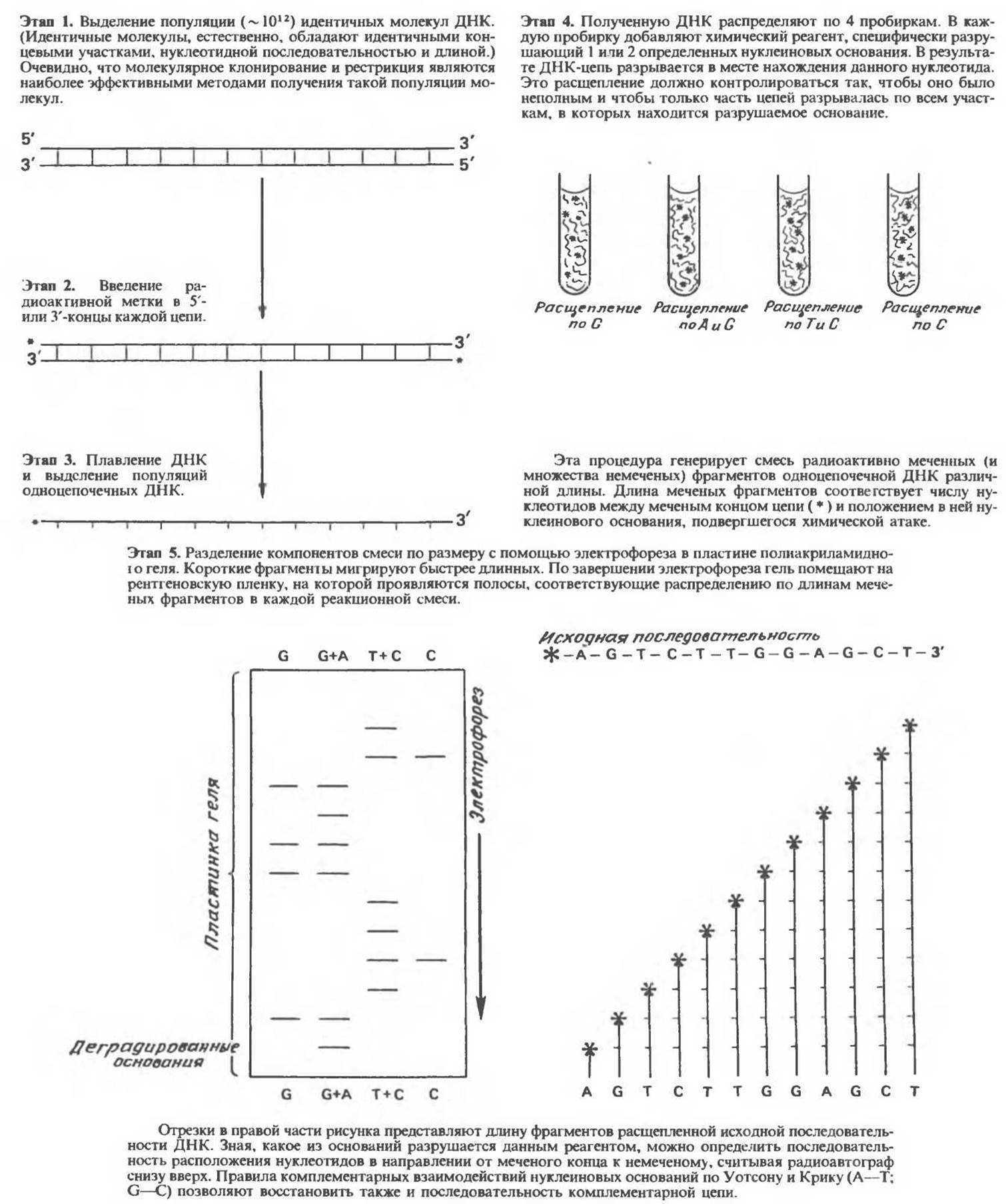
Fig. 36.6. Determination of the DNA nucleotide sequence (DNA Sequencing) according to Maxam and Gilbert.
Genetic Mapping
This term refers to a set of approaches and methods used to assign each gene to a specific chromosome, thereby compiling a Genetic Map of an Organism. For instance, in humans, the chromosomal localization of A number of disease-related genes has been established by applying two main methods: somatic cell Hybridization and in situ hybridization. In in situ hybridization, a preparation of metaphase Chromosomes on a Glass slide is incubated with a radioactively labeled probe. The exact site of hybridization is determined using autoradiography (photographic emulsion is applied directly to the slide). The formation of silver grains over a histologically identified chromosome allows researchers to conclude that the gene in question belongs to a specific chromosome, and often to a particular region of it. Some human genes localized by in situ hybridization are listed in Table 36.5.
There is no doubt that The Human Genome map will be completed in the coming years; furthermore, the fundamental possibility of sequencing the entire human genome is currently under Structure/133.html">Discussion. However, even now, based on available data, a number of essential Conclusions can be drawn.
1. Genes encoding Proteins with similar Functions may reside on different chromosomes (e.g., a- and ß-globins).
2. Genes belonging to the same family may also be located on different chromosomes (e.g., Growth Hormone and prolactin).
3. Genes determining many hereditary pathologies caused by deficiencies in specific proteins (including X-linked ones) are indeed localized in strictly defined chromosomal sites.
Table 36.5. Localization of Human Genes
|
Gene |
Chromosome |
Disease |
|
11p15 |
||
|
Prolactin |
6p23-q12 |
|
|
Growth hormone |
17q21-qter |
Growth hormone deficiency |
|
a-Globin |
16p12-pter |
a-Thalassemia |
|
ß-Globin |
11p12 |
ß-Thalassemia, sickle cell disease |
|
Adenosine deaminase |
20q13-qter |
Adenosine deaminase deficiency |
|
Phenylalanine hydroxylase |
12q24 |
Phenylketonuria |
|
Hypoxanthine-guanine phosphoribosyltransferase |
Xq26-q27 |
Lesch-Nyhan syndrome |
|
DNA segment G8 |
4p |
Huntington's chorea |
The table shows the chromosomal locations of several genes and the diseases caused by abnormalities in their expression products. The first (highlighted) number or letter indicates the chromosome. The remaining numbers and letters specify the intrachromosomal Location according to McKusick V. A., "Mendelian Inheritance in Man", 6th ed., Johns Hopkins Univ. Press, 1983.
Through The Use of cloned fragments, the chromosomal localization of many Genetic Disorders has been established for which no specific protein deficiencies could previously be identified. Such diseases include Huntington's disease (chromosome 4); cystic fibrosis (chromosome 7); adult Polycystic Kidney Disease (chromosome 16); and Duchenne muscular dystrophy (X chromosome). If the DNA region harboring the defect has a characteristic gene structure (Fig. 36.1), this gene can be synthesized, inserted into an appropriate vector, expressed, and studied functionally. Additionally, one can synthesize an oligopeptide whose Amino Acid Sequence is determined by the established Open Reading Frame within the coding region. Antibodies raised against this peptide serve as a tool to detect the expression of this peptide (or confirm its absence) in healthy and affected individuals.
Production of Proteins
One of the Practical Applications OF Recombinant DNA technology is The production of biomedical products. Genetic engineering makes it possible to yield large quantities of proteins that cannot be isolated using conventional purification methods (e.g., interferon, plasminogen activator); moreover, recombinant DNA techniques allow the production of specific human proteins to replace analogous animal proteins used in clinical practice (e.g., insulin, growth hormone). The advantages of both approaches are obvious.
Initially, the goals of genetic engineering were limited to producing substances (typically proteins) for the Treatment (insulin), Diagnosis (AIDS test), and Prevention (hepatitis B virus vaccine) of human diseases. Today, our understanding of the potential of biotechnology has expanded significantly. For instance, attempts are already underway to engineer plants that are resistant to drought and extreme temperatures and are capable of more efficient Nitrogen Fixation.
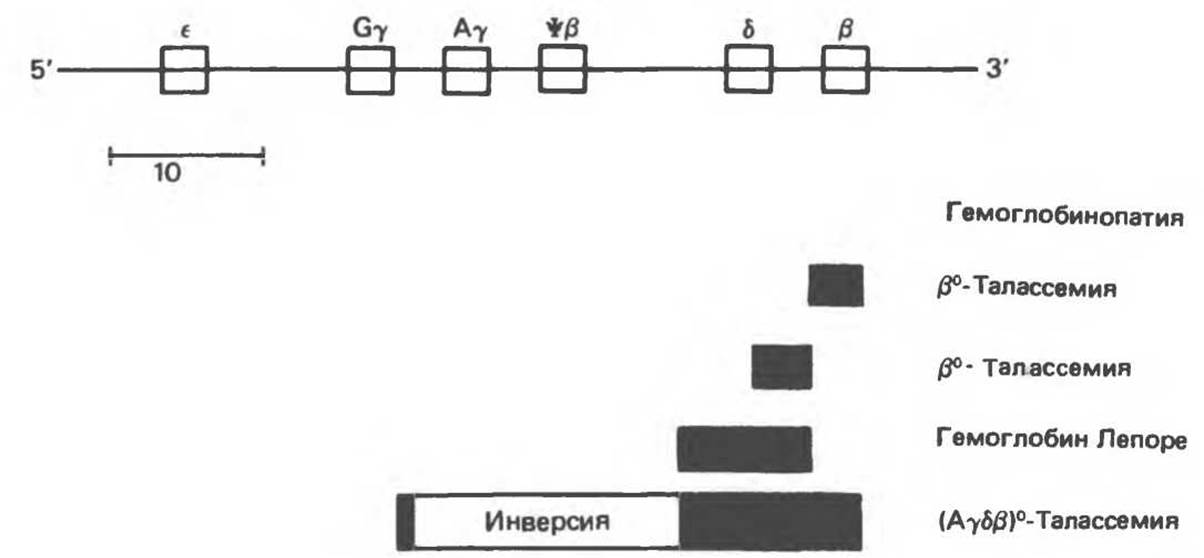
Fig. 36.7. Schematic diagram of the ß-globin gene cluster and Certain genetic disorders leading to pathology. The ß-globin gene is located on chromosome 11 in close proximity to two y-globin genes and the 8-globin gene. The ß-gene family is arranged in the sequence 5'-ξ-Gy-Ay-ψß-δ-ß-3'. The ξ locus is expressed during early embryonic life (a2ξ2). The y genes are expressed at the fetal stage, forming fetal Hemoglobin (HbF, a2y2). Adult Hemoglobin consists of HbA (a2ß2) or HbA2 (a2δ2). The ψß gene is a pseudogene; its sequence is homologous to that of the ß-gene but contains Mutations that prevent its expression. Deletions (shaded regions) in the ß-locus cause ß-thalassemia (deficiency or absence [ß°] of ß-globin). Deletions of the δ- and ß-genes lead to the formation of Lepore hemoglobin (only a-globin is produced). Inversion (Ayδβ) of this region (unshaded area) completely inhibits gene function and results in thalassemia (type III). Each type of thalassemia is characteristic of specific ethnic groups. For example, (Ayδβ)°-thalassemia is found predominantly in individuals of Indian descent. Many other deletions causing specific types of thalassemia have also been mapped within this region of the genome.
Last update: 06/08/2026
Editorial and Educational Adaptation: This material has been compiled based on the primary/original source text. The project team performed an editorial review, corrected technical inaccuracies, structured sections, and adapted the content for an educational format.
What was processed:
- elimination of formatting defects (OCR errors, structural breaks, corrupted characters);
- editorial organization of content;
- standardization of terminology in accordance with academic sources;
- verification of factual statements against the original source text.
All mentions of the author, publication year, and origin of the primary text have been preserved in accordance with the source.