Human Biochemistry, Volume 2 - Murray R. 1993
Biochemistry of Intra- and Intercellular Communications
Sex Gland Hormones
Regulation of Testicular Function
Regulation of steroidogenesis
Testicular function is regulated by LH and FSH (Fig. 50.3). LH stimulates steroidogenesis and testosterone production by binding to receptors on Cell/30.html">The Plasma Membrane of Leydig Cells (similar LH receptors are found On the surface of corpus luteum cells) and activating adenylate cyclase, which leads to an increase in intracellular cAMP concentration. As a result, the side-chain Cleavage of Cholesterol is accelerated. Whether this is due to enzyme activation or induction, or to enhanced cholesterol transport to the enzyme, has not yet been established. It is quite possible that this process involves the induction of a specific protein that accelerates this step. The similarity between this effect of LH and the action of ACTH on the adrenal cortex is evident. Although LH (or hCG) has been reported to induce steroidogenesis Enzymes, including 3β-hydroxysteroid dehydrogenase, C17-20-lyase, and 5α-reductase, the primary effect apparently occurs at some stage of The conversion of cholesterol to pregnenolone.
Class="center">
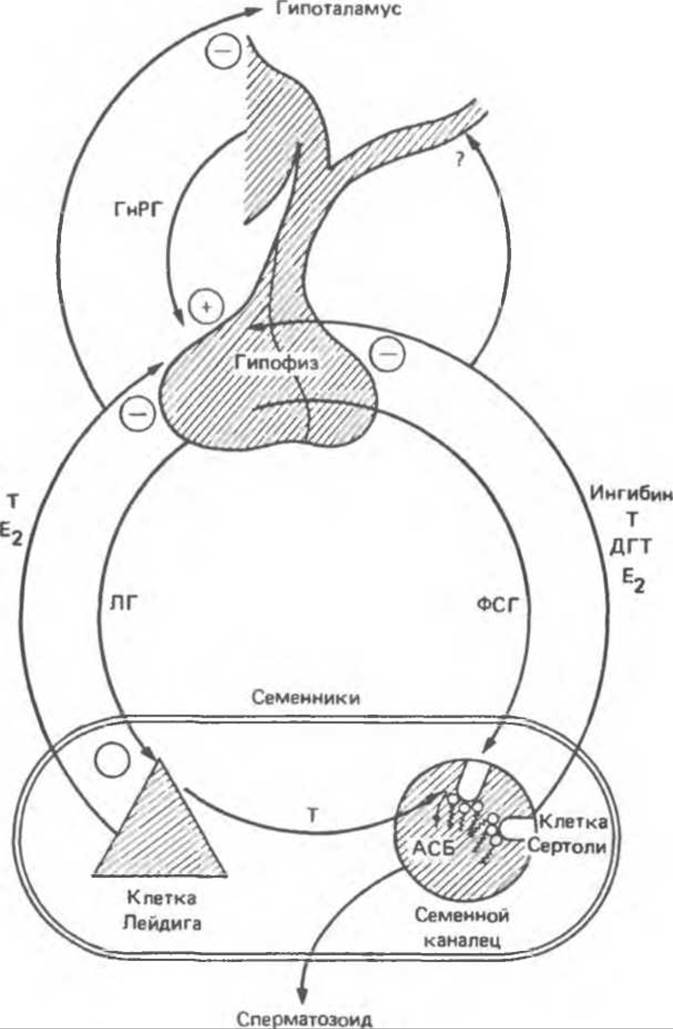
Fig. 50.3. Feedback regulation of testicular function. GnRH — gonadotropin-releasing hormone, LH — luteinizing hormone, FSH — follicle-stimulating hormone, T — testosterone, DHT — dihydrotestosterone, ABP — androgen-binding protein, E2 — 17β-estradiol. A plus sign in a circle denotes a positive effect, and a minus sign denotes a negative effect. (Reproduced, with permission, from Braunstein G. D. The tests. In: Basic and Clinical Endocrinology, 2nd. ed., Greenspan F. G., Forsham P. H. [editors], Appleton and Lange, 1986.)
The feedback regulation of gonadotropin secretion is likely mediated by the binding of testosterone to its receptor (Figs. 50.3 and 50.4). In this case, feedback is exerted in the Hypothalamus by inhibiting the release or production of GnRH, or possibly by suppressing both Functions. It is also possible that the action of GnRH on the LH-producing Cells of the anterior pituitary is inhibited.
Under normal conditions, GnRH release is pulsatile; in experimental systems, maximal gonadotropin production (LH and FSH) is observed only when pulsatile delivery of GnRH is simulated. Prolonged exposure to persistently elevated GnRH concentrations apparently leads to target cell desensitization and profound suppression of LH and FSH secretion; this is why long-acting GnRH analogues can be effective as contraceptive agents.
Prior to Puberty, serum testosterone levels are very low. During the Cytology/cytology/16.html">Early stages of sexual maturation, Sleep-associated pulses of LH and FSH secretion increase. As serum testosterone levels rise, secondary sex characteristics appear. The trigger signal for this process has not yet been fully elucidated; According to the prevailing hypothesis, the hypothalamic centers responsible for GnRH production become less sensitive to the inhibitory feedback effect of sex Steroid Hormones.
Regulation of Spermatogenesis
Within this complex issue, we will consider only a single question — the feedback regulation of FSH secretion. FSH interacts with Sertoli cells and stimulates the synthesis of androgen-binding protein (ABP). This protein is a testosterone-binding glycoprotein that differs from SHBG and the intracellular androgen receptor. ABP is secreted into the lumen of the seminiferous tubule, which facilitates The transport of testosterone (in high concentrations) from the Leydig cells, where it is produced, to the site of spermatogenesis (Fig. 50.3). This process appears to be critically important, since spermatogenesis is not restored even when normal testosterone concentrations are maintained in the general Circulation (such as during hormone replacement therapy).
Although only a single gonadotropin-releasing hormone (GnRH) has been identified to date, evidence suggests independent secretion of FSH and LH. For instance, following selective damage to the seminiferous tubules or the cessation of spermatogenesis for various reasons, men maintain normal LH and testosterone levels, but exhibit elevated FSH concentrations. A substance termed "inhibin," produced in the seminiferous tubules or Sertoli cells, has been isolated and regulates FSH secretion. Part of this feedback effect may be mediated by estradiol, which is synthesized in small quantities by Leydig and Sertoli cells. Estradiol production in these cells is stimulated by FSH, and estradiol itself under certain experimental conditions suppresses FSH release. These putative mechanisms of FSH regulation are illustrated in Fig. 50.3.
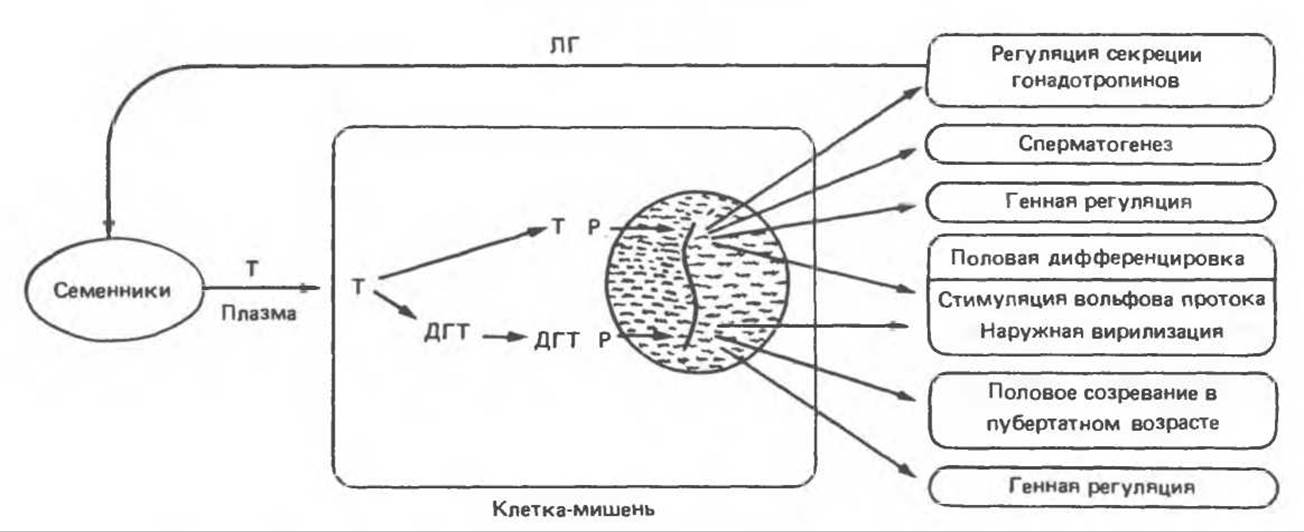
Fig. 50.4. Mechanism of androgen action. LH — luteinizing hormone, T — testosterone, DHT — dihydrotestosterone, R — androgen receptor. (Modified and reproduced, with permission, from Wilson J. D. et al. The endocrine control of male phenotypic development. Aust. J. Biol. Sci., 1983, 36, 101.)
Last update: 06/08/2026
Editorial and Educational Adaptation: This material has been compiled based on the primary/original source text. The project team performed an editorial review, corrected technical inaccuracies, structured sections, and adapted the content for an educational format.
What was processed:
- elimination of formatting defects (OCR errors, structural breaks, corrupted characters);
- editorial organization of content;
- standardization of terminology in accordance with academic sources;
- verification of factual statements against the original source text.
All mentions of the author, publication year, and origin of the primary text have been preserved in accordance with the source.