Principles of Biochemistry Volume 1 - A. Lehninger 1985
Biomolecules
Water
General Structural Properties of Amino Acids
When Proteins are boiled in the presence of strong acids and alkalis, the covalent bonds between the Amino Acids that make up protein chains are cleaved. The resulting free Amino acids are relatively small molecules with a known Structure. The first amino acid, asparagine, was discovered in 1806. The last of the 20 amino acids found in proteins to be discovered was Threonine, which was successfully identified only in 1938. Each amino acid has a trivial (traditional) name, sometimes derived from the source from which it was first isolated. For example, asparagine, as one might easily guess, was first discovered in asparagus, and glutamic acid in wheat gluten; Glycine was named for its sweet taste (from the Greek "glykos", meaning sweet).
All 20 amino acids found in proteins share a common structural feature: the presence of a carboxyl group and an amino group attached to the same carbon atom (Fig. 5-2). Amino acids differ only in their side chains (R-groups), which vary in structure, electrical charge, and solubility in Water among different amino acids. The 20 amino acids that make up proteins are often referred to as standard, principal, or normal amino acids to distinguish them from Other Amino Acids present in living organisms that do not occur in proteins. Standard Amino acids have three-letter and single-letter Abbreviations (Table 5-1) used for shorthand notation of Amino Acid Composition and sequences in polypeptide chains.
Class="center">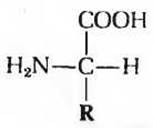
Fig. 5-2. General structural formula of amino acids (in non-ionic form) that make up proteins. The part of the structure shown in black is identical in all a-amino acids (except Proline). The letter R, highlighted in red, denotes the side chain (R-group). Each amino acid has its own characteristic R-group. In all amino acids except glycine, the a-carbon atom is bonded to four different substituent groups and is therefore an asymmetric, or chiral, carbon atom.
Table 5.1. Abbreviated designations of amino acids
|
Amino acid |
Three-letter abbreviation |
Single-letter abbreviation |
|
Ala |
A |
|
|
Arg |
R |
|
|
Asparagine |
Asn |
N |
|
Aspartic acid |
Asp |
D |
|
Valine |
Val |
V |
|
His |
H |
|
|
Glycine |
Gly |
G |
|
Glutamine |
Gln |
Q |
|
Glutamic acid |
Glu |
E |
|
Isoleucine |
Ile |
I |
|
Leucine |
Leu |
L |
|
Lys |
K |
|
|
Met |
M |
|
|
Proline |
Pro |
P |
|
Ser |
S |
|
|
Tyr |
Y |
|
|
Threonine |
Thr |
T |
|
Trp |
W |
|
|
Phenylalanine |
Phe |
F |
|
Cys |
C |
Last update: 06/08/2026
Editorial and Educational Adaptation: This material has been compiled based on the primary/original source text. The project team performed an editorial review, corrected technical inaccuracies, structured sections, and adapted the content for an educational format.
What was processed:
- elimination of formatting defects (OCR errors, structural breaks, corrupted characters);
- editorial organization of content;
- standardization of terminology in accordance with academic sources;
- verification of factual statements against the original source text.
All mentions of the author, publication year, and origin of the primary text have been preserved in accordance with the source.