Principles of Biochemistry Volume 1 - A. Lehninger 1985
Biomolecules
Composition of living matter: biomolecules
Chemical evolution can be replicated in laboratory conditions
Today, Oparin's concept regarding THE ORIGIN OF Biomolecules is supported by laboratory experiments. The classic experiment illustrating the abiotic (non-biological) origin of organic biomolecules was conducted in 1953 by Stanley Miller. Over the course of a week (or longer), he passed electrical discharges, designed to simulate lightning, through a gas mixture of methane, ammonia, Water vapor, and hydrogen that filled the space between two electrodes (Fig. 3-16). He then cooled the Contents of the sealed reaction vessel to condense the water-soluble components and analyzed the resulting products. In the gas phase, Miller detected carbon monoxide, carbon dioxide, and nitrogen, which apparently formed from the initial gas mixture. The darkly colored condensate contained significant amounts of water-soluble organic substances. Among the compounds identified by Miller were α-Amino Acids, including several amino acids found in Proteins. In addition, several simple organic acids commonly found in living organisms were detected, notably acetic acid.
Class="center">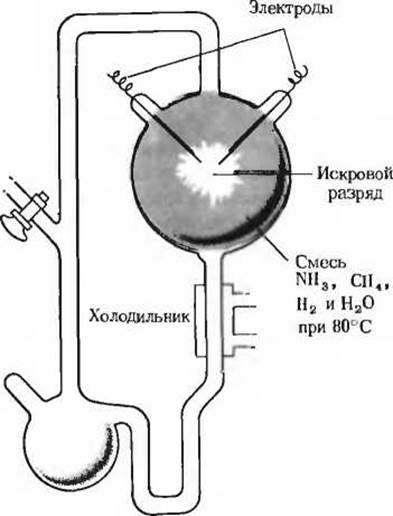
Fig. 3-16. Spark-discharge apparatus designed to demonstrate the abiotic formation of Organic compounds under simulated primitive atmosphere conditions.
Miller suggested that methane and ammonia first reacted to form hydrogen cyanide (HCN), a highly reactive substance; subsequent reactions of hydrogen cyanide with Other components of the gas mixture led to The formation of various amino acids. Since then, other researchers have performed many similar experiments using various gas mixtures, including nitrogen, hydrogen, carbon monoxide, and carbon dioxide; these experiments have consistently demonstrated that, in the presence of an available energy source, Amino Acids and other organic biomolecules readily form from such mixtures. It has been established that the formation of simple organic molecules is driven by A wide variety of energy forms and radiation—heat, visible light, ultraviolet radiation, X-rays, γ-rays, spark and silent electrical discharges, ultrasound, Shock waves, and α- and β-particles. Experiments simulating the conditions of early Earth readily yield hundreds of different organic compounds, including representatives of all The major types of molecules found in Cells, as well as a range of substances not found in living nature. Among these substances are many protein-derived amino acids, nitrogenous bases that serve as the Building Blocks of Nucleic Acids, and various organic acids and sugars present in biological systems. Thus, it appears highly probable that the primordial ocean was enriched with soluble organic compounds, potentially including many, if not all, of the building-block molecules utilized by living cells today.
Important confirmation that simple organic molecules can form abiotically came from the spectroscopic detection of hundreds of different organic compounds in interstellar space. These observations suggest that life may have originated in other PARTS OF THE universe as well. The term chemical evolution refers to The Emergence of organic substances from inorganic precursors driven by energy input and their subsequent development. We now know that Earth was formed approximately 4800 million years ago. It is believed that chemical evolution continued on Earth for at least the first 1000 million years of its history. Then, roughly 3500 million years ago, the first living cells emerged, initiating The process of biological evolution that continues to this day.
Today, the concentration of organic compounds in the oceans is relatively low; outside of living organisms, biomolecules are found only in trace amounts. What happened to the organic-rich primordial "soup"? It is hypothesized that the earliest living cells utilized the organic compounds dissolved in the seas not only as building blocks to construct their own structures, but also as nutrients or "fuel" to provide the energy required for growth. Over time, organic matter in the primordial sea began to disappear faster than it was replenished by natural processes. This idea, and indeed the entire concept of chemical evolution, was formulated more than 100 years ago by Charles Darwin. This is evident from an excerpt of a letter he wrote in 1871 to Sir Joseph Hooker: "It is often said that all the conditions for the first production of a living Organism are now present, which could ever have been present. But if (and oh what a big if) we could conceive in some warm little pond with all sorts of ammonia and phosphoric salts, light, heat, electricity &c., that a protein compound was chemically formed ready to undergo still more complex changes, at the present day such matter would be instantly devoured or absorbed, which would not have been the case before living creatures were formed."
The depletion of organic molecules from the seas forced living organisms to "learn" to synthesize their own organic biomolecules. They learned to harness sunlight energy via Photosynthesis to produce sugars and other organic compounds from carbon dioxide; they also learned to fix atmospheric nitrogen and convert it into nitrogen-containing biomolecules, such as amino acids. As evolution progressed, various living organisms began to interact with one another, exchanging nutrients and energy, which led to the formation of increasingly complex ecological systems.
Building upon these introductory chapters dedicated to cells and the interacting biomolecules that comprise them, we can now proceed to a more detailed examination of the molecular components of cells, keeping in mind that they all obey the intricate principles of the molecular logic of life. We will begin with water—the liquid matrix of All living organisms.
Last update: 06/08/2026
Editorial and Educational Adaptation: This material has been compiled based on the primary/original source text. The project team performed an editorial review, corrected technical inaccuracies, structured sections, and adapted the content for an educational format.
What was processed:
- elimination of formatting defects (OCR errors, structural breaks, corrupted characters);
- editorial organization of content;
- standardization of terminology in accordance with academic sources;
- verification of factual statements against the original source text.
All mentions of the author, publication year, and origin of the primary text have been preserved in accordance with the source.