Principles of Biochemistry Volume 1 - A. Lehninger 1985
Biomolecules
The composition of living matter: biomolecules
Molecules used as building blocks have a simple structure
Fig. 3-11 shows The Structure of Biomolecules belonging to various families of building blocks. In Proteins, the building blocks are 20 different Amino Acids; all of them contain a carboxyl group and an amino group attached to the same carbon atom. Amino acids differ from one another only in the structure of a single part of the molecule, namely the side group, commonly designated by the symbol R (Fig. 3-11, A).
All Nucleic Acids are formed from eight different repeating structural units, or NUCLEOTIDES; four of these serve as structural units of DNA, while the other four are used in the construction of RNA. Each nucleotide, in turn, consists of three smaller units: 1) a nitrogenous base, 2) a five-carbon sugar, and 3) phosphoric acid. The five different bases and two carbohydrate components of nucleotides are shown in Fig. 3-11, B.
Class="center">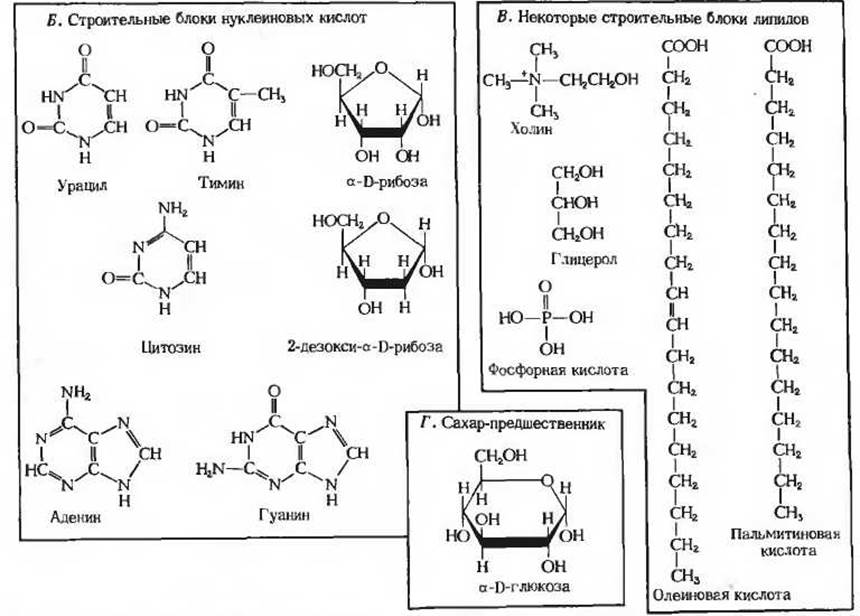
Fig. 3-11. Primary biomolecules acting as the main building blocks form, as it were, the letters of the biochemical alphabet. This figure shows the 20 amino acids (A) from which the proteins of all organisms are constructed, the five nitrogenous bases and two five-carbon sugars (B) that make up all nucleic acids, the main lipid building blocks (C), and a-D-glucose (D), the precursor of most CARBOHYDRATES.
As noted above, the most common naturally occurring Polysaccharides, starch and Cellulose, consist of repeating units of D-glucose. Lipids are also built from a relatively small number of types of organic molecules. Most lipid molecules contain one or more long-chain Fatty acids, derivatives of palmitic or oleic acids (Fig. 3-11, C). In addition, many lipids contain alcohols, such as glycerol, and some also contain phosphoric acid. Thus, the majority of biomolecules are constructed from approximately three dozen Organic compounds shown in Fig. 3-11.
All these compounds perform A wide variety of Functions in living organisms. For example, D-glucose, shown in Fig. 3-12, not only serves as a building block for the reserve carbohydrate starch and the structural carbohydrate cellulose, but also acts as a precursor in the Synthesis of Other sugars, such as D-fructose, D-mannose, and sucrose (cane sugar). Fatty acids are components not only of Complex Lipids in Cell membranes, but also of fats—energy-rich compounds that provide storage of reserve "fuel" in the Organism. Furthermore, fatty acids are part of the protective waxy coating on plant leaves and fruits, and also serve as precursors for other specialized compounds. Amino acids are not just protein building blocks; some of them can act as Neurotransmitters and precursors to A number of Hormones, and in plants, toxic Alkaloids. Adenine serves as a building block for nucleic acids, certain Coenzymes, and ATP, a compound that acts as the primary energy carrier in Cells.
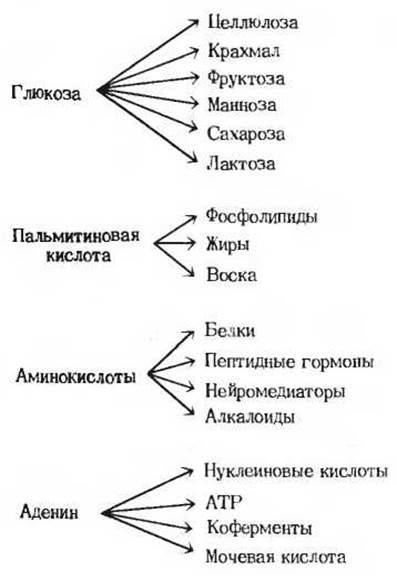
Fig. 3-12. Each primary biomolecule used as a building block also plays The Role of a precursor in The Biosynthesis of many Other types of biomolecules.
Thus, the biomolecules shown in Fig. 3-11 that act as building blocks are essentially the precursors or progenitors of most other biomolecules. Therefore, we can view them as the molecular alphabet of living matter. One cannot look upon these simple organic substances without a certain sense of awe and admiration—after all, they were selected through evolution to participate in the extraordinary and unique set of relationships that we call the molecular logic of living organisms.
Last update: 06/08/2026
Editorial and Educational Adaptation: This material has been compiled based on the primary/original source text. The project team performed an editorial review, corrected technical inaccuracies, structured sections, and adapted the content for an educational format.
What was processed:
- elimination of formatting defects (OCR errors, structural breaks, corrupted characters);
- editorial organization of content;
- standardization of terminology in accordance with academic sources;
- verification of factual statements against the original source text.
All mentions of the author, publication year, and origin of the primary text have been preserved in accordance with the source.