Principles of Biochemistry, Volume 1 - A. Lehninger 1985
Biomolecules
The composition of living matter: biomolecules
Macromolecules are formed from smaller molecules that serve as building blocks
We have already seen (see Chapter 1) that although living organisms contain a vast array of different Proteins and Nucleic Acids, the construction of these complex structures relies on remarkably simple principles. Simple molecules serve as the building blocks for all proteins and nucleic acids; their number is small, and they share a universal Structure across all species. The molecules of all proteins, which exist as long chains, are built from just 20 different Amino Acids arranged in various linear sequences. Similarly, the long, chain-like molecules of nucleic acids in all organisms are constructed from a small set of NUCLEOTIDES arranged in diverse sequences. Proteins and nucleic acids are informational macromolecules; each PROTEIN AND NUCLEIC acid carries specific information encoded in The sequence of its building blocks.
Class="center">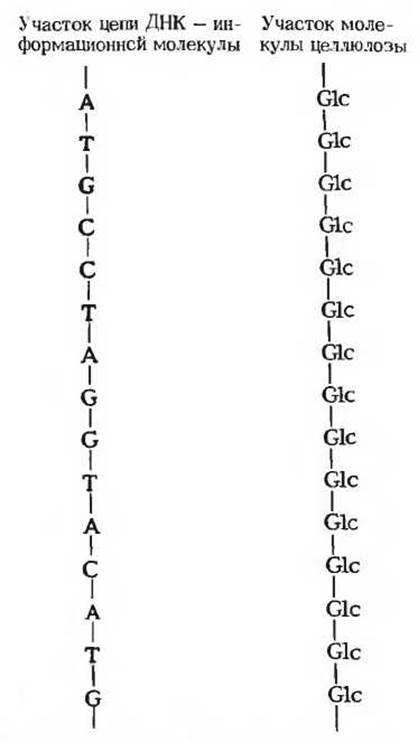
Fig. 3-10. Building block sequences in informational and non-informational macromolecules. The letters A, T, G, and C denote the four bases in the DNA informational macromolecule; Glc represents glucose, the repeating structural unit in the Cellulose molecule, which contains no Genetic information.
Polysaccharides are likewise composed of A large number of building blocks. Starch and cellulose, for example, consist of long chains of a single type of building block, namely the sugar glucose. Because polysaccharides are built from structural units of only a single type or alternating units of two types, they cannot carry encoded genetic information (Fig. 3-10).
Thus, over 90% of the dry organic matter in living organisms is made up of thousands of diverse macromolecules constructed from merely three to four dozen Different types of simple organic molecules. Therefore, to understand The structure of biological macromolecules and the fundamental organizational principles of biochemistry, we must become familiar with the Structure and properties of this relatively small group of Organic compounds.

Last update: 06/08/2026
Editorial and Educational Adaptation: This material has been compiled based on the primary/original source text. The project team performed an editorial review, corrected technical inaccuracies, structured sections, and adapted the content for an educational format.
What was processed:
- elimination of formatting defects (OCR errors, structural breaks, corrupted characters);
- editorial organization of content;
- standardization of terminology in accordance with academic sources;
- verification of factual statements against the original source text.
All mentions of the author, publication year, and origin of the primary text have been preserved in accordance with the source.