Basics of Biochemistry - Filippovich, Y. B. 1999
Enzymes
Kinetics of Enzymatic Reactions
Enzymatic kinetics, in a broad sense, refers to the dependence of an enzyme-catalyzed reaction rate on the Chemical Nature of the reacting substances (substrates, enzyme) and the conditions of their interaction (concentration, Temperature, medium pH, presence of activators or inhibitors, etc.). However, the dependence of the enzymatic process rate on temperature, medium pH, and METABOLISM/18.html">The Influence of inhibitors and activators is largely associated with changes in The properties of the enzyme as a protein body. Therefore, we will focus here exclusively on the regularities determined by The Nature and concentration of the reacting substances and their variations.
As shown above, The first phase of a biocatalytic process is The formation of the enzyme-substrate complex:
Class="center">
This equilibrium system can be characterized by a corresponding Equilibrium Constant. Its reciprocal is called the dissociation constant of the enzyme-substrate complex, or the substrate constant, and is denoted as Ks:

It depends on The Nature of the substrate and the enzyme and reflects their degree of affinity. For instance, for sucrase (an enzyme that accelerates the Hydrolysis of sucrose), Ks = 0.0167 M, meaning that the concentration of the enzyme-substrate complex exceeds the concentrations of the free enzyme and substrate by approximately 60 times. Consequently, the lower the value of Ks, the higher the affinity of the enzyme for the substrate.
Since the concentration of the enzyme-substrate complex changes due to its conversion into the reaction product with the regeneration of the free enzyme:
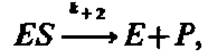
the value of Ks is determined from The ratio of the rate constants of the forward (k+1) and reverse (k-1) reactions, i.e.,

This Conclusion can be reached by equating the rates of the forward and reverse reactions, which is characteristic of the system's equilibrium state: v1 = k+1 [E] [S], and if v1 = v2, then k+1 [E] [S] = k-1 [ES], i.e., [E] [S] / [ES] = k-1 / k+1 = Ks.
Thus, the substrate constant, or dissociation constant, of the enzyme-substrate complex (Ks) characterizes the biocatalytic process in terms of the affinity between the enzyme and the substrate and the ratio of the rate constants for the breakdown and Formation of the enzyme-substrate complex.
Since, simultaneously with the dissociation of the enzyme-substrate complex back into the starting substances, the substrate is converted into the product, and the enzyme-product complex breaks down into its constituent components:
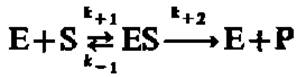
to fully characterize the enzymatic process, THE CONCEPT OF the Michaelis constant (Km) is introduced, which represents the ratio of the rate constants of all three reactions taking place during Enzymatic Catalysis: Km = (k-1 + k+2) / k+1. The numerical value of Km is always somewhat higher than that of Ks. For example, Ks for the sucrase-sucrose complex is 0.0167 M, whereas Km is 0.0280 M.
The rate of an enzyme-catalyzed chemical reaction (like that of a regular chemical reaction) is measured by the number of moles of substrate converted per unit of time. However, it is fundamentally important that standard conditions for enzyme activity are maintained during this measurement: a temperature of 25°C, an optimal pH value, and, most crucially, complete saturation of the enzyme with the substrate. The rate of an enzymatic reaction measured under these specified conditions is designated as V and is called the maximum velocity of the enzymatic reaction. It is determined by the Enzyme Concentration and the rate constant of The breakdown of the enzyme-product complex: V = k+2 [E].
The enzymatic reaction rate observed in the absence of complete enzyme saturation by the substrate is denoted as v. At any given moment, it is proportional to the concentration of the enzyme-substrate complex: v = k+2 [ES]. Since [ES] = k+1 / k-1 = 1 / Ks, i.e., [ES] = [E] [S] / Ks, then v = k+1 [E] [S] / Ks.
Thus, the observed rate of the enzymatic reaction depends on the concentrations of the enzyme and substrate and their affinity. Numerically, Km is equal to the Substrate Concentration (in moles per liter) at which V equals 1/2 V (Fig. 48).
The concentrations of the enzyme and substrate are usually expressed in micromoles per liter. However, since the exact Molecular Weight of most Enzymes and the number of catalytic (active) sites in their molecules are unknown, a conventional method for expressing the absolute amount of enzyme is used. The unit of any enzyme amount (designated as E in Russian and German, and U in English, French, Italian, and Spanish) is defined as the quantity that, under standard conditions, catalyzes The conversion of 1 µmol of substrate per minute. This value (1 µmol/min) is also the unit of enzyme activity. This standard system for designating enzyme amounts was introduced in 1961 by the Commission on Enzymes of the International Union of Biochemistry and has become firmly established in enzymology, remaining in use to this day. As noted above, according to this system, the rate of an enzymatic reaction was expressed as the number of micromoles of substrate converted per minute.
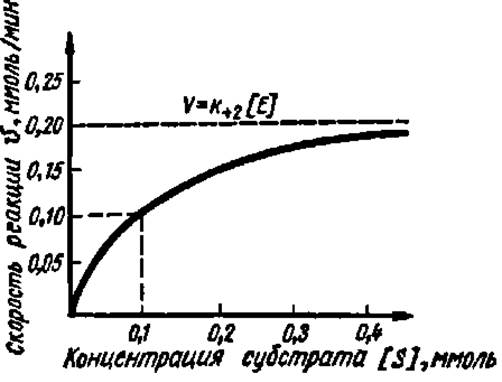
Fig. 48. Dependence of the enzymatic reaction rate on substrate concentration at a constant enzyme concentration
In 1972, in connection with the transition to expressing the rates of biocatalytic transformations in moles of substrate converted per second, it was proposed to replace the old, unnamed unit of enzymatic activity (E or U) with a new unit—the katal (symbol: kat), which denotes The amount of enzyme capable of ensuring the conversion of 1 mole of substrate per second (under standard conditions). Since a unit of enzymatic activity of 1 kat, corresponding to a reaction rate of 1 mol/s, is practically unfeasible (transformations proceed at a much lower rate), catalytic activity in the new system of units is expressed in microkatals (µkat), nanokatals (nkat), and picokatals (pkat), which correspond to reaction rates in micromoles, nanomoles, and picomoles per second, respectively. The old unit (E or U) is equal to 16.67 nkat. Over the coming years, a complete transition to expressing enzymatic activity in katals is anticipated.
The concentration of an enzyme in a solution, expressed in the aforementioned units (E), is given as their number per 1 ml of solution. For a dry enzyme preparation, data are provided on the number of units (E) per 1 mg. If the protein content in the enzyme preparation is determined, the specific activity of the enzyme preparation is calculated, expressed as the number of units (E) per 1 mg of protein. When data on the number of units (E) per 1 mg of pure enzyme are available, we refer to the specific activity of the enzyme. If the molecular weight of the enzyme is known, it is easy to calculate the number of units (E) per 1 µmol of it, i.e., the molecular activity of the enzyme. Consequently, we are no longer expressing enzyme concentration, but rather enzyme activity, either as the number of micromoles of substrate converted per minute by 1 mg of enzyme (specific enzyme activity) or as the number of substrate molecules converted per minute by a single enzyme molecule (molecular activity).
If the number of active sites in an enzyme molecule is known, its activity is characterized by the number of substrate molecules converted via a single Active Site. For example, the molecular activity of catalase is 5 million, whereas The activity of its catalytic site (there are 4 in a catalase molecule) is only 1 million 250 thousand H2O2 molecules.
Last update: 06/08/2026
Editorial and Educational Adaptation: This material has been compiled based on the primary/original source text. The project team performed an editorial review, corrected technical inaccuracies, structured sections, and adapted the content for an educational format.
What was processed:
- elimination of formatting defects (OCR errors, structural breaks, corrupted characters);
- editorial organization of content;
- standardization of terminology in accordance with academic sources;
- verification of factual statements against the original source text.
All mentions of the author, publication year, and origin of the primary text have been preserved in accordance with the source.