Fundamentals of Biochemistry - Filippovich, Y. B. 1999
Enzymes
Mechanism of Enzyme Action
The MECHANISM OF ACTION of single-component and two-component Enzymes is fundamentally similar, as the active sites in their molecules are functionally akin.
A leading role in the Mechanism of Enzymatic catalysis is played by The formation of enzyme-substrate complexes, the existence of which was first proposed by J. Brown (1902). In The first phase of Enzymatic Catalysis, a compound arises between the substrate (or substrates) and the enzyme, in which the reactants are linked by ionic, covalent, or Other types of bonds. Next (the second phase), under the Influence of the attached enzyme, the substrate undergoes a modification that makes it more susceptible to the corresponding chemical reaction. In the third phase, the chemical reaction itself takes place, and finally, in the fourth phase, the resulting reaction products are released from the enzyme-product complex. If we denote the enzyme as E, the substrate as S, the activated substrate as S', and the reaction product as P, this sequence of processes can be represented by the following scheme:
Class="center">
This scheme was initially developed by V. Henri (1903), then by L. Michaelis and M. Menten (1913), and subsequently confirmed by the direct isolation of ES, ES', and EP complexes.
One example of enzymatic catalysis carried out in accordance with this scheme is the Hydrolysis of acetylcholine. This compound serves as a mediator (messenger) in the transmission of nerve impulses: in response to the release of acetylcholine by the nerve fiber terminal, an excitatory response is triggered in the nerve Cell. For this process to proceed continuously, after each act of Nerve Impulse transmission, the portion of acetylcholine (1–2 µg) that caused the excitation must be completely destroyed. This is achieved through the hydrolysis of acetylcholine facilitated by the enzyme acetylcholinesterase. Hydrolysis occurs at an enormous rate: 1–2 µg of acetylcholine within 0.1–0.2 ms:
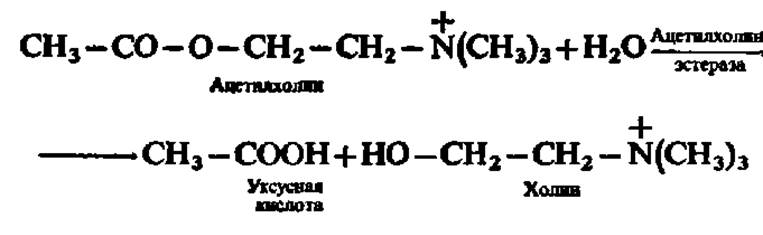

Fig. 47. Mechanism of action of acetylcholinesterase:
A — Active Site of the enzyme; B — enzyme-substrate complex; C — preparation for transformation (activation) of the substrate; D — complex of reaction products with the enzyme (details in the text)
Acetylcholinesterase is a single-component enzyme. Its active site contains at least four amino acid residues—Glu, Ser, His, and Tyr—which ensure the sequential execution of the Stages of enzymatic catalysis listed above.
Initially, an enzyme-substrate complex is formed between the enzyme (acetylcholinesterase) and the substrate (acetylcholine). It is formed through electrostatic interaction between the negatively charged ionized COO⁻ group of the Glu residue and the positively charged N atom of the acetylcholine molecule (Fig. 47, I, B). Following the Formation of the enzyme-substrate complex, the remaining amino acid residues of the acetylcholinesterase active site come into play. First, a bond closes between the carbon of the polarized CO group of the Choline acetyl radical and the oxygen of the OH group of the Ser residue. Then, a Hydrogen bond forms between the oxygen of the ester bond in the acetylcholine molecule and the OH group of the Tyr residue (Fig. 47, II, C).
The spatial arrangement of the acetylcholine molecule and the Ser and Tyr residues within the active site is such that the formation of these bonds weakens the linkage between the CO group and the ester oxygen atom in the acetylcholine molecule (the "rack" effect). As a result, much less Energy is required to cleave it; that is, the energy barrier is lowered due to the activation of the acetylcholine molecule (the ES' complex). Consequently, under METABOLISM/18.html">The Influence of the His residue, which draws a proton away from the OH group of Ser, the ester bond between the Ser residue and the acetyl group is strengthened while the ester bond in the acetylcholine molecule is simultaneously cleaved, accompanied by The transfer of a proton from the Tyr residue to the choline moiety (Fig. 47, III, D). The latter is released from the active site (Fig. 47, IV), and its place is taken by a Water molecule. It forms a bond with the carbonyl oxygen of the acetyl group and the oxygen of Tyr (not shown in Fig. 47), after which the proton returns from the His residue to the oxygen of the Ser OH group, and the water proton returns to the Tyr residue. Simultaneously, the second reaction product, acetic acid, is released, and the free active site of acetylcholinesterase is regenerated (Fig. 47, IV, A), ready for a new catalytic act.
During the formation of the enzyme-substrate complex and in subsequent phases of enzymatic catalysis, repeated alterations occur in the Tertiary Structure of the enzyme, leading to the sequential approach and spatial orientation of the active groups that interact with one another at various stages of substrate transformation. Alterations in the tertiary STRUCTURE OF THE protein are impossible without the participation of all or almost all of the polypeptide chain forming the protein molecule. Consequently, essentially the entire enzyme molecule takes part in the catalytic act.
Individual stages of enzyme-substrate interaction during enzymatic catalysis are becoming increasingly clear. In particular, it has been established that the stage of substrate adsorption at the enzyme's active site is followed by the "recognition" by the enzyme's substrate-binding center of that part of the substrate molecule which does not directly undergo chemical transformation. Due to multipoint contacts arising therefrom—realized via weak interaction forces (hydrophobic, Hydrogen Bonds, etc.)—the bond between the substrate and the enzyme is strengthened. Concurrently, that part of the substrate which subsequently participates in the chemical reaction is "stabilized" within the enzyme's active site; it is fixed in a strained conformation close to the Transition State of the substrate as it converts into the product. As a result, the reacting fragment of the substrate molecule and the catalytic groups of the enzyme form a productive complex, in which the electronic-conformational transitions necessary for the actual chemical stage of the enzymatic process have already partially taken place. This leads to a lowering of the activation energy required for the chemical reaction, driven by an Entropy effect resulting from immobilization, anchoring, and rigid orientation of the substrate within the enzyme's active site. Thus, each link in the multi-step chemical reaction accelerated by the enzyme creates nearly optimal conditions for the progression of its next stage. As a consequence, the chemical reaction proceeds tens or hundreds of thousands of times faster under enzymatic catalysis.
Examining the fine mechanism of enzymatic catalysis helps to elucidate the Specificity of Enzyme Action, which distinguishes them from inorganic catalysts. The unique structure and interaction of the catalytic, substrate-binding, and allosteric centers of the enzyme ensure the cooperative execution of multi-step processes. It is precisely the spatial and temporal ordering of reactions, along with their cooperative nature, that characterize the action of biocatalysts, ensuring high specificity and an overall high reaction rate.
Last update: 06/08/2026
Editorial and Educational Adaptation: This material has been compiled based on the primary/original source text. The project team performed an editorial review, corrected technical inaccuracies, structured sections, and adapted the content for an educational format.
What was processed:
- elimination of formatting defects (OCR errors, structural breaks, corrupted characters);
- editorial organization of content;
- standardization of terminology in accordance with academic sources;
- verification of factual statements against the original source text.
All mentions of the author, publication year, and origin of the primary text have been preserved in accordance with the source.