Biological Chemistry - Berezov T. T., Korovkin B. F. 1998
Lipid Metabolism
Phospholipid Metabolism
Unlike triglycerides and Fatty acids, Phospholipids are not a significant source of energy. Instead, they play a crucial role in the Structure and function of Cell membranes, the activation of membrane-bound and lysosomal Enzymes, Nerve Impulse propagation, Blood clotting, immunological responses, cell proliferation, tissue regeneration, and electron transport within the Respiratory Chain of enzymes. A particularly vital function of phospholipids is The formation of lipoprotein complexes.
The Biosynthesis of phospholipids takes place intensively in the Liver, intestinal wall, Testes, Ovaries, Mammary Glands, and other Tissues. The most important phospholipids are synthesized primarily within The Endoplasmic reticulum of The Cell.
A central role in phospholipid biosynthesis is played by 1,2-diglycerides (in the synthesis of phosphatidylcholines and phosphatidylethanolamines), phosphatidic acid (in the synthesis of phosphatidylinositols), and sphingosine (in the synthesis of sphingomyelins). Cytidine triphosphate (CTP) participates in the synthesis of virtually all phospholipids. Let us examine the Synthesis of specific phospholipids as Examples.
Biosynthesis of phosphatidylethanolamine. Initially, ethanolamine is phosphorylated in the presence of a specific kinase to yield phosphoethanolamine:
Class="center">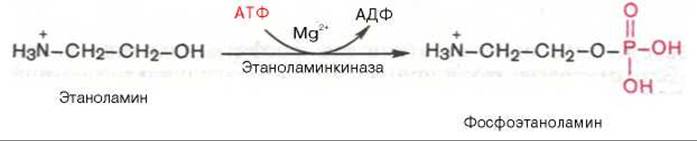
Next, phosphoethanolamine reacts with CTP, resulting in the formation of cytidine diphosphate ethanolamine (CDP-ethanolamine) and pyrophosphate (PPi):

In the subsequent reaction, CDP-ethanolamine reacts with a 1,2-diglyceride—generated via the dephosphorylation of phosphatidic acid—to form phosphatidylethanolamine. This reaction is catalyzed by the enzyme ethanolamine phosphotransferase:

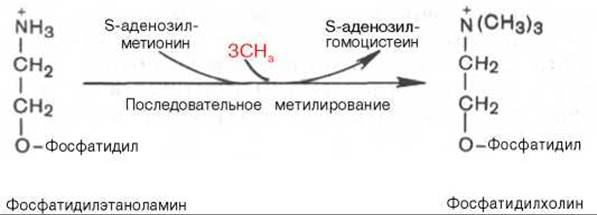
Biosynthesis of phosphatidylcholine (lecithin). Phosphatidylethanolamine serves as a precursor for phosphatidylcholine. Through the sequential transfer of three methyl groups from three molecules of S-adenosylmethionine (a methyl group donor, see Chapter 6) to the amino group of the ethanolamine residue, phosphatidylcholine is produced:
Another pathway for phosphatidylcholine synthesis exists in animal Cells. In this case, similar to the synthesis of phosphatidylethanolamine, CTP is utilized as a carrier, but for phosphocholine rather than phosphoethanolamine. In the first step of this synthesis, free Choline is activated by choline kinase to form phosphocholine:

Subsequently, phosphocholine reacts with CTP to yield cytidine diphosphate choline (CDP-choline):

Further on, CDP-choline interacts with a 1,2-diglyceride, resulting in the formation of phosphatidylcholine:

Biosynthesis of phosphatidylserine. In mammals, phosphatidylserine is produced via an ethanolamine-Serine exchange reaction in the following manner:

A second pathway for phosphatidylserine formation also exists, which involves the preliminary incorporation of phosphatidic acid into phosphoglyceride synthesis:

Next, serine is transferred to the phosphatidyl residue, yielding phosphatidylserine:

Phosphatidylinositol is formed in a similar manner.
Biosynthesis of sphingomyelin. The intermediate in sphingomyelin biosynthesis is ceramide (N-acylsphingosine), which is formed through the interaction of sphingosine with acyl-CoA. Sphingomyelin is synthesized As a result of the interaction (reaction) between ceramide and CDP-choline:

It should be noted that the distinction in the synthesis of choline- and ethanolamine-containing phospholipids on the one hand, and Inositol-containing phospholipids on the other, lies in the fact that in the former case, CTP participates in the formation of CDP-choline or CDP-ethanolamine as reactive nitrogenous bases, whereas in the latter case, CTP is involved in the formation of CDP-diacylglycerol as a reactive form of diglyceride.
Last update: 06/08/2026
Editorial and Educational Adaptation: This material has been compiled based on the primary/original source text. The project team performed an editorial review, corrected technical inaccuracies, structured sections, and adapted the content for an educational format.
What was processed:
- elimination of formatting defects (OCR errors, structural breaks, corrupted characters);
- editorial organization of content;
- standardization of terminology in accordance with academic sources;
- verification of factual statements against the original source text.
All mentions of the author, publication year, and origin of the primary text have been preserved in accordance with the source.